

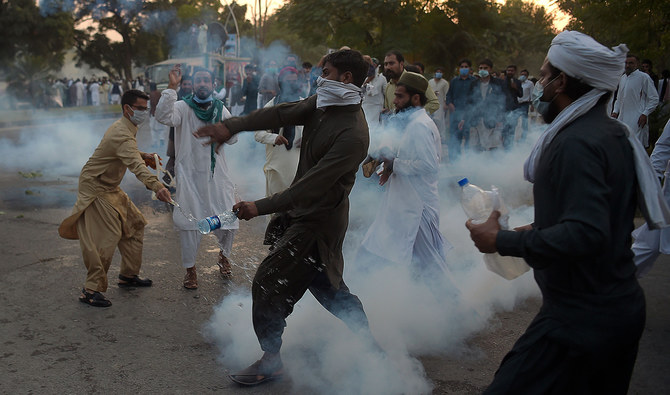

ISLAMABAD: Thousands of emotionally charged demonstrators clashed with the police on Friday while trying to reach the French Embassy in Pakistan’s federal capital, forcing uniformed personnel of the law enforcement agency deployed to protect the Diplomatic Enclave in the city to fire tear gas and beat protestors with batons.
According to video footages broadcast by local media outlets, many of these protestors tried to cross the police barriers. Some of them even managed to climb shipping containers parked outside the diplomatic neighborhood to close its entry and exit points for security purposes.
Crowds of Islamist activists hanged an effigy of French President Emmanuel Macron from a highway overpass after pounding it furiously with their shoes. Several demonstrators were wounded in clashes with police and authorities deployed more security forces to protect the embassy.
In the country's eastern city of Lahore, thousands of worshippers celebrating the Mawlid, the birthday of the Prophet Muhammad (PBUH), took to the streets, chanting anti-France slogans, raising banners and clogging major roads en route to a Sufi shrine.
In Multan, a city in Pakistan's eastern Punjab province, thousands more burned an effigy of Macron and demanded that Pakistan sever ties with France and boycott French goods.
Similar demonstrations were also witnessed in other Muslim countries where people poured out of prayer services to join anti-France protests on Friday, as the French president’s vow to protect the right to caricature the Prophet Muhammad (PBUH) continued to roil the Muslim world.
In Jerusalem, hundreds of Palestinians protested against Macron outside the Al-Aqsa Mosque, the third holiest site in Islam, chanting, “With our souls and with our blood we sacrifice for our prophet, Muhammad (PBUH).” Some youths scuffled with Israeli police as they exited the esplanade into the Old City. Israeli police said they successfully dispersed the gathering and detained three people.
A few hundred demonstrators in Lebanon's capital Beirut flocked toward the Palais des Pins, the official residence of the French ambassador to Lebanon, but found their way blocked by lines of police officers in riot gear. Carrying black and white flags with Islamist insignia, the Sunni Islamist activists cried, “At your service, oh prophet of God.” Some slung stones at police who responded with tear gas.
Anti-France protests in Lebanon are an embarrassment for Prime Minister-designate Saad Hariri, who is trying to form a new government that would implement a French plan for reform in Lebanon. France, Lebanon's former colonial ruler, has been helping chart a course for the country out of its severe economic and financial crisis.
A huge crowd of some 50,000 noisily chanting protesters also rallied in Bangladesh's capital of Dhaka, burning effigies of Macron and holding signs that read, “Say no to Islamophobia," “Stop racism,” and “Boycott French products.” Authorities deployed hundreds of riot police and used barbed wire to cordon off the country's main mosque.
In Afghanistan, members of the Islamist party Hizb-e-Islami set the French flag ablaze. Its leader, Gulbuddin Hekmatyar, warned Macron that if he doesn't “control the situation, we are going to a third world war and Europe will be responsible.”
The protests come amid rising tensions between France and Muslim-majority nations, which flared up earlier this month when a young Muslim beheaded a French schoolteacher who had shown caricatures of the Prophet Muhammad (PBUH) in class.
Those images, republished by the satirical magazine Charlie Hebdo to mark the opening of the trial for the deadly 2015 attack against the publication, have stirred the ire of Muslims across the world who consider depictions of the prophet blasphemous.


