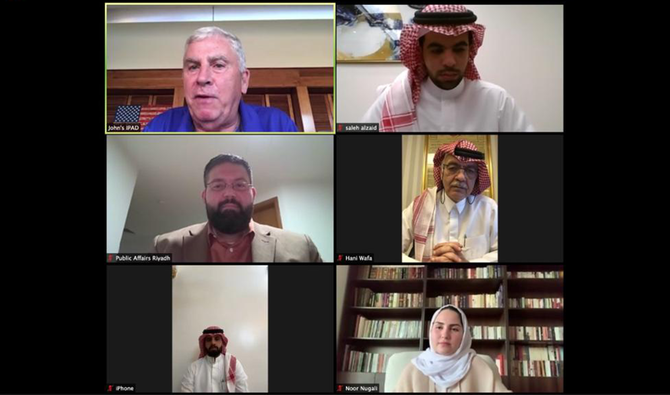
RIYADH: The US wants to be Saudi Arabia’s “No.1 partner” as it achieves its Vision 2030 reform plan, according to US envoy John Abizaid.
“We recognize that the Kingdom is diversifying its economy, creating new employment opportunities for youth, encouraging and empowering women’s participation in the economy and society, and we are very much interested in being a strategic partner with you in all of those endeavors,” Abizaid told journalists at a roundtable in Riyadh on Wednesday.
Referring to the strategic Saudi-US dialogue in Washington on Oct. 14, the US ambassador said: “We talked a lot about the progress that Saudi Arabia has made.”
Abizaid said the discussions in Washington focused on cooperation in defense, security and intelligence, and critical infrastructure protection, along with promoting resilient energy markets, “especially in light of the economic effects of the COVID-19 pandemic.”
“Of course, we also talked about the importance of using only trusted vendors and critical information and communications technology in exploring new areas of cooperation and cybersecurity and other areas,” he added.
The common malign threat in the region continues to be Iran.
“We (Saudi Arabia and the US) are partners in deterring Iran’s actions in the region. We’re always hopeful that Iran finds a path to peace.
“But whenever we think there is a path to peace, they manage to find ways to bend that,” he added
“We, in conjunction with you and our other Gulf partners, are working hard to deter Iran’s malign actions in the region. Our secretary said the US will never allow Iran, the world’s largest state sponsor of terrorism, to freely buy and sell planes, tanks, missiles and other kinds of conventional weapons. It goes without saying that he also said we’re not going to allow them to obtain nuclear weapons and threaten the region.”
While the world waits on the results of the upcoming US election, Abizaid said that he sees no change in the future relationship between the two countries. “The things that we talked about in the strategic dialogue will continue to be important to us, no matter what,” he said.
“What’s important is (our) mutual interests,” he said. “And I don’t see those changing.
“There may be some emphasis on different areas that will be different, but I wouldn’t anticipate that the relationship will be anything other than what it has been for 75 years, which is the rock of stability in the region.”
In a wide-ranging discussion, the ambassador also discussed how Turkey is “flexing its muscles in ways not seen before.”
The US enjoys “an ally-to-ally” relationship with Turkey, but “there are a series of problems between the Turks and the Greeks in the eastern Mediterranean area that we worry about.
“Turkey is a treaty ally of the US, a NATO alliance partner and has very close relationships with all countries in Europe. It is trying to achieve a better future for its own people,” he said.
However, “there are Turkish activities that we are not happy with in various places where they sponsor proxy forces that haven’t contributed to peace and security.
“That being said, our relationship with the Turks is one of ally to ally. We can talk to them. We can reason with them. We have a very robust and capable relationship with them. I know there are some problems that seem to be getting a little bit more severe in the eastern Mediterranean region which everyone in the region needs to work to try to tamp down.
“We really appreciate what Saudi Arabia has done trying to work with the Turks to ask them to keep things calm and not to move in a more difficult direction in the region. It’s an interesting time. They’re flexing their muscles in ways that we haven’t seen before. But in the long run, I think Turkey will be a good and competent member of the peaceful community of nations in the region.”
Abizaid said the G20 decision to hold its summit virtually, rather than canceling, “is an amazing tribute to everybody’s belief that we could work our way through a difficult situation.
“World leaders have had a chance to talk to one another about a way forward that will allow us not only to combat the virus but also to combat the bad effects of what the virus has done to the global economy and to the specific economies of the top 20 nations in the world. I mean, it’s been a remarkable achievement to continue to move forward. I’m very proud of the way that it has been handled.”
The ambassador said the US Secretary of Foreign Affairs, Mike Pompeo, had complimented Saudi Foreign Minister Prince Faisal bin Farhan on the Kingdom’s “handling of the situation, allowing the G20 to go forward in a meaningful way.”


![]()

US wants to be ‘No.1 partner in Saudi Vision 2030,’ says envoy
Short Url
https://arab.news/j4fef
US wants to be ‘No.1 partner in Saudi Vision 2030,’ says envoy
- Enduring Saudi partnership key to deterring ‘malign Iranian threat’


Latest updates


© 2026 SAUDI RESEARCH & PUBLISHING COMPANY, All Rights Reserved And subject to Terms of Use Agreement.