

UK urged to repatriate Daesh women, kids from Syrian camps

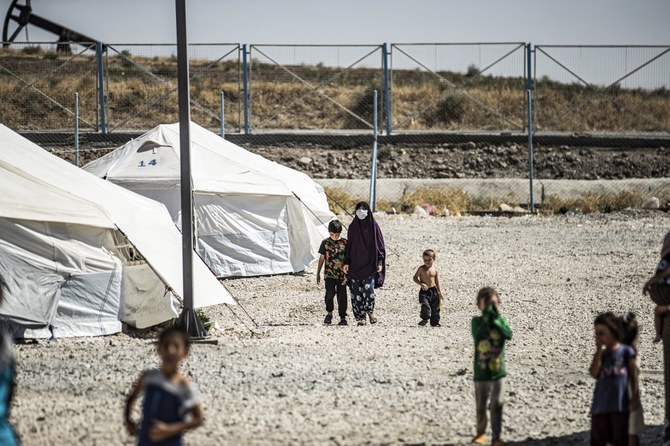
A woman walks next to a child by tents at Camp Roj, housing family members of people accused to belong Daesh. (File/AFP)
Short Url
Updated 28 October 2020
Follow

UK urged to repatriate Daesh women, kids from Syrian camps

  • Think tank: Mass breakouts likely unless people removed
  • Children could become ‘ticking time bombs’ unless taken back to the West

LONDON: British children are being held in Syrian camps meant for Daesh members, where they face malnutrition, poor sanitation, the threat of COVID-19 and worsening weather, according to a report by the Egmont Institute, a Belgian think tank.

Several children have already died in the camps, including the infant son of British Daesh member Shamima Begum.

The UK’s refusal to repatriate them or their parents risks the prospect of mass breakouts of the “most dangerous terrorists in the world,” the report said.

It added that the conditions that led to the creation of Daesh, through mass networking and radicalization in overcrowded prisons administered by the US in the aftermath of the 2003 invasion of Iraq, were being repeated in the camps in Syria.

The institute said the camps currently contain 35 British children and 24 adults, 15 of whom are women. In total, over 600 children of EU nationals have been accounted for.

“The majority of (the children) are below five years old, and they have every chance to fully re-socialize in their home countries,” the report said.

“Children are not ‘ticking time bombs,’ but they could become ones if we do not bring them back.”

The report condemned Western states for refusing to repatriate Daesh members and affiliates, and in some cases strip them of citizenship, in order to avoid what it called “political suicide” for those elected officials responsible for taking the decision.

“During their detention period, in Syria or Iraq, European fighters will continue to be at risk of further radicalization and networking with other foreign Isis (Daesh) inmates,” wrote the report’s authors Thomas Renard and Rik Coolsaet.

“The only question we should ask ourselves is whether we are willing to abandon any form of control on European foreign fighters, at the risk to see them come back in some years even more radicalized, or if we’d rather take back control to ensure their proper prosecution, detention and rehabilitation.”

In July, a number of prominent UK politicians wrote to the government highlighting the dangers posed by continuing to leave British and EU Daesh members in Syria.

The MPs, including former Conservative government ministers Tobias Ellwood, David Davis and Andrew Mitchell, said: “We are concerned that their current indefinite detention in increasingly precarious Kurdish detention camps poses a significant security challenge to the UK, as well as significant harm to the children involved.

“We urge you to ensure that these individuals are brought back to the UK so that any adults accused of crimes can be fairly prosecuted with due process, and the children’s safety is ensured.”

The threat of mass escapes has risen exponentially in recent months, with a recent US military report highlighting the deteriorating situation across many of the Kurdish-controlled camps.

Kurdish authorities have repeatedly called on EU countries and the UK to repatriate some or all of their citizens held in Syria to alleviate pressure and free up resources in the ongoing conflict.

Two women from the UK and Ireland, along with their children, were among roughly 750 women and children who escaped from the Ain Issa camp after Turkish forces invaded the area last October.

The whereabouts of most are unknown, with many thought to have tried to re-join jihadists in northern Syria.

Violence and insurrection have frequently broken out at other camps for former Daesh members, including at Al-Hol, which holds in excess of 65,000 women and children, and at Hasakah, the main center for captured Daesh fighters.

The Egmont Institute report said COVID-19 also poses a severe risk to the camps’ viability. “There are concerns that measures to prevent the spread of COVID-19, such as less physical contact between guards and prisoners, might facilitate (an) informal power grab by (Daesh)-linked groups and exacerbate a permissive environment for criminal activity,” it added.

A spokesperson for the UK government said: “Our priority is to ensure the safety and security of the UK. Those who remain in Syria include some of the most dangerous individuals who chose to stay to fight or otherwise support a group that committed the most atrocious crimes including butchering and beheading innocent civilians.

“The government has been clear that they should face justice for their crimes in the most appropriate jurisdiction, which will often be where their offenses have been committed.”


Somali president to Asharq Al-Awsat: Working with Saudi-led partners to void Israel’s Somaliland recognition

Updated 59 min 8 sec ago
Follow

Somali president to Asharq Al-Awsat: Working with Saudi-led partners to void Israel’s Somaliland recognition

  • Hassan Sheikh Mohamud unveils three-pronged diplomatic and legal strategy to defend Somalia’s sovereignty and territorial unity
  • Says Mogadishu coordinates with Saudi Arabia and Arab, African partners to counter what he calls a dangerous precedent

RIYADH: Somali President Hassan Sheikh Mohamud unveiled a three-pronged political and legal strategy to nullify what he described as Israeli recognition of the breakaway region of Somaliland, warning that such a move threatens Somalia’s sovereignty and regional stability.

Speaking to Asharq Al-Awsat, Mohamud said his government is acting in close coordination with partners led by Saudi Arabia to safeguard stability and shield the Horn of Africa from what he called “reckless escalation.”

Without naming specific countries, the Somali leader said some regional states may see the Israeli recognition as an opportunity to pursue “narrow, short-term interests at the expense of Somalia’s unity and regional stability.”

“I do not wish to name any particular country or countries,” he said. “But it is clear that some may view this recognition as a chance to achieve limited gains.”

Somali President Hassan Sheikh Mohamud visiting the country's soldiers in the frontline. (X)

He stressed that Somalia’s unity is a “red line,” adding that Mogadishu has taken firm positions to protect national sovereignty. “We warn against being misled by reckless Israeli adventurism,” he said.

Mohamud was referring to recognition announced by Israeli Prime Minister Benjamin Netanyahu of the self-declared Republic of Somaliland as an independent state.

“I affirm with the utmost clarity and firmness that any recognition of Somaliland as an independent state constitutes a blatant violation of the sovereignty and unity of the Federal Republic of Somalia,” he said.

He described the move as a grave breach of international law, the UN Charter, and African Union resolutions that uphold respect for inherited African borders.

On that basis, Somalia has adopted and will continue to pursue three parallel measures, he revealed.

The first involves immediate diplomatic action through the UN, African Union, and Organization of Islamic Cooperation to reject and legally and politically invalidate the recognition.

Mohamud said Somalia called for and secured a formal session at the UN Security Council to address what he termed a “flagrant Israeli violation” of Somalia’s sovereignty and territorial integrity.

The session, he said, marked a significant diplomatic victory for Mogadishu, particularly given Somalia’s current membership on the council.

He expressed “deep appreciation” for statements of solidarity and condemnation issued by the African Union, Arab League, OIC, Gulf Cooperation Council, Intergovernmental Authority on Development (IGAD), and the EU, among others.

The second step centers on coordinating a unified Arab, Islamic, and African position. Mohamud praised Saudi Arabia for being among the first to issue a clear statement rejecting any infringement on Somalia’s unity.

He said the Saudi position reflects the Kingdom’s longstanding commitment to state sovereignty and territorial integrity, reinforced by the Saudi cabinet’s “firm and principled” support for Somalia during what he described as a delicate moment.

The third step focuses on strengthening internal national dialogue to address political issues within the framework of a single Somali state, free from external interference or dictates.

Mohamud warned that if left unchecked, the recognition could set a “dangerous precedent and undermine regional and international peace and security.”

He said it could embolden separatist movements not only in the Horn of Africa but across Africa and the Arab world, citing developments in countries such as Sudan and Yemen as evidence of the high cost of state fragmentation.

“This concerns a vital global shipping artery and core Arab national security,” he said, referring to the Red Sea.

“Any political or security tension along Somalia’s coast will directly affect international trade and energy security.”

He added that instability would impact Red Sea littoral states, particularly Saudi Arabia, Egypt, Sudan, Eritrea, Yemen, and Jordan. “Preserving Somalia’s unity is a cornerstone of collective Red Sea security,” he said.

Mohamud argued that Israel’s objective goes beyond political recognition. 

“We believe the goal extends beyond a political gesture,” he told Asharq Al-Awsat. “It includes seeking a strategic foothold in the Horn of Africa near the Red Sea, enabling influence over the Bab Al-Mandeb Strait and threatening the national security of Red Sea states.”

He described the move as a test of Somali, Arab, and African resolve on issues of sovereignty and territorial unity, emphasizing that Somalia’s opposition to secession is a principled and enduring national stance supported widely in the Arab and African worlds, “foremost by Saudi Arabia.”

He rejected any attempt to turn Somalia into a battleground for regional or international rivalries. “We will not allow Somalia to become an arena for settling conflicts that do not serve our people’s interests or our region’s security,” he declared.

Regarding Saudi-Somali relations, Mohamud described the partnership as “deep-rooted and strategic, rooted in shared history, religion, and a common destiny.” Saudi Arabia, he said, “remains a central partner in supporting Somalia’s stability, reconstruction, development, and Red Sea security.”

He voiced admiration for Saudi Arabia’s Vision 2030 and the economic and development gains achieved under the leadership of Custodian of the Two Holy Mosques King Salman bin Abdulaziz and Prince Mohammed bin Salman, Crown Prince and Prime Minister.

Asked about the recent Saudi Cabinet decision rejecting any attempt to divide Somalia, Mohamud said the federal government received it with “great appreciation and relief.”

He said the position extends the Kingdom’s historic support for Somalia’s territorial unity and sovereignty, reinforces regional stability, and sends an important message to the international community on the need to respect state sovereignty and refrain from interference in internal affairs.