

UK government wins bid for Supreme Court to hear ‘Daesh bride’ Shamima Begum’s case

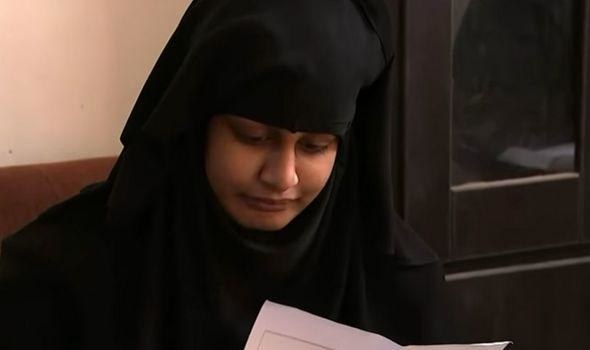
Begum, 20, who is currently marooned in a Syrian refugee camp, lost the first stage of her case about the legality of the government’s decision at the Special Immigration Appeals Commission (SIAC) in February. (Screenshot/ITV News)
Short Url
Updated 31 July 2020
Follow

UK government wins bid for Supreme Court to hear ‘Daesh bride’ Shamima Begum’s case

  • Home Office successfully appealed a lower court ruling this month which would have allowed Shamima Begum, 20, to return to Britain

LONDON: The UK government on Friday won a bid for the Supreme Court to decide if a woman stripped of her citizenship after joining the Daesh group in Syria can return to fight the decision.
The Home Office successfully appealed a lower court ruling this month which would have allowed Shamima Begum, 20, to return to Britain to pursue her appeal.
Begum, 20, who is currently marooned in a Syrian refugee camp, lost the first stage of her case about the legality of the government’s decision at the Special Immigration Appeals Commission (SIAC) in February.
However, the tribunal also ruled she could not have a “fair and effective appeal” or play “any meaningful part” in the process, as she was living in a Syrian refugee camp.
Three senior judges at the Court of Appeal upheld that SIAC ruling on July 16, concluding Begum should be allowed to come to Britain for the legal challenge.

-----

READ MORE: Daughter of beheaded aid worker says Shamima Begum a ‘ticking time bomb’

UK teen Shamima Begum was strict enforcer under Daesh ‘morality police’

-----

They ruled “fairness and justice” outweighed any national security concerns, which “could be addressed and managed if she returns.”
But judge Eleanor King, one of that trio, said at a remote hearing Friday that the country’s highest court should now consider a case that raised “points of law of general public importance.”
Begum was 15 when she and two other schoolgirls from Bethnal Green in east London left home to join the group on February 17, 2015.
She claims she married a Dutch convert soon after arriving in Daesh-held territory. She was discovered, nine months pregnant, in a Syrian refugee camp in February last year.
Her newborn baby died soon after she gave birth. Two of her other children also died under Daesh rule.
The then-home secretary, Sajid Javid, annulled Begum’s British citizenship on national security grounds after an outcry led by right-wing media.
That prompted her to take legal action, arguing the decision was unlawful, made her stateless and exposed her to the risk of death or inhuman and degrading treatment.
British-born Begum is of Bangladeshi heritage. But Bangladesh’s foreign minister has said he would not consider granting her citizenship.


Single ‘digital nation-state’ is not a far-fetched notion, Melania Trump tells UN Security Council

Updated 5 sec ago
Follow

Single ‘digital nation-state’ is not a far-fetched notion, Melania Trump tells UN Security Council

  • US first lady argues that AI and global connectivity could reshape education, help reduce conflict and empower children worldwide
  • Societies rooted in knowledge foster innovation, tolerance and moral reasoning, while those shaped by ignorance risk disorder and conflict, she says

NEW YORK CITY: The idea of a single digital nation-state is “not so far-fetched,” US First Lady Melania Trump told the UN Security Council on Monday.
She argued that artificial intelligence and global connectivity could reshape education, help reduce conflict and empower children worldwide.
The US holds the rotating presidency of the council for March, and as she presided over its first meeting of the month Trump said technology was erasing borders and creating what she described as a shared intellectual future.
“Perhaps this idea isn’t so far-fetched,” she said, pointing to the rise of digital currencies, blockchain-based payment systems, and AI-driven databases she argued were already transforming media and financial markets.
Trump thanked the US’s fellow council members — the UK, France, Russia, China, Greece, the Democratic Republic of Congo, Denmark, Panama, Liberia, Somalia, Colombia, Pakistan, Bahrain and Latvia — for their role in efforts to maintain international security.
The responsibility for preventing conflict “must be applied evenly and should never be carried out lightly,” she said. Her remarks focused in particular on the role of education as the foundation of peace and stability.
“A nation that makes learning sacred protects its books, its language, its science and its mathematics. It protects its future,” Trump said, arguing that societies rooted in knowledge foster innovation, tolerance and moral reasoning, while those shaped by ignorance risk disorder and conflict.
Education is widely recognized as a fundamental human right, she added, yet many children and young adults around the world remain barred from the chance to attend high school or university. The losses arising from this squandered potential, from potential medical breakthroughs to possible advances in food security and technology, are borne not only by the individual countries involved but by humanity as a whole, she said.
Trump called for the expansion of global access to technology to help bridge the digital divide, noting that about 6 billion people, 70 percent of the world’s population, now use mobile devices and the internet.
“If our nations band together, we can close the technological divide,” she said, describing a world in which a farmer on a remote Greek island, a student in Somalia and a resident of New York City can all tap into centuries of accumulated human knowledge.
AI was democratizing access to information once confined to university libraries, she added, and redefining participation in the global “economy of ideas.”
She continued: “Conflict arises from ignorance. Knowledge creates understanding, replacing fear with peace and unity.”
Trump called on council members to safeguard learning and promote access to higher education, urging them to “build a future generation of leaders who embrace peace through education.”
She added: “The path to peace depends on us taking responsibility to empower our children through education and technology.”