JERUSALEM: Israeli President Reuven Rivlin began two days of crucial talks Sunday with representatives of all parliamentary factions before selecting his candidate for prime minister, after a deadlocked repeat election was set to make forming any new government a daunting task.
Israel's largely ceremonial president is tasked with picking the politician with the best chance of forming a stable coalition government. While usually a mere formality, this time Rivlin plays a key role after an election result in which neither of the top candidates has an outright majority.
"The president, in this case, will be very, very involved in the particulars. He will ask for clear answers," Harel Tubi, the president's top aide, told Israel's Army Radio. "I think he'll turn the consultations this time into consultations that have the ability to present other possibilities, of the sort that the public hasn't heard about yet."
In last week's vote, Benny Gantz's centrist Blue and White party won 33 seats in the 120-member parliament, while incumbent Benjamin Netanyahu's conservative Likud took 31 seats. Neither can muster a parliamentary majority with their traditional smaller allies.
The deciding factor looks to be Avigdor Lieberman and the eight seats his Yisrael Beitenu party captured. Lieberman is demanding a broad unity government with the two major parties that is secular and excludes the ultra-Orthodox Jewish parties. That appears to be the emerging compromise between Blue and White and Likud, though both are insisting upon leading it.
Complicating matters is Blue and White's refusal to sit with Netanyahu because he faces a likely indictment on corruption charges.
The first step out of the quagmire is the consultations at the president's residence, where each of the parties is asked to make its recommendations. Though Netanyahu's Likud dropped in support, its allies appear to give Netanyahu the support of 55 members of parliament. For Gantz to edge out Netanyahu, he'll need the backing of the Joint List of Arab parties, which emerged as the third largest party with 13 seats, and has traditionally refrained from openly endorsing a candidate for prime minister.
The Arab-led parties have never sat in an Israeli government and its leader, Ayman Odeh, says he is aiming to become opposition leader in case of a unity government. But he hasn't ruled out giving Gantz his recommendation to the president to thwart another Netanyahu-led government. It would make the first time since 1992 the Arab parties played a role in the process. The decision will come down later Sunday, before party representatives meet Rivlin.
In opening his series of meetings, Rivlin gave no indication of where he was leaning, but said he interpreted the will of the people as yearning for a "stable" government.
"I've learned over the years that the people are less concerned about who runs the system," the 80-year-old Rivlin said. "They first of all want the system to create a stable government. And there can't be a stable government without the two big parties."
Rivlin's eventual candidate will have up to six weeks to form a coalition. If that fails, Rivlin could give another candidate for prime minister 28 days to form a coalition. And if that doesn't work, new elections would be triggered yet again. Rivlin has said he will do everything possible to avoid such a scenario and no one appears interested in a third Israeli election within a year.
Last week's vote happened because Netanyahu was unable to form a coalition after April's election without the support of Lieberman, an unpredictable ally-turned-rival who has upended Israeli politics in recent months. The nationalist, yet secular, former defense minister said he was equally uncomfortable with both blocs, and announced that he will not recommend anyone for prime minister.
"We have defined to ourselves one option, the three parties," he said, referring to his own party along with Blue and White and Likud. "If we can form a government like that I'll be happy, if not, like people bigger than us say, it's a big honor to serve the people of Israel in the opposition too."
Looming over the whole process is Netanyahu's pre-indictment hearing scheduled in two weeks, after which he could face charges of bribery, breach of trust and fraud in three separate corruption cases. Netanyahu had hoped to secure a narrow majority of hard-line and religious parties that support granting him immunity from prosecution. With immunity now off the table, Netanyahu is desperate to remain in office despite the long odds.
Israeli law does not require a sitting premier to resign if indicted. But if he is charged, as is widely expected, he would come under heavy pressure to resign.


![]()

Israeli president Reuven Rivlin begins talks to form new government
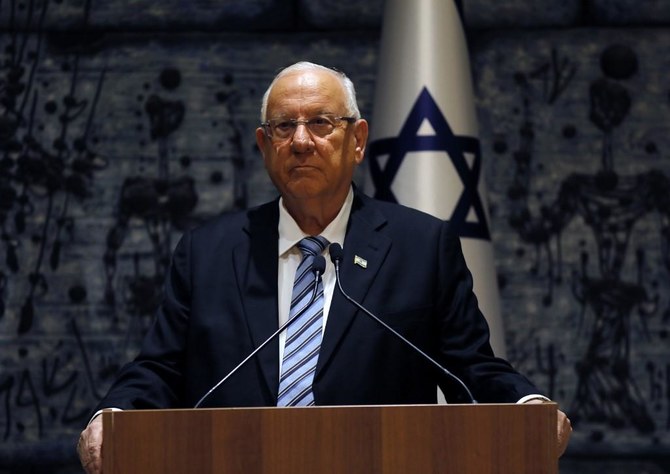
Israeli president Reuven Rivlin begins talks to form new government
- Reuven Rivlin will begin hearing Sunday the recommendations of various parties at his residence


Latest updates


Recommended


© 2026 SAUDI RESEARCH & PUBLISHING COMPANY, All Rights Reserved And subject to Terms of Use Agreement.