



DUBAI: ‘Islamic art’ is a broad term, encompassing delicate sacred folios, stately architectural structures, calligraphy, and paintings — and practiced beyond the geographical borders of Islamic lands — reaching the Far East and Europe — sometimes by non-Muslim artisans. Islamic art, both religious and secular, has proven popular through the ages with many, including royal patrons, archaeologists, artists, art collectors, and curious amateurs.
To mark International Museum Day on May 18, Arab News takes a closer look at some unique objects of Islamic art from leading museum collections around the world, from North America to the Middle East and beyond.
Bifolium from ‘The Nurse’s Quran’
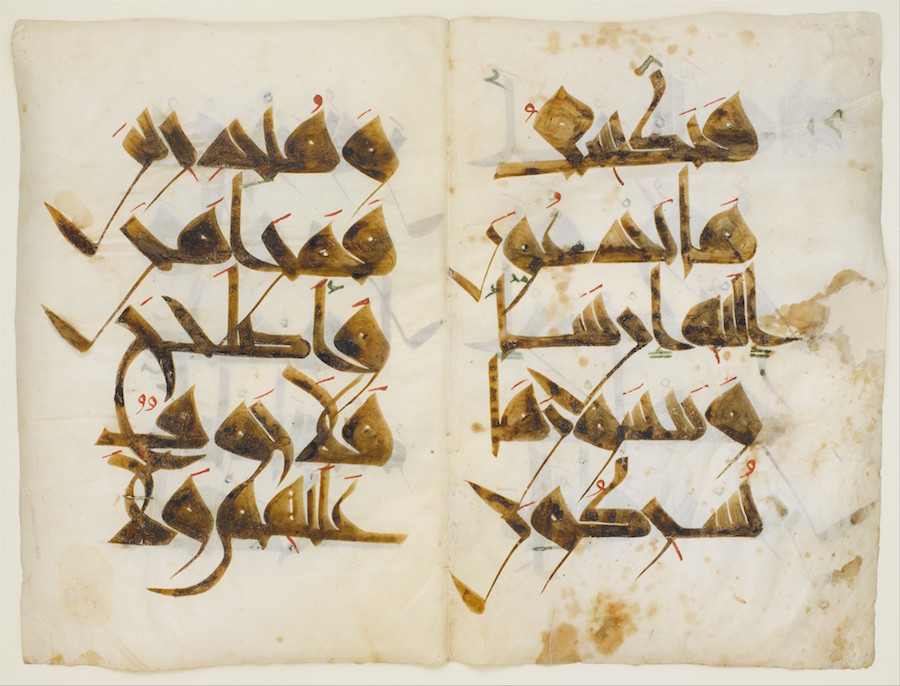
From New York’s Metropolitan Museum of Art
“The Nurse’s Quran” (Mushaf Al-Hadina in Arabic) is considered one of the most remarkable demonstrations of illustrated Quranic manuscripts. Written in ink and gold on parchment, this bifolio from the early 11th century was made in Tunisia (probably in Qairawan), and consists of five lines from the sixth chapter of the Quran — “Al An’am” (The Cattle). Along with red, blue and green diacritical marks, the ‘new-style’ Kufic calligraphy seen here is striking in its curvy yet contained execution.
The manuscript was reportedly commissioned by a North African female patron named Fatima, who donated it to the Great Mosque of Qairawan. She served as a nursemaid to an unknown Zirid leader from a line of Berbers ruling areas in central North Africa. Maryam Ekhtiar, the museum’s associate curator of Islamic art, writes that this important manuscript “serves as a testament to the generosity, faith, and influence of women patrons at the Zirid court.”
Persian court carpet

From the Isabella Stewart Gardner Museum, Boston
Speaking of female patrons, the eccentric American art collector Isabella Stewart Gardner was ahead of her time when she unveiled her home and museum to the Bostonian public in 1903. She collected exemplary works by European masters including Rembrandt, Botticelli, and Vermeer.
But she was also keen on art from the Middle East (Gardner was well-traveled and visited Egypt and Palestine). And in her palazzo-like museum is a fine example of one of the staples of Islamic art — a carpet. This one is from a Persian court, and likely created in the 17th century.
Gardner purchased the rug in London in 1894, and, according to the museum’s curator, Nat Silver, it acts as “a defining feature of her museum's Titian Room.” Silver told Arab News that the carpet depicts “a two-layer arabesque of palmettes, vines, and curved leaves on a dark maroon ground surrounded by a border of palmettes and flowers on dark blue.”
Bowl with Kufic calligraphy
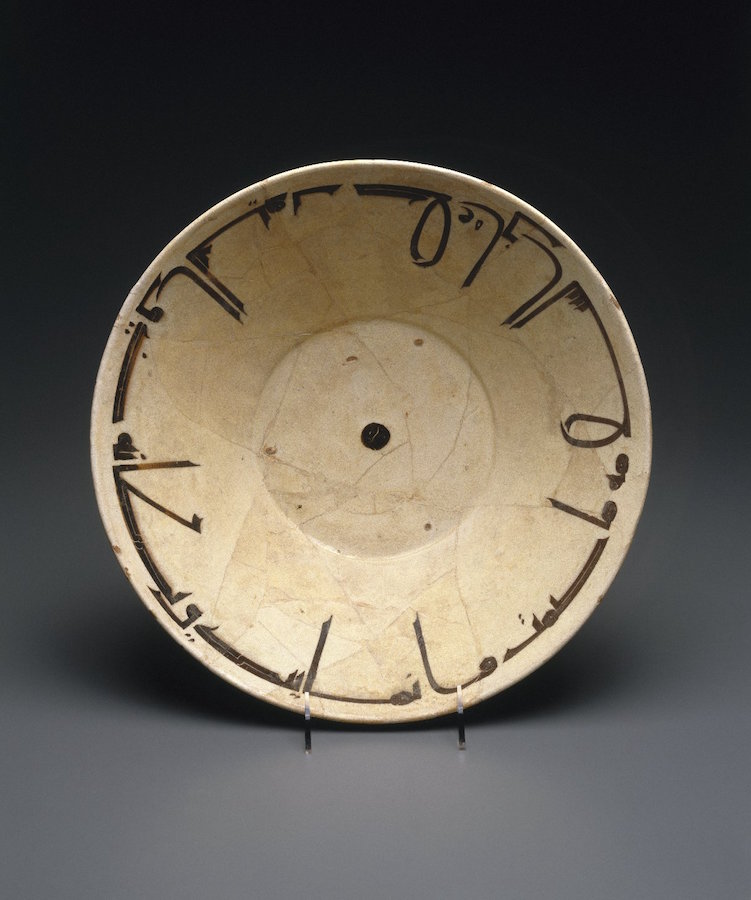
From the Brooklyn Museum, New York
This simple yet sublime 10th-century ceramic bowl is believed to have been produced in Nishapur, in northeastern Iran, by an unknown ceramicist. An Arabic proverb decorates the edge of the bowl — written in elegant Kufic calligraphy, one of the oldest Arabic scripts known for its short vertical and elongated horizontal strokes. It reads: "Peace is that which is silent and the inner [thoughts] of the man with faults will only be revealed through his speech."
An Islamic arts specialist at the museum explained to Arab News who might have owned this type of earthenware: “It is thought that such wares were intended for the Arab elites and merchants living in that region and those who were educated and refined (enough) to appreciate the content — as well as the calligraphic nature — of the decoration.”
Carved oliphant

From the Aga Khan Museum, Toronto
This Fumihiko Maki-designed museum is North America’s first major museum dedicated entirely to the arts of Islamic civilizations. Karen Donaldson, the museum’s collections manager, said that one of its most-prized items is one of the world’s 80 surviving ‘oliphants’ — a horn made from the ivory tusk of an elephant.
Symbolizing the intersection of Islamic and Christian cultures, this elephant’s tusk, with its intricate imagery, dates back to the 11th or 12th century and was probably carved by Muslim artisans in southern Italy. It would have been used for ceremonial purposes.
“The term ‘oliphant’ was first used in the 12th-century epic poem, ‘Song of Roland,’” explained Donaldson. “In this text, when fighting Arabs in Spain during the Battle of Roncevaux Pass, Roland sounds his horn to recall Charlemagne and his army.”
Enameled jewelry ornament

From the Museum of Islamic Civilization, Sharjah
This small yet vibrant enameled jewelry ornament bears two peacocks, whose unison produces an imposing floral motif. Of the majestic bird’s symbolism, the museum’s organizers said: “In the Islamic world, the peacock was sometimes understood to evoke notions of paradise and eternal life.”
It was created around the late-18th or early-19th century in Jaipur, Rajasthan, during the Mughal era, which witnessed the spread of Islamic art in South Asia. By the 17th century, Rajasthan was considered a powerhouse of sophisticated enamel craftsmanship. The work produced there typically included studded jewelry pieces, protected with an enameled surface on their front and backside, and embellished with pearls and precious stones.
Universal astrolabe

From the Benaki Museum, Athens
Astronomy was widely practiced by scientists and scholars across the Arab world. The astrolabe (Greek for ‘star taker’) — shaped like a large clock topped with a rosette — was a scientific tool used to calculate locations and tell the time, among other functions.
This piece in Athens’ Benaki Museum — founded by Islamic art enthusiast Antonis Benakis in 1930 — is the only known version of an Islamic universal astrolabe.
The five-plated brass object comes from Syria and was produced by Aleppo-based craftsman and mathematician Ahmad ibn Al-Sarraj in 1328-9 for a patron named Muhammad Al-Tanukhi. Intricately inscribed on the rim of the astrolabe are the names of its four subsequent owners. At least one of them was known as a professional timekeeper (muwaqqit).
Basin
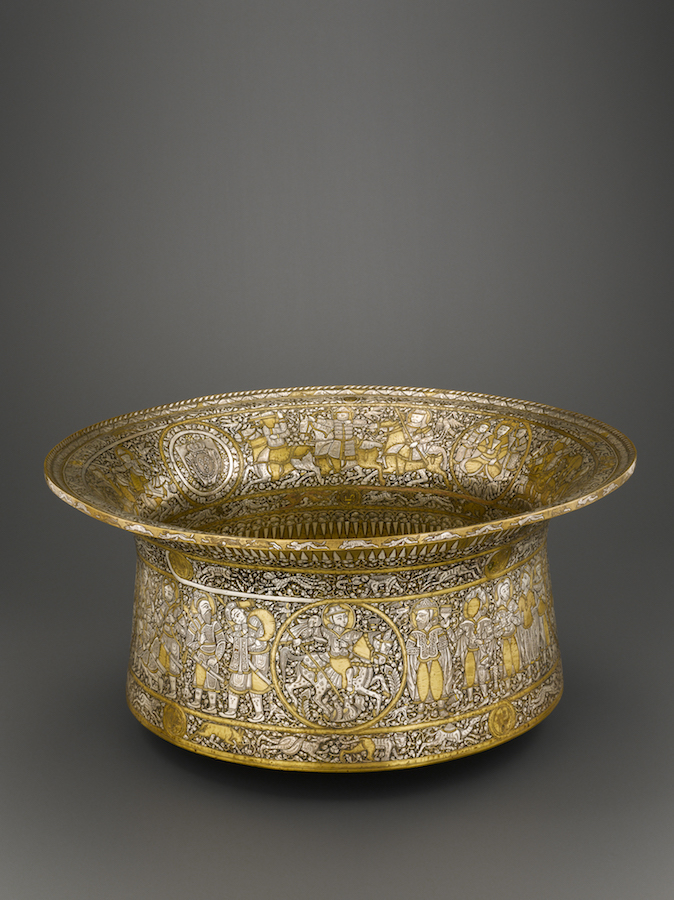
From the Musée du Louvre, Paris
The Louvre inaugurated its modern and airy two-floor Islamic art galleries, designed by Mario Bellini and Rudy Ricciotti, in 2012. A particularly intriguing masterpiece on display is a large 14th-century metal basin created in either Syria or Egypt during the artistically prolific Mamluk era. It was brought to France by King Louis IX in the early 13th century and was apparently used for many years to baptize the offspring of French royalty, including Napoleon III’s son, Prince Napoléon-Eugène, at the Notre Dame Cathedral in 1856. It was an apt font for the regal babes — richly decorated with its figurines of huntsmen, courtiers, and rulers. It became known as the Baptistère of Saint Louis.
Bronze box
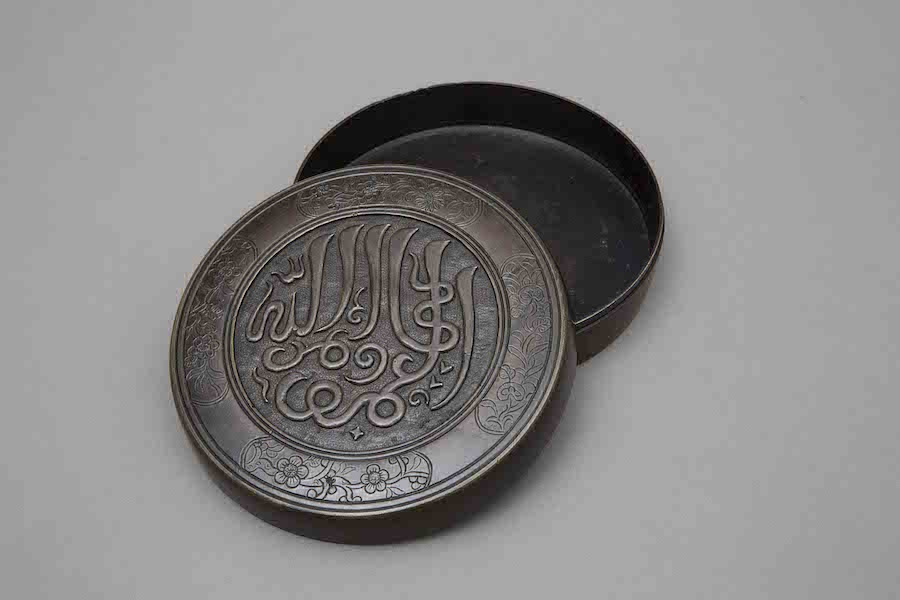
From the Islamic Arts Museum Malaysia, Kuala Lumpur
This rare bronze-cast brass box was designed some time in the 17th century in China during the Qing Dynasty, the nation’s final imperial dynasty, which dissolved in 1912. Research shows that the Islamic presence in China goes back to the Tang dynasty (618-907) with the arrival of Muslim emissaries. It was not long before Chinese artisans started incorporating Islamic motifs in their designs for foreign buyers.
At first glance, the box cover’s squiggly lines look illegible, but on closer inspection one can see that the term ‘Allah’ is inscribed on the top left part. In addition, the cover’s rim is decorated with floral motifs, which were common in Chinese art. Rendered in Sini (‘Chinese’ in Arabic) script, this free-flowing style of writing is characterized by its thick and tapered effect lettering. It was developed specifically for Islamic inscriptions found in ceramics, manuscripts and structures.


