PARIS: Muslims are “not persecuted” in France, the French Council of the Muslim Faith (CFCM) said Monday as a row over radical Islam and freedom of speech pits some Muslim nations against Paris.
“France is a great country, Muslim citizens are not persecuted, they freely construct their mosques and they freely practice their religion,” said the council, which acts as an official go-between for the state and observant Muslims.
French President Emmanuel Macron has vowed to take the fight to Islamist radicals after the Oct. 16 beheading of a history teacher who had shown cartoons of the Prophet Muhammad to pupils in a class discussion on free speech.
But a backlash against his comments saw protests in Muslim-majority countries over the weekend, with people burning pictures of Macron in Syria and setting fire to French flags in the Libyan capital Tripoli.
Boycotts of French goods are under way in supermarkets in Qatar and Kuwait, with further calls to spurn French products in Jordan, Turkey and other states.
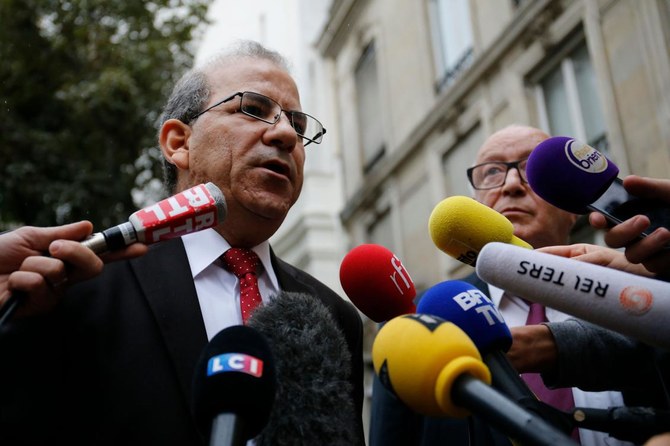
The head of the CFCM, Mohammed Moussaoui, urged French Muslims on Monday to “defend the interests” of the nation in the face of the international outcry.
“We know that the promoters of these campaigns say they defend Islam and the Muslims of France, we urge them to be reasonable... all the smear campaigns against France are counterproductive and create division,” he said.
Regarding cartoons of the Prophet Mohamed, viewed as offensive by many Muslims, Moussaoui said French law gave people “the right to hate” the cartoons.
But he said he supported the stance of Macron, who has vowed France would never relinquish cartoons or the right to mock religion.
Representatives of the CFCM are to meet Macron at the Elysee Palace later Monday.

Muslims ‘not persecuted’ in France, says country’s Muslim council
https://arab.news/cfptc
Muslims ‘not persecuted’ in France, says country’s Muslim council
Ethiopia’s prime minister accuses Eritrea of mass killings during Tigray war
- Landlocked Ethiopia says that Eritrea is arming rebel groups, while Eritrea says Ethiopia’s aspiration is to gain access to a seaport
- Ethiopia lost sovereign access to the Red Sea when Eritrea seceded in 1993 after decades of guerrilla warfare
ADDIS ABABA: Ethiopia’s government Tuesday for the first time acknowledged the involvement of troops from neighboring Eritrea in the war in the Tigray region that ended in 2022, accusing them of mass killings, amid reports of renewed fighting in the region.
Ethiopian Prime Minister Abiy Ahmed, while addressing parliament Tuesday, accused Eritrean troops fighting alongside Ethiopian forces of mass killings in the war, during which more than 400,000 people are estimated to have died.
Eritrean and Ethiopian troops fought against regional forces in the northern Tigray region in a war that ended in 2022 with the signing of a peace agreement.
Eritrea’s Information Minister Yemane Gebremeskel told The Associated Press that Ahmed’s comments were “cheap and despicable lies” and did not merit a response.
Both nations have been accusing each other of provoking a potential civil war, with landlocked Ethiopia saying that Eritrea is arming and funding rebel groups, while Eritrea says Ethiopia’s aspiration is to gain access to a seaport.
“The rift did not begin with the Red Sea issue, as many people think,” Ahmed told parliamentarians. “It started in the first round of the war in Tigray, when the Eritrean army followed us into Shire and began demolishing houses, massacred our youth in Axum, looted factories in Adwa, and uprooted our factories.”
“The Red Sea and Ethiopia cannot remain separated forever,” he added.
Ethiopia lost sovereign access to the Red Sea when Eritrea seceded in 1993 after decades of guerrilla warfare.
Gebremeskel said the prime minister has only recently changed his tune in his push for access to the Red Sea.
Ahmed “and his top military brass were profusely showering praises and State Medals on the Eritrea army and its senior officers. … But when he later developed the delusional malaise of ‘sovereignty access to the sea’ and an agenda of war against Eritrea, he began to sing to a different chorus,” he said.
Eritrea and Ethiopia initially made peace after Abiy came to power in 2018, with Abiy winning a Nobel Peace Prize for his efforts toward reconciliation.
In June, Eritrea accused Ethiopia of having a “long-brewing war agenda” aimed at seizing its Red Sea ports. Ethiopia recently said that Eritrea was “actively preparing to wage war against it.”
Analysts say an alliance between Eritrea and regional forces in the troubled Tigray region may be forming, as fighting has been reported in recent weeks. Flights by the national carrier to the region were canceled last week over the renewed clashes.


