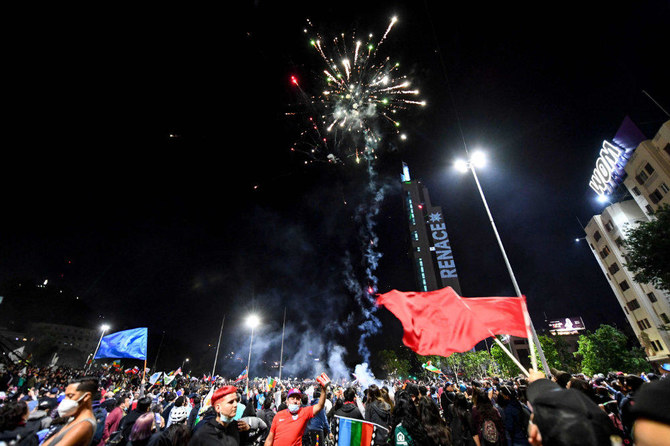

SANTIAGO, Chile: Chileans voted overwhelmingly in a landmark referendum Sunday to replace their dictatorship-era constitution, long seen as underpinning the nation’s glaring economic and social inequalities.
The result set off wild celebrations across the capital and other cities after voters turned out in droves toThe vote threw out the constitution left by the regime of 1973-1990 dictator Augusto Pinochet.
Thousands of people flocked onto the streets of Santiago amid a cacophony of horn-blaring to celebrate victory for the “Approve” campaign within minutes of the polls closing.
“I never imagined that us Chileans would be capable of uniting for such a change!” said a jubilant Maria Isabel Nunez, 46, as she walked in the crowd hand-in-hand with her 20-year-old daughter.
With more than half the votes counted, the “Approve” campaign had amassed 77.9 percent of the vote, with the “Reject” campaign polling just 22.10 percent.
Acknowledging the result, President Sebastian Pinera called on the nation to work together for a “new constitution” in a speech broadcast from his Moneda Palace surrounded by his cabinet.
“This plebiscite is not the end, it is the beginning of a path that we must all walk together to agree on a new constitution for Chile,” Pinera said.
“Until now, the constitution has divided us. From today we must all work together so that the new constitution is the great framework of unity, stability and the future.”
Social unrest
Police had fired tear gas and water cannon in brief clashes with stone-throwing demonstrators in Plaza Italia, the epicenter of months of protests, as night fell.
However, the violence was replaced by celebration after the police retreated.
Earlier, in long, orderly lines across Santiago and in cities around the country, masked voters shuffled patiently toward polling stations to participate in the historic referendum.
The vote came a year to the day after more than one million people thronged downtown Santiago amidst a wave of social unrest that left 30 people dead and thousands wounded.
The sheer size of the October 25 march demonstrated the breadth of social discontent and proved a tipping point in demonstrators’ demands for a referendum.
Within weeks, Pinera had agreed to initiate a process to draft a new constitution, beginning with a referendum to decide the fate of the current text.
“I am full of hope that things will change and that we will bring a radical turnaround in this country,” said Romina Nunez, 42, a poll organizer at the National Stadium in Santiago, the country’s biggest polling center.
Thousands were voting at the vast stadium, which achieved infamy as a detention center where military regime opponents were tortured.
Elias Perez, a 39-year-old psychologist, said he wanted to give the place another meaning as he prepared to vote for change in a place rich with symbolism.
“To be able to exercise the right to vote in a space of profound pain, where there were systematic violations of the human rights of many fellow Chileans, and be able to generate change in this same space — is a symbolic way of paying honor and tribute to all those who are no longer with us,” he said.
Pinochet's rule
Demand for a new constitution had been a recurring theme of the protests, set off by a hike in public transport fares. They rapidly turned into widespread demonstrations against social and economic inequalities — encompassing health, education and pensions — inherited from Pinochet’s rule.
For those supporting change, mainly the leftist opposition parties, a new charter would allow a fairer social order to replace the persistent inequalities enshrined in the current charter.
Critics say the constitution is an obstacle to meaningful social reforms, and a new one is necessary to provide more equitable access to private health care, education and pension systems.
The new constitution would expand the role of the state in providing a welfare safety net, ensuring basic rights to health, education, water distribution and pensions.
Many conservatives, however, say the constitution has been key to Chile’s decades of economic growth and stability and a greater state role would add pressure on an economy struggling to emerge from the Covid-19 health crisis.
They say their fears have been fueled by the violence that accompanied the protests.
As part of the referendum, Chileans also voted by a similar margin for a 155-member convention made up entirely of elected citizens to be tasked with drafting the new constitution.
Their draft would be put to another referendum in 2022.
Strict coronavirus protocols were in place for the vote. Voters had their hands sprayed with gel by marshalls as they entered polling stations, and tables, chairs and other furniture inside had been disinfected.
Chile surpassed 500,000 Covid-19 cases on Saturday, with nearly 14,000 deaths.