

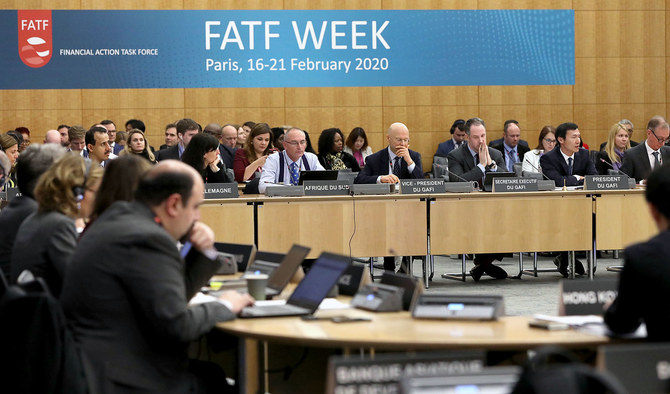

KARACHI: The global financial watchdog, the Financial Action Task Force (FATF), decided on Friday to keep Pakistan on its “grey list” while acknowledging that the country had made significant progress in meeting international anti-terrorism financing norms and should not be downgraded to the “blacklist.”
The FATF began its virtual plenary meeting on October 21 under the first two-year German presidency of Dr Marcus Pleyer.
“Pakistan will remain our increased monitoring list,” he announced after the end of the conference. “The plenary recognizes that Pakistan has made progress. The government has now completed 21 out of 27 items of its action plan. The government of Pakistan has signaled the commitment to complete the rest of its action plan.”
“Even though Pakistan has made progress it needs to do more,” he continued. “It cannot stop now and needs to carry out reforms in particular to implement targeted financial sanctions and prosecuting sanctions financing terrorism.”
Responding to a question, the FATF president said that onsite inspection would be carried out after the next plenary in February 2021 to decide about Pakistan’s exclusion from the grey list.
Pakistan was placed on the list of countries with inadequate controls over terrorism financing by the FATF in June 2018.
The Asia-Pacific Group on Money Laundering (APG), an inter-governmental organization in the Asia-Pacific region, issued the first Follow Up Report (FUR) on Pakistan last month.
The report reflected the country’s performance until February 2020 and noted that it had complied with only two recommendations related to financial institution secrecy laws and financial intelligence units out of 40 recommendations on the effectiveness of anti-money laundering and combating financing terror (AML/CFT) system.
However, Pakistan managed to pass three crucial FATF-related laws during a joint session of parliament in September this year. With these laws, the country managed to comply with most of the legislation required by the international watchdog to strength the country’s financial system.
The FATF “strongly” urged Pakistan in February this year to complete its full action plan by June 2020, warning it would take action against the country which could include advising financial institutions to give special attention to business relations and transactions with Pakistan. Later, the deadline was extended and the country was given time until October 2020 due to the COVID-19 pandemic.
Pakistan also punished Hafiz Saeed, a Jamaat-ud-Dawa leader, in a terror financing case and decided to send him to prison for five and a half years.
Commenting on the FATF decision, financial experts said the decision to keep Pakistan on grey list owed to the government’s hasty legislation.
“The most vital issue relates to the roles assigned to the AML-CFT authority and self-regulatory bodies. These laws give powers to regulate AML-CFT to various government and professional bodies. They were not carefully drafted, create conflict of interest, and are complicated and ambiguous,” Dr Ikram ul Haq, a Lahore-based senior economist, said after the FATF decision.
The FATF blacklist have international pariah states like Iran and North Korea, and these countries are shunned by international financial institutions.


