

W20 stresses importance of gender inclusivity across G20 groups

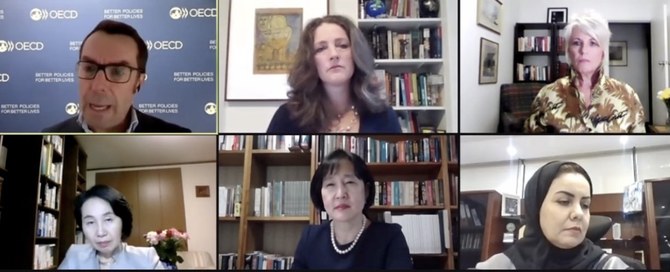
The second day of the virtual Women 20 (W20) meeting — hosted by Saudi Arabia as part of its G20 presidency — stressed the importance of ensuring inclusivity across the G20’s different working groups. (Screenshot)
Short Url
Updated 22 October 2020
Follow

W20 stresses importance of gender inclusivity across G20 groups

  • Women 20 (W20) meeting was hosted by Saudi Arabia as part of its G20 presidency

RIYADH: The second day of the virtual Women 20 (W20) meeting — hosted by Saudi Arabia as part of its G20 presidency — stressed the importance of ensuring inclusivity across the G20’s different working groups.

“The women’s empowerment team at the G20 Secretariat was established by the Saudi sherpa and… my team has engaged with working groups and discussed their topics, such as finance-track development, employment, health, education, agriculture, anti-corruption, energy, the digital economy, tourism, and trade and investments,” said Hala Altuwaijri, chair of the Women's Empowerment Team at the G20 Secretariat and secretary-general of the Family Affairs Council.

She added: “What we learned from previous presidencies is that we look at female empowerment as mainstream, as cross-cutting, and that it should not be the focus of one group only. In other words, every working group should have the empowerment of women as a priority... this is what the Saudi presidency has committed to.”

Addressing gender in the workplace, Libby Lyons, director of the Workplace Gender Equality Agency in Australia, said that Australia will close the equality gap at all management levels within the next 20 years.

“Forty-three percent (of) all promotions went to women last year in the private sector in Australia. The problem persists, however, for women accessing leadership positions such as CEOs and board members,” she said in a session titled “G20 Policies: Catalyzing Women's Economic Empowerment.”

Lyons’ agency has been collecting data annually for more than seven years from every organization in the private sector with more than 100 employees, giving it a clear picture of what is happening in terms of gender equality. “We must collect standardized data to track what we are doing and assess our actions,” she noted.

She said that in Australia, private enterprise is driving this change, facilitated by the government, which is a unique model. “I think that it is a lesson we can all learn,” Lyons said.

Discussing the most notable G20 commitments over the last five years, Wendy Teleki, head of We-Fi Secretariat, said that We-Fi was founded in 2017 at the G20 Hamburg Summit focused on supporting entrepreneurs around the world.

Since then, it has allocated $300 million in funds through its partners to programs that are ultimately expected to benefit more than 130,000 women, she added.

This year, We-Fi has allocated an additional $50 million and Teleki said that another $50 million “will be allocated to the issues of technology, early-stage financing, and COVID-19 relief response to empower women entrepreneurs and help them in their reliance on technology.”

Addressing the private-sector alliance, empowerment and progression of women’s economic representation, which was established last year in Japan as a means to advocate the advancement of women in the private sector, Tomoko Hayashi, director-general of the Gender Equality Bureau in the Cabinet Office said: “The Empower project…aims to increase the number of women with access to leadership positions. Also it devises actionable plans to increase the digital literacy of women in developing countries.”

She added: “COVID-19 has greatly impacted women, including (by) increasing rates of unemployment and domestic violence. At the same time, it created a great opportunity for women to change the rules of the game.”


Threat to Kingdom’s security is ‘red line’ that will be ‘addressed and neutralized,’ Saudi envoy says

Updated 14 January 2026
Follow

Threat to Kingdom’s security is ‘red line’ that will be ‘addressed and neutralized,’ Saudi envoy says

  • Abdulaziz Alwasil tells UN Security Council the situation in southern Yemen is ‘a just cause with social and historic dimensions’ that can only be resolved through dialogue
  • Recent military activity in the south was unilateral, resulting in an escalation that harms the interests of Yemeni people and undermines efforts to address issues in the south, he said

NEW YORK CITY: Any attempt to threaten Saudi Arabia’s national security is a “red line” and will be met with decisive action, the Kingdom’s ambassador to the UN told the Security Council on Wednesday.

Speaking during a meeting of the council to discuss Yemen, Abdulaziz Alwasil said the situation in the south of the country is “a just cause with social and historic dimensions” that can only be resolved through dialogue.

“We stress that any attempt to threaten our national security is a red line, and we will not hesitate to take the necessary actions and steps to address it and neutralize it,” he added.

Alwasil reaffirmed Saudi Arabia’s support for Yemeni President Rashad Al-Alimi, the Presidential Leadership Council, and the Yemeni government in their efforts to achieve security, stability, development and peace while preserving national unity.

He said military activity by Southern Transitional Council forces in Hadramout and Al-Mahra on Dec. 2, 2025, was unilateral, did not have the approval of the Presidential Leadership Council, and was not carried out in coordination with the Coalition to Restore Legitimacy in Yemen.

It had resulted in an unjustified escalation that harmed the interests of the Yemeni people, undermined efforts to address the issues in the south, and ran counter to the coalition’s objectives, Alwasil added.

The Kingdom, working with its coalition partners, the Presidential Leadership Council and the Yemeni government, had moved to contain the situation by dispatching a military force to coordinate arrangements with the Southern Transitional Council in Aden, he said.

The aim was to ensure the return of the southern council’s forces to their previous positions outside of Hadramout and Al-Mahra, and the handover of camps to legitimate government forces and local authorities in line with agreed procedures, Alwasil added.

He expressed regret over the military operations that took place in Hadramout and Al-Mahra, close to Saudi Arabia’s southern border, which he said posed a direct threat to the Kingdom’s national security, as well as the security of Yemen and regional stability. Such steps were extremely dangerous, he added, and contradicted the principles on which the Coalition to Restore Legitimacy in Yemen had been founded.

Alwasil welcomed a prisoner and detainee exchange agreement signed in Muscat on Dec. 23, which he described as an important humanitarian measure to alleviate suffering and build confidence.

He praised Oman for hosting and sponsoring the consultations and supporting negotiations, and commended the efforts of UN’s special envoy for Yemen, Hans Grundberg, the International Committee of the Red Cross and all others that has played a part.

Regarding the political efforts to resolve the crisis, Alwasil said Saudi Arabia welcomed President Al-Alimi’s call for an inclusive conference in Riyadh to bring together all stakeholders to discuss just solutions to the situation in southern Yemen.

Preparations for the conference have begun, he added, in cooperation with the Yemeni government and southern representatives, reflecting the close ties between the two countries and their shared interests in stabilizing Yemen.

He urged all southern stakeholders to participate actively and constructively in the talks, to help find comprehensive and just solutions that meet the legitimate aspirations of the people of southern Yemen.

Alwasil called on all Yemeni forces and stakeholders to cooperate and intensify their efforts to reach a lasting political settlement that would ensure security and stability.

He described the southern issue as “a just cause with social and historic dimensions,” adding that “the only way to address it is through dialogue that leads to a comprehensive political solution” based on nationally and internationally agreed terms of reference.