



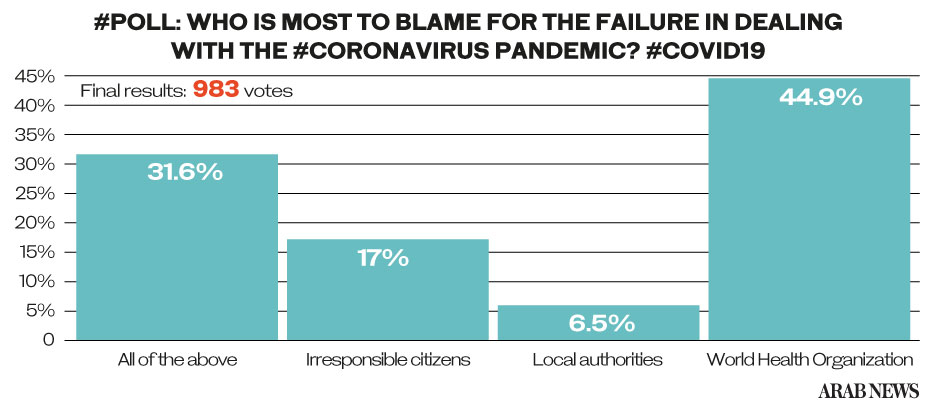
DUBAI: Nearly half of the respondents to an Arab News Twitter poll said the World Health Organisation (WHO) was to blame for the failure to deal with the coronavirus pandemic.
There have been 41.3 million cases of COVID-19, of which 1.13 million people have died – 28.1 million have so far recovered.
The year 2020 has seen a pandemic that brought nations to their knees as governments imposed lockdowns, and rules requiring people to wear masks, not to see loved ones and to work from home where possible
The mental health of the world’s population has been pushed to limits never experienced before in our lifetimes with isolation being one of the biggest factors.
Everyone has their views on how the pandemic has been handled, but few seem to agree on who is responsible.
The Arab News Twitter poll saw 44.9 percent blame the WHO for failing to manage the situation, while 17 percent blamed irresponsible members of the public who refuse to follow the guidelines and rules.
Just 6.5 percent said it was the fault of local authorities – but 31.6 percent said it was a combination of all three.
“I disagree with irresponsible citizens.... In the grand scheme the population has been very very compliant.... only the odd person wears no mask in stores ... you can’t blame the pandemic on a minute proportion of the population... The WHO and UN are to blame,” tweeted @Roofershound.
But others said a lack of consistent leadership was the biggest problem.
“The UK HMG has significant blame in spreading the disease because it was just a cold from Dec to April via their standard NHS policy of bed clearing elderly patients "medically fit" but with a cold to NHS funded respite & palliative beds. Killing an extra 20K via cross infection,” tweeted @AJamesW2.
The pandemic has – like this poll – split opinion globally – some support a lockdown, many say people should wear masks – it’s the law in some parts of the world and then others say their civil liberties have been taken with all these restrictions.
“ Some people’s definition of their rights and democracy is the same as a five year old cry babe “no, I don’t want to wear a mask,” @ArabNewsFriends added.
Now you have read this, take our new poll


