

Government closure of prominent Kashmiri newspaper office condemned

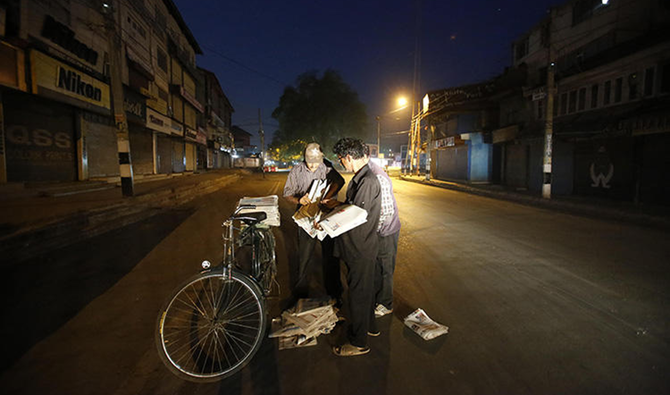
Newspaper vendors collect copies of the papers in Srinagar. An international press freedom organization on Tuesday condemned authorities in Jammu and Kashmir for closing the Srinagar office of the Kashmir Times. (AP/File)
Short Url
Updated 21 October 2020
Follow

Government closure of prominent Kashmiri newspaper office condemned

  • International press freedom body urges authorities to stop trying to silence ‘independent, critical voices’ in valley

NEW DELHI: An international press freedom organization on Tuesday condemned authorities in Jammu and Kashmir for closing the Srinagar office of the Kashmir Times (KT), a leading English daily and one of the oldest newspapers in the valley.

The US-based Committee to Protect Journalists (CPJ) urged the local government to stop trying to silence “independent and critical voices” after the paper’s premises were shut down.

In a tweet, the CPJ said: “We condemn the ongoing targeting and harassment of @AnuradhaBhasin_ (the newspaper’s editor) and the Kashmir Times. Authorities must stop trying to silence independent and critical voices and should respect press freedom.”


Bhasin told Arab News that authorities sealed the KT’s office without giving any prior notice.

“Without following any due process or serving any eviction notice, estate department officials came (on Monday) and asked the people working inside to come out and locked the office with our entire infrastructure. This was done without any office and order,” she said.

The journalist was recently evicted from her government-allotted residence in Hindu-majority Jammu in a similar fashion. “The administration not only evicted me without any notice but handed over my belongings to a new allotted,” she added.

Local officials, however, said that “proper procedure” had been followed before shutting down the KT’s office.

“The building that we sealed was in the name of Ved Bhasin (late journalist and KT editor), and he expired four years ago,” an official – who wished to remain anonymous – in charge of the government building in Srinagar Estate Office told Arab News on Tuesday.

“Since this building was allotted in someone else’s name, the government canceled the allotment in the normal process. We served the notice in July and it is not an abrupt sealing,” he said.

The KT’s closure followed a similar incident on Saturday when the local administration sealed the office of a leading news agency of the region, the Kashmir News Service (KNS).

Ishfaq Tantray, secretary-general of the Srinagar-based Kashmir Press Club (KPC), described the move as a government “attack” on the valley’s media. “The actions are a clear vendetta against independent journalists and media houses. They don’t want media and independent voices to function freely.”

Bhasin is not new to turmoil and has been at loggerheads with the government since August last year when she challenged a communication blockade and media gag issued by the authorities, in the Supreme Court, after the abrogation of Kashmir’s special status on Aug. 5.

The day before that, on the eve of the revocation of the semi-autonomous and constitutional status of the region, New Delhi launched a major crackdown in the entire Jammu and Kashmir valley detaining several political leaders and suspending the basic constitutional and democratic rights of the people.

For months, the entire region, particularly the valley, was devoid of internet and telecommunication services, making the publication of newspapers almost impossible.

“Why we are being targeted is because we continued to maintain the tradition of maintaining independence despite our sagging finances and constraints. We have continued to speak critically of the government’s policies and actions and tried to bring out as many voices of people,” Bhasin said.

The KT was first established as a weekly in 1954 and became a daily newspaper in 1964.

A majority of media houses in Kashmir operate from government-allocated buildings.

With its headquarters in Jammu, the KT moved its bureau office in Srinagar to its current address in 1993 when it was allotted space by the government.

Up until recently, the KT was the largest circulated daily with 2 million subscriptions in the region and enjoyed a reputation of being “key to Kashmir affairs.”

Bhasin said the government stopped advertising with the newspaper in August last year “in retaliation against its challenging of the internet ban in the apex court.” Soon after, she had to shut down its print edition in both Jammu and Srinagar and the newspaper “paid the price” for being the “voice of the people.”

She added: “There is an attempt by the government to completely crush the media and impose silence and compel them not to write about people’s sufferings and their victimization.”

Fahad Shah, editor of Srinagar-based web magazine The Kashmir Walla, was questioned several times in recent months for his reportage.

“This is just another way of intimidating the press. It is not about shutting offices. It is the larger message that government sends to the press even though the majority of press in Kashmir is self-censoring now,” Shah told Arab News.

“The government fears free press, not press in general. Those who are not succumbing to pressure are seen as a threat, and we are just a few people. Most of the media here listen to what the government tells them to do,” added Shah, who was detained by police on Oct. 5 and questioned for several hours before being released.

He said neither detention nor questioning would deter him from speaking out.

“I care about the story, sending the word out, speaking out even if the whole world is quiet. I do it for my sanity. And nothing will change it. This is how I am, and it shows in our newspaper also.

“But yes, it is not easy. There are a lot of ways people try to attack you and bring you down. But one cannot give up,” he added.

Tantray said conditions for independent and free journalism in Kashmir had become “very difficult,” adding that “the summons to journalists and coercions by the administration is an indicator of this.”


Judge bars federal prosecutors from seeking the death penalty against Luigi Mangione

Updated 02 February 2026
Follow

Judge bars federal prosecutors from seeking the death penalty against Luigi Mangione

  • Judge Margaret Garnett’s Friday ruling foiled the Trump administration’s bid to see Mangione executed
  • Garnett dismissed a federal murder charge against Mangione, finding it technically flawed. She left in place stalking charges that could carry a life sentence

NEW YORK: Federal prosecutors can’t seek the death penalty against Luigi Mangione in the killing of UnitedHealthcare CEO Brian Thompson, a federal judge ruled Friday, foiling the Trump administration’s bid to see him executed for what it called a “premeditated, cold-blooded assassination that shocked America.”
Judge Margaret Garnett dismissed a federal murder charge that had enabled prosecutors to seek capital punishment, finding it technically flawed. She wrote that she did so to “foreclose the death penalty as an available punishment to be considered by the jury” as it weighs whether to convict Mangione.
Garnett also dismissed a gun charge but left in place stalking charges that carry a maximum punishment of life in prison. To seek the death penalty, prosecutors needed to show that Mangione killed Thompson while committing another “crime of violence.” Stalking doesn’t fit that definition, Garnett wrote in her opinion, citing case law and legal precedents.
In a win for prosecutors, Garnett ruled they can use evidence collected from his backpack during his arrest, including a 9mm handgun and a notebook in which authorities say Mangione described his intent to “wack” an insurance executive. Mangione’s lawyers had sought to exclude those items, arguing the search was illegal because police hadn’t yet obtained a warrant.
During a hearing Friday, Garnett gave prosecutors 30 days to update her on whether they’ll appeal her death penalty decision. A spokesperson for the US attorney’s office in Manhattan, which is prosecuting the federal case, declined to comment.
Garnett acknowledged that the decision “may strike the average person — and indeed many lawyers and judges — as tortured and strange, and the result may seem contrary to our intuitions about the criminal law.” But, she said, it reflected her “committed effort to faithfully apply the dictates of the Supreme Court to the charges in this case. The law must be the Court’s only concern.”
Mangione, 27, appeared relaxed as he sat with his lawyers during the scheduled hearing, which took place about an hour after Garnett issued her written ruling. Prosecutors retained their right to appeal but said they were ready to proceed to trial.
Outside court afterward, Mangione attorney Karen Friedman Agnifilo said her client and his defense team were relieved by the “incredible decision.”
Jury selection in the federal case is set for Sept. 8, followed by opening statements and testimony on Oct. 13. The state trial’s date hasn’t been set. On Wednesday, the Manhattan district attorney’s office urged the judge in that case to schedule a July 1 trial date.
“That case is none of my concern,” Garnett said, adding that she would proceed as if the federal case is the only case unless she hears formally from parties involved in the state case. She also said the federal case will be paused if the government appeals her death penalty ruling.
Thompson, 50, was killed on Dec. 4, 2024, as he walked to a midtown Manhattan hotel for UnitedHealth Group’s annual investor conference. Surveillance video showed a masked gunman shooting him from behind. Police say “delay,” “deny” and “depose” were written on the ammunition, mimicking a phrase used by critics to describe how insurers avoid paying claims.
Mangione, an Ivy League graduate from a wealthy Maryland family, was arrested five days later at a McDonald’s in Altoona, Pennsylvania, about 230 miles (about 370 kilometers) west of Manhattan.
Following through on Trump’s campaign promise to vigorously pursue capital punishment, Attorney General Pam Bondi ordered Manhattan federal prosecutors last April to seek the death penalty against Mangione.
It was the first time the Justice Department sought the death penalty in President Donald Trump’s second term. He returned to office a year ago with a vow to resume federal executions after they were halted under his predecessor, President Joe Biden.
Garnett, a Biden appointee and former Manhattan federal prosecutor, ruled after hearing oral arguments earlier this month.
Besides seeking to have the death penalty rejected on the grounds Garnett cited, Mangione’s lawyers argued that Bondi’s announcement flouted long-established Justice Department protocols and was “based on politics, not merit.”
They said her remarks, followed by posts to her Instagram account and a TV appearance, “indelibly prejudiced” the grand jury process resulting in his indictment weeks later.
Prosecutors urged Garnett to keep the death penalty on the table, arguing that the charges were legally sound and Bondi’s remarks weren’t prejudicial, as “pretrial publicity, even when intense, is not itself a constitutional defect.”
Prosecutors argued that careful questioning of prospective jurors would alleviate the defense’s concerns about their knowledge of the case and ensure Mangione’s rights are respected at trial.
“What the defendant recasts as a constitutional crisis is merely a repackaging of arguments” rejected in previous cases, prosecutors said. “None warrants dismissal of the indictment or categorical preclusion of a congressionally authorized punishment.”