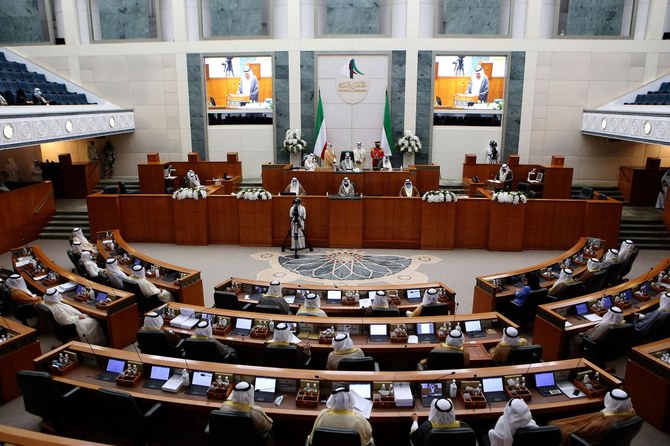
KUWAIT: Kuwait’s Emir Sheikh Nawaf Al-Ahmad Al-Sabah called on Tuesday for national unity to meet challenges facing the Gulf state, in a speech to lawmakers ahead of elections on Dec. 5.
The parliamentary elections come at a time when the wealthy OPEC member is facing a liquidity crisis caused by low oil prices and the coronavirus pandemic against the backdrop of continued tensions between larger neighbors Saudi Arabia and Iran.
“National unity has proven to be our strongest weapon in facing challenges, dangers and crises,” said the emir, who assumed power last month on the death of the previous ruler.
Frequent clashes between the cabinet and parliament have led to successive government reshuffles and dissolutions of parliament, hindering investment and reform efforts. The outspoken assembly, the Gulf’s oldest legislature, can block bills and question ministers.
Prime Minister Sheikh Sabah Al-Khalid Al-Sabah, also addressing the opening of a supplementary legislative session, called for greater efforts to “diversify revenue sources and rationalize spending and consumption ... without detriment to citizens” in the cradle-to-grave welfare state.
He said the government was seeking more sustainable tools to finance the budget, in which public sector salaries and subsidies accounted for 71% of spending for the 2020-2021 fiscal year.
The nearly $140 billion economy is facing a yawning deficit of $46 billion this year. A priority will be overcoming legislative gridlock on a bill that would allow Kuwait to tap international debt markets.
Lawmakers opposed to the debt law have called for clarity on government plans to reduce reliance on oil exports, which accounted for 89% of revenues in the last fiscal year.
The emir is expected to maintain oil and investment policy and a balanced foreign policy that strove for Arab unity.
In his speech, the premier said Kuwait would continue mediation efforts to end a Gulf dispute that has seen Saudi Arabia and its allies boycott Qatar since mid-2017. He reiterated his country’s support for Palestinians’ rights.

Kuwait’s new emir calls for national unity ahead of elections
Short Url
https://arab.news/p8nes
Kuwait’s new emir calls for national unity ahead of elections
Iran urges US to drop ‘excessive demands’ to reach deal
- Longtime adversaries Iran and the United States held their third round of Omani-mediated nuclear talks on Thursday in Geneva
- Both Iran and Oman cited progress after the talks, with technical discussions scheduled for Monday in Vienna
TEHRAN: Iran’s Foreign Minister Abbas Araghchi said on Friday that in order to reach a deal, the United States will have to drop its “excessive demands,” after the two sides held talks in Geneva.
In a phone call with Egypt’s top diplomat Badr Abdelatty, Araghchi said “success in this path requires seriousness and realism from the other side and avoidance of any miscalculation and excessive demands.”
Araghchi did not clarify what demands he was referring to, but Washington has pointed to Iran’s ballistic missile program and has repeatedly described Tehran’s uranium enrichment capability as a red line.
US President Donald Trump said on Wednesday that Tehran had “already developed missiles that can threaten Europe and our bases overseas, and they’re working to build missiles that will soon reach the United States of America.”
Also on Wednesday, US Secretary of State Marco Rubio said Iran is “not enriching right now, but they’re trying to get to the point where they ultimately can,” adding that Tehran “refuses” to discuss its ballistic missile program and “that’s a big problem.”
Iran has repeatedly said its missile program is part of its defensive capabilities and has ruled out abandoning uranium enrichment, insisting its nuclear program is solely for peaceful purposes.
Longtime adversaries Iran and the United States held their third round of Omani-mediated nuclear talks on Thursday in Geneva, seeking to avert military escalation as Washington expands its military build-up in the region.
Both Iran and Oman cited progress after the talks, with technical discussions scheduled for Monday in Vienna ahead of a fourth round expected next week.
In a phone call with Egypt’s top diplomat Badr Abdelatty, Araghchi said “success in this path requires seriousness and realism from the other side and avoidance of any miscalculation and excessive demands.”
Araghchi did not clarify what demands he was referring to, but Washington has pointed to Iran’s ballistic missile program and has repeatedly described Tehran’s uranium enrichment capability as a red line.
US President Donald Trump said on Wednesday that Tehran had “already developed missiles that can threaten Europe and our bases overseas, and they’re working to build missiles that will soon reach the United States of America.”
Also on Wednesday, US Secretary of State Marco Rubio said Iran is “not enriching right now, but they’re trying to get to the point where they ultimately can,” adding that Tehran “refuses” to discuss its ballistic missile program and “that’s a big problem.”
Iran has repeatedly said its missile program is part of its defensive capabilities and has ruled out abandoning uranium enrichment, insisting its nuclear program is solely for peaceful purposes.
Longtime adversaries Iran and the United States held their third round of Omani-mediated nuclear talks on Thursday in Geneva, seeking to avert military escalation as Washington expands its military build-up in the region.
Both Iran and Oman cited progress after the talks, with technical discussions scheduled for Monday in Vienna ahead of a fourth round expected next week.
© 2026 SAUDI RESEARCH & PUBLISHING COMPANY, All Rights Reserved And subject to Terms of Use Agreement.