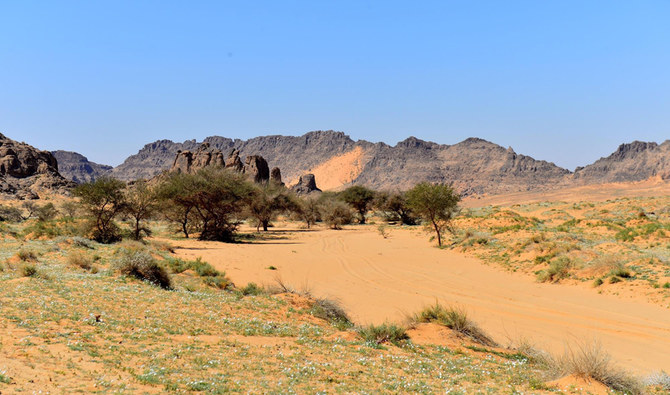
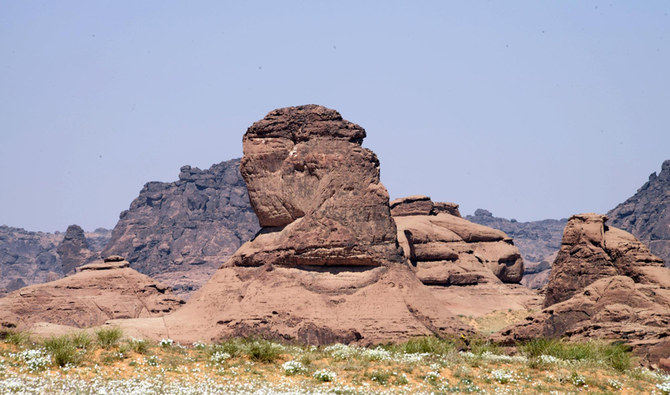
The dramatic Al-Musma mountains in the Hail region of Saudi Arabia are known for their distinctive rock formations and engravings from ancient civilizations.
The range surrounds Hail from the west extending 180 kilometers from the peaks of Al-Aarqoub in the south to Al-Nafud Al-Kabir in the north, taking in mountains such as Ghadab, Sahya, Al-Mudhaibeh, Al-Sataiha, Al-Auja, and Makhrouqa.
Formerly referred to as the Mahjar range (meaning mountains surrounded by sand, inscriptions, and historical landmarks), it has been described as one of the best places in the Kingdom to stargaze.
The area is also a popular destination for amateur and professional photographers from throughout the Kingdom, the Gulf region, and the world. The location of Al-Musma mountains, with their unusual rock shapes, caught the attention of many distinguished European travelers including German Louis Uting, French explorer Charles Huber in 1884, Gertro Debel from Britain, Czechoslovakian Louis Mussel, British adventurer Charles Doughty in 1845, and Italian journeyman Carlo Guarmani in 1860.
The trips of Uting and Huber documented a number of Arab and Nabataean inscriptions, as well as primitive drawings of animals. Today, the mountains are a magnet for hikers and play host to numerous other recreational and sporting activities.


![]()
![]()
![]()
![]()
![]()
![]()
![]()

ThePlace: Al-Musma mountains, located in Saudi Arabia’s Hail region




Short Url
https://arab.news/gxqva
ThePlace: Al-Musma mountains, located in Saudi Arabia’s Hail region
- The trips of Uting and Huber documented a number of Arab and Nabataean inscriptions, as well as primitive drawings of animals


Latest updates


Recommended


© 2026 SAUDI RESEARCH & PUBLISHING COMPANY, All Rights Reserved And subject to Terms of Use Agreement.