Israeli parliament backs UAE, Bahrain normalization deals

1 / 2
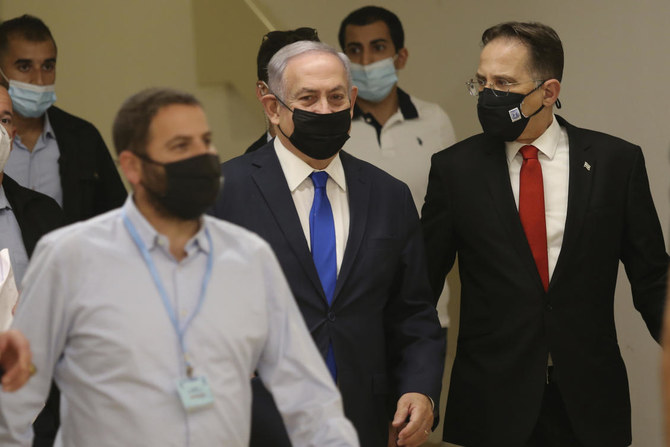
Israeli Prime Minister Benjamin Netanyahu, center, arrives at the Israeli Knesset, or Parliament in Jerusalem ahead of the discussion of the peace treaty with the UAE, Thursday, Oct. 15, 2020. (AP)
2 / 2
Israeli Prime Minister Benjamin Netanyahu wears a protective face mask as he arrives to attend a vote on the approval of the normalisation deal with the UAE at the Knesset, Israel's parliament, in Jerusalem October 15, 2020. (Reuters)
Short Url
Updated 15 October 2020
Follow

Israeli parliament backs UAE, Bahrain normalization deals

  • A total of 80 lawmakers voted to approve the US-brokered agreements, with 13 against, members of Israel’s United Arab List party
  • The UAE in August became the first Arab nation to establish relations with Israel since Egypt in 1979 and Jordan in 1994, followed after by Bahrain

JERUSALEM: Israel’s parliament voted Thursday in favor of the normalization of ties with the United Arab Emirates and Bahrain after a marathon debate with over 100 speeches lasting more than eight hours.
A total of 80 lawmakers voted to approve the US-brokered agreements, with 13 against, members of Israel’s United Arab List party.
“This historic agreement... will bring us closer to other countries in the region to sign other peace agreements,” Prime Minister Benjamin Netanyahu said.
Netanyahu said Israel had contact recently with another country in the region for the first time, but did not reveal its name.
The UAE in August became the first Arab nation to establish relations with Israel since Egypt in 1979 and Jordan in 1994, followed after by Bahrain.
The US-brokered deals were formalized at the White House on September 15.
The Gulf agreements were condemned by the Palestinians as a “betrayal,” and broke with years of Arab League policy on the Israeli-Palestinian conflict.
The US administration is trying to broker other deals between the Jewish state and other Arab nations.


Much of Iran’s near-bomb-grade uranium likely to be in Isfahan, IAEA’s Grossi says

Updated 7 sec ago
Follow

Much of Iran’s near-bomb-grade uranium likely to be in Isfahan, IAEA’s Grossi says

  • Isfahan tunnels appear to have survived military strikes
  • Some highly ‌enriched uranium was known to be stored there
PARIS: Almost half of Iran’s uranium enriched to up to 60 percent purity, a short step from weapons-grade, was stored in a tunnel complex at Isfahan and is probably still there, UN nuclear watchdog chief Rafael Grossi said on Monday.
The tunnel complex is the only target that appears not to have been badly damaged in attacks last June by Israel and the US on Iran’s nuclear ‌facilities.
Diplomats have long ‌said Isfahan has been used to store ‌60 percent uranium, ⁠which the International ⁠Atomic Energy Agency confirmed in a report to member states last month, without saying how much was there.
Iran still has highly enriched uranium stocks
The IAEA estimates that when Israel launched its first attacks in June, Iran had 440.9 kg of 60 percent uranium. If enriched further, that would provide the explosive needed for 10 nuclear weapons, according to an IAEA yardstick.
“What we believe ⁠is that Isfahan had until our last inspection a bit ‌more than 200 kg, maybe a ‌little bit more than that, of 60 percent uranium,” IAEA chief Rafael Grossi told ‌reporters in Paris.
He said the stock was “mainly” at Isfahan, and some held elsewhere ‌may have been destroyed.
“The widespread assumption is that the material is still there. So we haven’t seen — and not only us, I think in general all those observing the facility through satellite imagery and other means to see what’s going ‌on there — movement indicating that the material could have been transferred,” Grossi said.
Iran has not informed the ⁠IAEA of the ⁠status or whereabouts of its highly enriched uranium since the June attacks, nor has it let IAEA inspectors return to its bombed facilities.
Iran’s nuclear program is one reason Israel and the US have given for their current attacks on Iran, arguing that it was getting too close to being able to produce a bomb, despite Trump saying in June that US strikes had obliterated the program. The IAEA has said it has no credible indication of a coordinated nuclear weapons program.
All three Iranian uranium-enrichment plants known to have been operating — two at Natanz and one at Fordow — were destroyed or badly damaged in June.
“There is an amount (of 60 percent uranium) in Natanz also, which we believe is still there,” Grossi said.