Israel approves first new settler homes since suspending annexation

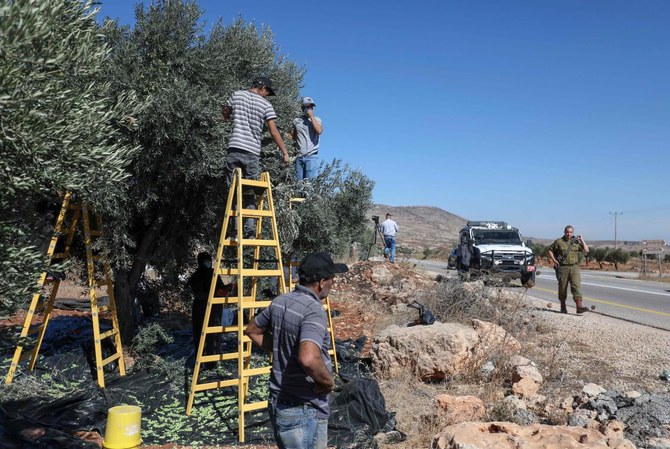
Israeli soldiers walk by as Palestinian volunteers help farmers pick olives near Al Mughayyir village, north of Ramallah, for fear of Israeli settler attacks on farmers in the occupied West Bank, on October 13, 2020. (AFP)
Short Url
Updated 14 October 2020
Follow

Israel approves first new settler homes since suspending annexation

  • The decision drew an angry response from Palestinians
  • The construction could help mute criticism of PM Netanyahu from settler leaders

JERUSALEM: Israel approved more than 1,300 new settler homes in the occupied West Bank on Wednesday in the first such go-ahead since it suspended annexation plans in the territory.
The decision drew an angry response from Palestinians, who seek to establish a state in the West Bank, Gaza and East Jerusalem.
“We urge the international community to intervene immediately to stop this settlement madness, which destroys any chance for a genuine peace process,” said Nabil Abu Rudeineh, a spokesman for Palestinian President Mahmoud Abbas.
The construction could help mute criticism of Prime Minister Benjamin Netanyahu from settler leaders, who are traditional allies.
They had bristled at the annexation suspension that helped pave the way for last month’s deals to forge diplomatic ties between Israel and the United Arab Emirates and Bahrain.

Opinion

This section contains relevant reference points, placed in (Opinion field)

Israel’s West Bank Civil Administration planning committee gave final approval for building 1,313 housing units in several settlements, it said in a statement. Plans for another 853 units were advanced but have not yet been given final approval.
A statement from Beit El settlement said 350 new housing units would be built there. It hailed the committee’s decision as “a tremendous achievement for Beit El.”
The forum, which last held such a hearing eight months ago, was due to reconvene on Thursday to advance additional projects in settlements, its publicly available agenda showed.
Peace Now, an Israeli settlement watchdog, said that in total the committee was set to move forward with projects comprising more than 4,000 new settler homes.
Most countries view settlements Israel has built in territory captured in the 1967 Middle East war as illegal and as an obstacle to peace with the Palestinians. The United States and Israel dispute this.
Israel cites historical and biblical links to the West Bank and around 450,000 of its settlers live there, among 3 million Palestinians.


The art of war: fears for masterpieces on loan to Louvre Abu Dhabi

Updated 13 March 2026
Follow

The art of war: fears for masterpieces on loan to Louvre Abu Dhabi

  • UAE paid more than €1 billion to borrow priceless works, but experts in France want them back

PARIS: The Middle East war has raised fears for the safety of priceless masterpieces on loan from France to the Louvre Abu Dhabi, the museum’s only foreign branch.
The Abu Dhabi museum, which opened in 2017, has so far escaped damage from nearly 1,800 Iranian drone and missile strikes launched since the conflict erupted on Feb. 28.
However, concerns are mounting in France. “The works must be removed,” said Didier Selles, who helped broker the original agreement between France and the UAE.
French journal La Tribune de l’Art echoed that alarm. “The Louvre’s works in Abu Dhabi must be secured!” it said.
France’s culture ministry said French authorities were “in close and regular contact with the authorities of the UAE to ensure the protection of the works loaned by France.”
Under the agreement with the UAE, France agreed to provide expertise, lend works of art and organize exhibitions, in return for €1 billion, including €400 million for licensing the use of the Louvre name. The deal was extended in 2021 to 2047 for an additional €165 million.
Works on loan include paintings by Rembrandt and Chardin, Classical statues of Isis, Roman sarcophagi and Islamic masterpieces: such as the Pyxis of Al-Mughira.

A Louvre Abu Dhabi source said the museum was designed to protect collections from both security threats and natural disasters.