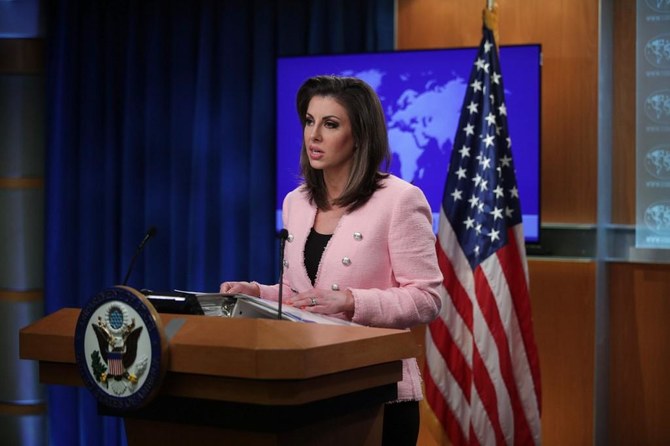
RIYADH: On the heels of the Saudi-American strategic dialogue, US State Department spokesperson Morgan Ortagus stressed her country’s support to the Kingdom in facing the Iranian, Houthi aggression and said that Saudi Arabia “absolutely” has the right to defend itself.
During a phone interview with Arab News, Ortagus described the Saudi-American relationship as “strategic, sophisticated and bipartisan” regardless of the outcome of the upcoming US presidential election.
Regarding critics who question US arms sales to the Kingdom, Ortagus said that deals have been happening “under Republican and Democratic administration for some time,” adding that both this administration, as well as previous ones, supported them.
Having lived in Saudi Arabia almost a decade ago while working under former President Barack Obama, she remembers those deals well.
“We know that Saudi Arabia and other countries in the Gulf are on the front line of Iranian aggression,” she said. “That’s why we have sought to bolster and strengthen our allies to stand up to the aggression from Iran.”
Expressing concern over the abandoned and decaying oil tanker, the Safer, that has been moored near Ras Issa oil terminal on the shores of the Red Sea for more than five years, she said: “The leaking and immobile oil storage vessel Safer is a time bomb in the Red Sea, and if it ruptures, it will devastate the Red Sea ecosystem — killing its marine life and its treasured environmental heritage and depriving the people who rely on the Red Sea of their livelihoods.
“The Houthis have politicized the tanker by continually imposing conditions before they will grant access to UN officials who need to board the Safer and do the work necessary to prevent massive environmental damage throughout the region. We call for an end to the delays and for the UN experts to be granted access so that they can assess the vessel and begin repairs.”
Following the strategic dialogue which took place on Oct. 14, US Secretary of State Mike Pompeo announced a $1 billion investment for a new embassy in Riyadh and two consulates in Jeddah and Dhahran. “This shows our commitment to Saudi Arabia,” said Ortagus.
The relationship between the two countries has spanned 75 years, “we think about it in terms of the past, present and future.”
She termed the relationship as “strong but certainly not without its challenges.”
Ortagus added: “We have faced enormous challenges and moments of very trying times. But, when we start to look forward toward the future, it is important that the relationship between the US and Saudi Arabia is a bipartisan relationship as it has always been.
“The relationship is certainly based on more than military, security, and oil.”
She said: “It has become a much more sophisticated trade relationship and very, very close people ties.
“We look at the next 75 years as something that can be fruitful and positive and certainly support Saudi Arabia’s Vision 2030 plan for the country.”
She underlined the US support for the upcoming G20 virtual summit which Saudi Arabia is hosting virtually due to the pandemic.
“I know we are all disappointed that we won’t be in Saudi Arabia for that meeting, but we will be working together quite closely,” Ortagus added.

Saudi Arabia ‘absolutely’ has the right to defend itself, says Ortagus
https://arab.news/5fe9c
Saudi Arabia ‘absolutely’ has the right to defend itself, says Ortagus
- US State Department spokesperson stresses support against Iran
- Ortagus tells Arab News relationship with Saudi Arabia “is bipartisan”
Is sourdough Saudi Arabia’s latest craft food?
- Saudi home bakers point to a practice that was once routine, not artisanal
- Naturally fermented bread reflects a broader shift toward process-driven, premium food culture
ALKHOBAR: Sourdough has started to shift from a niche interest into a mainstream feature of home kitchens, cafes and specialty bakeries across the Kingdom.
The rise of sourdough is part of a wider shift in Saudi Arabia’s food landscape, where artisanal production and slower preparation methods are gaining traction.
Specialty coffee seems to have set the early template for this transition, normalizing premium pricing, craftsmanship and an interest in process.
Bread is now undergoing a similar shift, with fermentation replacing extraction and roasting as the central point of differentiation.
In both cases, the appeal is rooted in the product’s perceived authenticity, reduced additives, and a clearer link between raw ingredients and final consumption.
Home bakers in Riyadh, Jeddah and the Eastern Province have adapted natural yeast cultures to the Saudi environment, adjusting feeding schedules, hydration ratios, and fermentation times to accommodate higher temperatures and lower humidity in the summer months.
HIGHLIGHTS
• Home bakers in Riyadh, Jeddah and the Eastern Province have adapted natural yeast cultures to the Saudi environment.
• They adjust feeding schedules, hydration ratios, and fermentation times to accommodate higher temperatures and lower humidity in the summer months.
Cafes and specialty bakeries have responded by adding sourdough loaves, baguettes and focaccia to their menus, often positioned as premium alternatives to conventional commercial bread.
For younger home bakers, the appeal lies in the craft and the learning curve rather than nostalgia. “It feels more real and more intentional,” home baker Sarah Al-Almaei told Arab News. She began experimenting with natural yeast at home after watching starter tutorials online.
The technical aspect — hydration percentages, fermentation control and starter maintenance — has become content in its own right, with TikTok and Instagram compressing trial-and-error learning into short videos and recipe cards.
But the practice of maintaining a natural yeast culture is not new in Saudi Arabia. Long before sourdough became a global trend, Saudi households kept what was commonly referred to as the “mother dough,” a natural yeast starter fed and used daily.
“We used to maintain it every day and bake with it,” said Hessa Al-Otaibi, 56, a Saudi home baker with more than four decades’ experience. “People today call it sourdough. For us, it was simply bread.”
Her comment highlights a cultural continuity that has remained largely unrecognized, partly because the practice was not framed as artisanal or health-oriented, but as a routine household function.
The modern sourdough trend differs in its market positioning. While the older model was practical and domestic, the current model is commercial, aesthetic and often health-coded. Bakeries justify higher pricing through longer fermentation times, higher ingredient costs and smaller batch production.
Consumers justify their purchases through digestibility, perceived health benefits, flavor and product integrity.
“Once you get used to it, it’s hard to go back,” said Amina Al-Zahrani, a regular buyer of sourdough from specialty bakeries in Alkhobar.
Digestibility and texture are often cited as reasons for substitution, especially among buyers who report discomfort from standard commercial bread.
Another consumer, Majda Al-Ansari, says sourdough has become part of her weekly routine, noting that availability and quality have improved significantly in the past year.
The social media component has played an outsized role in accelerating adoption. Home bakers document starter feeding cycles, cold proofing and first bakes, turning a once-private domestic process into visible public content.
This has also created micro-markets of home-based sellers, where individual bakers offer loaves to local buyers, often fulfilling orders through direct messaging.
What remains to be seen is how far the trend will scale. If specialty bakeries continue to expand and consumers maintain willingness to pay premium prices, sourdough could establish a long-term place in Saudi food culture.
If not, it may revert to a smaller niche of committed home bakers and specialty cafes. For now, however, sourdough occupies an unusual position: both a newly fashionable trend and a quiet continuation of an older Saudi baking practice.


