

Pakistani opposition to launch anti-government protests from Friday

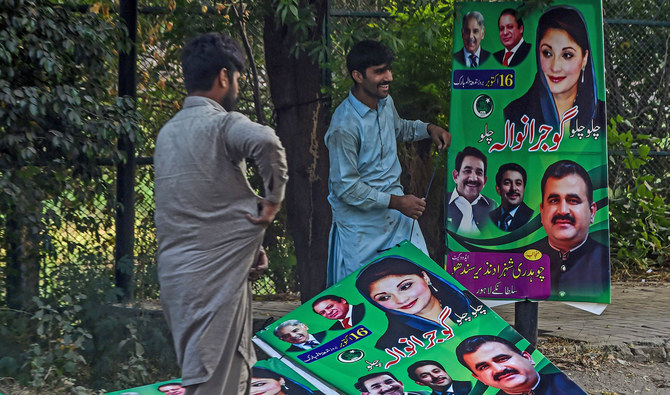
Workers hang posters of opposition party Pakistan Muslim League Nawaz (PML-N) on a street in Lahore on Oct. 15, 2020, as part of preparations ahead of an opposition rally. (AFP)
Short Url
Updated 15 October 2020
Follow

Pakistani opposition to launch anti-government protests from Friday

  • The opposition Pakistan Democratic Movement alliance will hold its first protest rally in Gujranwala
  • The federal information minister says the opposition parties have joined hands to protect their ill-gotten wealth

ISLAMABAD: Pakistan’s opposition parties on Thursday chalked out a strategy for anti-government protests that are scheduled to begin from tomorrow to oust the Pakistan Tehreek-e-Insaf (PTI) government through street agitation.

The opposition factions recently formed an alliance — the Pakistan Democratic Movement (PDM) — to address public gatherings across the country in a move to build pressure on the government for early general elections.

In a huddle at the residence of PDM chairman Maulana Fazlur Rehman in Islamabad, the opposition pledged to go ahead with its planned public rallies, with the first one scheduled to be held in Gujranwala tomorrow despite arrests of its workers.

“This government is the product of election rigging, and it has badly failed to deliver,” Mian Iftikhar Hussain, PDM information-secretary, told the media after the meeting.

Prime Minister Khan’s PTI party came to power in August 2018 after defeating all major opposition parties in general elections. The opposition alliance has, however, accused the ruling administration of election irregularities while demanding fresh polls in the country. The government vehemently denies the rigging charge.

“We are out on the streets for transparent elections, and our program is completely peaceful,” Hussain said, adding that all segments of the society, including health workers, teachers and even government employees, were protesting against the government’s flawed policies.

“Who voted for you when people from all walks of life are protesting against you,” he questioned the government, adding that the PTI administration was arresting political workers to limit their strength in the Gujranwala rally.

The government’s all policies, including foreign, interior and education, had failed, he said, adding that it had also failed to control inflation which was directly affecting the common man.

It was decided that all opposition leaders would travel to the site of public gathering in Gujranwala from their respective areas in Punjab and Khyber Pakhtunkhwa provinces along with their party workers. As per the plan, they would also hold a public rally in Karachi on October 18 and in Quetta on October 25.

The government has formally allowed the opposition alliance to hold the public gathering at a designated site in Gujranwala city.

Speaking on the occasion, Shahid Khaqan Abbasi, ex-premier and senior leader of the opposition Pakistan Muslim League-Nawaz party, said that former prime minister Nawaz Sharif would also address the gathering through a video link.

Sharif is currently in London for medical treatment, though local courts have issued his arrest warrants and directed the government to bring him back to face the corruption cases.

Responding to the opposition, Federal Minister for Information and Broadcasting Senator Shibli Faraz said the government had allowed the opposition to hold the public gathering as “protest is right of every political party.”

“The opposition parties have united to protect their looted money,” he added in a video message to the media.


Pakistan stocks plunge 9 percent, trading halted as Middle East tensions rattle markets

Updated 4 sec ago
Follow

Pakistan stocks plunge 9 percent, trading halted as Middle East tensions rattle markets

  • Benchmark index triggers automatic halt minutes after opening
  • Rising oil prices raise concerns over inflation, import bill and currency pressure

ISLAMABAD: Pakistan’s stock market fell nearly 9 percent within the first few minutes of trading on Monday, triggering an automatic one-hour halt under risk management rules, following intensifying hostilities in the Middle East.

Trading on the Pakistan Stock Exchange (PSX) was temporarily suspended after the sharp early selloff, reflecting panic across regional markets. The market reaction came after the United States and Israel conducted strikes in Iran over the weekend that killed Supreme Leader Ayatollah Ali Khamenei and other senior officials. Iran retaliated by bombing US bases in Gulf states and direct attacks on Israel. Concerns over potential disruption to energy supplies, particularly through the Strait of Hormuz l, which handles roughly one-fifth of global oil shipments, pushed crude prices sharply higher.

Although Pakistan, which borders Iran, is not directly involved in the conflict, the country remains vulnerable to external shocks due to its heavy reliance on imported energy and remittances from the Gulf region, analysts said.

“Due to the evolving nature of the conflict and involvement of various countries, the volatility may continue till the resolution or de-escalation of this conflict,” Topline Securities said in a note to clients.

The brokerage said Pakistan’s benchmark index has already fallen about 19 percent from its January high of 189,000 points and warned that further instability could weigh on investor sentiment.

Oil prices rose 6–7 percent in the latest session and are up about 15 percent over the past seven trading sessions amid mounting regional uncertainty, according to the brokerage note.

Pakistan imports an estimated $15–16 billion worth of petroleum products annually, including crude oil, refined fuel, LNG and LPG. Every 10 percent increase in oil prices could raise the country’s import bill by approximately $1.5–1.6 billion, Topline said. Other imports linked to energy prices include edible oil, coal and rubber-based products.

Higher oil prices could also feed into inflation. 

“Every 10 percent increase in crude oil prices may elevate inflation estimates by 40–50 basis points,” the brokerage said, noting both direct fuel price impacts and secondary effects across supply chains.

Analysts also flagged potential currency pressure, as rising import costs and concerns over Middle East instability, a region that accounts for more than half of Pakistan’s remittance inflows, could weigh on the rupee.

However, Topline said Pakistan’s foreign exchange reserves remain at relatively comfortable levels due to recent credit rating improvements and proactive central bank interventions.

With Monday’s decline, the market is now trading below 6.5 times projected 2027 earnings, compared with a historical average of 6.9 times, the brokerage added.

The conflict’s trajectory remains uncertain, and investors are closely watching developments in the Gulf, particularly around energy routes and further retaliatory actions.