

Lahore High Court summons foreign office over Pakistanis imprisoned in Iran

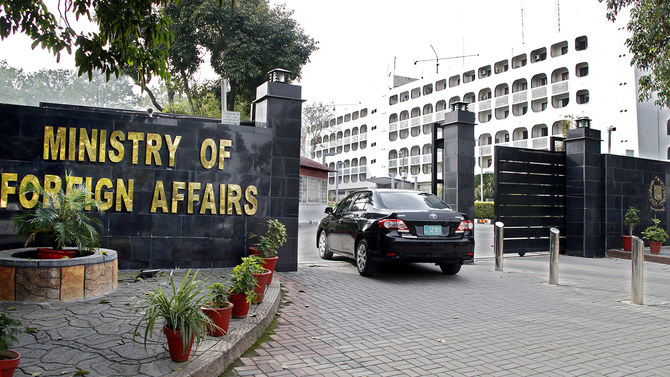
This photograph taken on Jan. 22, 2020, shows the premises of Ministry of Foreign Affairs in Islamabad. (AN photo)
Short Url
Updated 15 October 2020
Follow

Lahore High Court summons foreign office over Pakistanis imprisoned in Iran

  • 174 Pakistanis currently detained in Iran, 75% of them on charges of drug-trafficking
  • “These are Pakistani citizens and information about them cannot be withheld,” Justice Waheed says

ISLAMABAD: Lahore High Court Justice Shahid Waheed this week ordered the Pakistan Foreign Office to submit a list of Pakistanis imprisoned in Iran and for a relevant officer to appear in person before the court on the next hearing.   

Barrister Sarah Belal informed the court that according to the government, there were 174 Pakistanis currently detained in Iran, 75% of them on charges of drug-trafficking. She added that in 2017 Iran passed a law that enabled prisoners sentenced to death for narcotics offenses to have their sentences commuted to life imprisonment.

“The Iranian Courts will not review the death sentences automatically. Instead, the Government of Pakistan will have to ensure effective representation of its citizens before the concerned judicial authority,” Belal said, adding that it was the Pakistani government’s duty under the constitution to protect its citizens wherever in the world they may be.

“These are Pakistani citizens and the information about them cannot be withheld,” Justice Waheed said while hearing the petition filed by Justice Project Pakistan on behalf of Pakistanis imprisoned in Iran for alleged drug offences. The case was last heard over two years ago during which Justice Waheed had admonished the federal government for seeking more time to submit details of Pakistanis on death row in Iran.

In 2012, the Lahore High Court had set a precedent in a petition filed by JPP by seeking details of Pakistanis detained in the now defunct Bagram air base-turned-prison in Afghanistan that eventually led to the repatriation of 43 Pakistanis.

Pakistanis in foreign jurisdictions are particularly vulnerable and therefore might not be able to file reviews themselves. Despite being informed of the Amendment and the urgent need to file reviews, the Ministry of Foreign Affairs and the Pakistani Embassy in Tehran have not provided updates on the steps taken to facilitate Pakistani prisoners entitled to relief, JPP said.

The former federal information minister Fawad Chaudhary in a press conference in September 2018 had stated that the matter of Pakistanis on Iran’s death row was discussed in detail with Iran’s foreign minister Jawad Zarif during his two-day visit to Pakistan. In June, the Iranian deputy minister for human rights announced that Tehran was willing to extradite 44 Pakistani prisoners on humanitarian grounds due to the COVID-19 outbreak but was awaiting a response from Pakistani authorities.

Ali Haider Habib, spokesperson of Justice Project Pakistan, added: “Consular access is a human right which imposes distinct but complementary obligations on both prosecuting and home states. The failure of the home state to provide adequate consular assistance amounts to a violation of its responsibility to protect the right to life. The Pakistani government must follow the honourable court’s directives to provide the relevant records and adhere to its constitutional responsibility towards these prisoners who are particularly vulnerable amid a pandemic that has already claimed hundreds of lives in the jails of Iran.”


Pakistan, China to sign multiple MoUs at major agriculture investment conference today

Updated 18 January 2026
Follow

Pakistan, China to sign multiple MoUs at major agriculture investment conference today

  • Hundreds of Chinese and Pakistani firms to attend Islamabad event
  • Conference seen as part of expanding CPEC ties into agriculture, trade

KARACHI: Islamabad and Beijing are set to sign multiple memorandums of understanding (MoUs) to boost agricultural investment and cooperation at a major conference taking place in the capital today, Monday, with hundreds of Chinese and Pakistani companies expected to participate.

The conference is being billed by Pakistan’s Ministry of National Food Security and Research as a platform for deepening bilateral agricultural ties and supporting broader economic engagement between the two countries.

“Multiple memorandums of understanding will be signed at the Pakistan–China Agricultural Conference,” the Ministry of National Food Security said in a statement. “115 Chinese and 165 Pakistani companies will participate.”

The conference reflects a growing emphasis on expanding Pakistan-China economic cooperation beyond the transport and energy foundations of the flagship China-Pakistan Economic Corridor (CPEC) into agriculture, industry and technology.

Under its first phase launched in 2015, CPEC, a core component of China’s Belt and Road Initiative, focused primarily on transportation infrastructure, energy generation and connectivity projects linking western China to the Arabian Sea via Pakistan. That phase included motorways, power plants and the development of the Gwadar Port in the country's southwest, aimed at helping Pakistan address chronic power shortages and enhance transport connectivity.

In recent years, both governments have formally moved toward a “CPEC 2.0” phase aimed at diversifying the corridor’s impact into areas such as special economic zones, innovation, digital cooperation and agriculture. Second-phase discussions have highlighted Pakistan’s goal of modernizing its agricultural sector, attracting Chinese technology and investment, and boosting export potential, with high-level talks taking place between planning officials and investors in Beijing.

Agri-sector cooperation has also seen practical collaboration, with joint initiatives examining technology transfer, export protocols and value-chain development, including partnerships in livestock, mechanization and horticulture.

Organizers say the Islamabad conference will bring together government policymakers, private sector investors, industry associations and multinational agribusiness firms from both nations. Discussions will center on investment opportunities, technology adoption, export expansion and building linkages with global buyers within the framework of Pakistan-China economic cooperation.