

Bangladesh PM urged to take action on rape cases

1 / 3
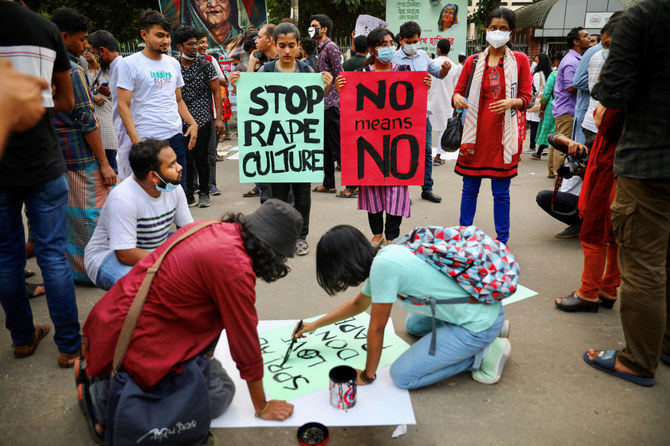
Students and activists prepare placards as they take part in an ongoing protest in Dhaka on October 9, 2020 demanding justice for an alleged gang rape of a woman in Noakhali, Bangladesh. (Reuters)
2 / 3
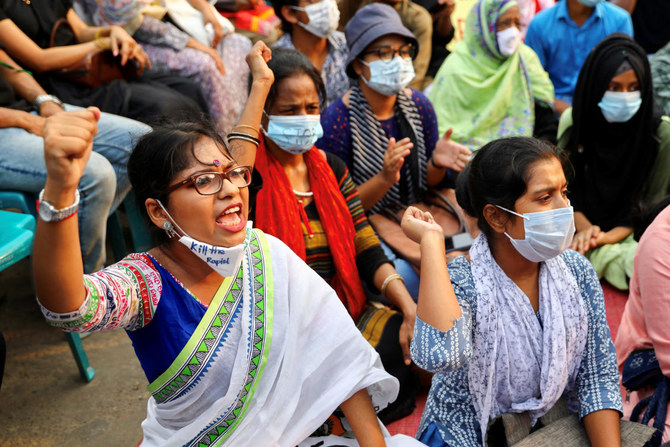
Students and activists prepare placards as they take part in an ongoing protest in Dhaka on October 9, 2020 demanding justice for an alleged gang rape of a woman in Noakhali, Bangladesh. (Reuters)
3 / 3
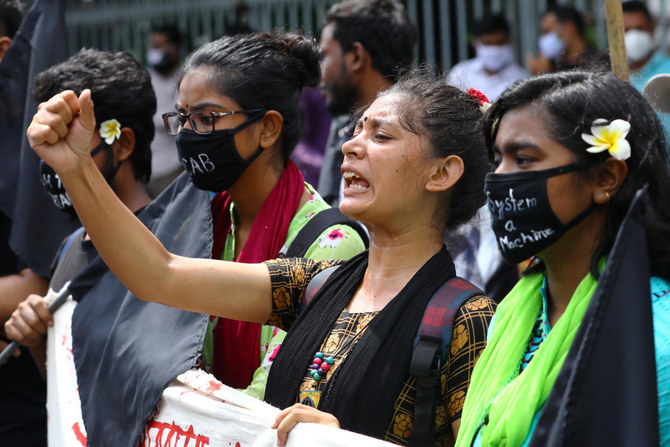
Students and activists prepare placards as they take part in an ongoing protest in Dhaka on October 6, 2020 demanding justice for an alleged gang rape of a woman in Noakhali, Bangladesh. (Reuters)
Short Url
Updated 09 October 2020
Follow

Bangladesh PM urged to take action on rape cases

  • 975 women were raped between January and September this year, with 208 of those subjected to gang rape
  • Forty-five women were killed after being assaulted, while 12 were reported to have killed themselves

DHAKA: There were protests in Bangladesh on Wednesday against recent incidents of rape and sexual violence, with some demonstrators demanding that the prime minister introduce the death penalty for convicted rapists.

According to data from the human rights group Ain O Salish Kendro, 975 women were raped between January and September this year, with 208 of those subjected to gang rape. Forty-five women were killed after being assaulted, while 12 were reported to have killed themselves.

“It's happening due to the existing system of lawlessness in society,” Asmani Asha, a spokesperson for the civil society group Bangladesh Against Rape (BAR), told Arab News. “The whole system in the country needs an overhaul to ensure a safe environment for women.” 

The protests followed two gang-rapes in the country’s Noakhali and Sylhet districts.

In the first case, which took place on Sept. 2, the victim was attacked at her home. The perpetrators filmed the assault and shared it on social media. There have been six arrests in Noakhali so far.

On Sept. 25, a woman who was with her husband at a college campus in Sylhet city was abducted and gang raped in a dormitory. Police have arrested six people, who are reported to be student leaders in the ruling Awami League (AL) party headed by Prime Minister Sheikh Hasina.

“The ruling party’s activists were found accused in connection with rape incidents, and many cases didn't come under the purview of legal systems. Our prime minister is a woman too. So we expect a bold initiative from her to protect the women of the country," Asha added, demanding the death sentence for the perpetrators. “Our protests will continue until the demands are met."

There is no provision for the death penalty for sex-related crimes in Bangladesh, and individuals are sentenced to life imprisonment if convicted. 

The government has pledged to bring all perpetrators to justice “irrespective of their political and social affiliations.” 

Officials on Wednesday expressed their solidarity with the victims.

“I am very saddened over the recent rape and violence incidents in the country … I express my solidarity with the protesters and personally believe that the culprits should be awarded capital punishment," Fazilatun Nessa Indira, minister for women and children affairs, told Arab News. She urged Bangladeshis to “boycott” the rapists.

“A pervert mindset instigates people in such heinous misdeeds. Our law enforcement agencies are working relentlessly to prevent the miscreants. Our parents should be more caring to teach children about morality and they should be more vigilant about their children's movement and activities.”

AL general secretary and government minister Obaidul Quader urged people to be patient and to inform authorities about any incidents of violence against women.

“I will tell everyone to be patient, no need to protest,” he told a party meeting on Tuesday. “The government is not releasing anyone involved. That is why the government is bringing the perpetrators to justice to solve the problem.”

But rights groups are pushing for the Women and Children Repression Act to be revised and for authorities to make necessary amendments so that perpetrators cannot exploit loopholes to evade justice. 

“We need to see the whole situation from a holistic approach,” rights activist Khushi Kabir told Arab News. “The authorities in charge should keep in mind that their duty is to serve the state, not any political party.”

She said that the government alone could not stop violence against women, and that authorities should call for social unity to make people aware of crimes against women.  

Sheikh Hafizur Rahman Karzon, a law professor at Dhaka University, said there needed to be a change in the existing trial process for rape cases.

“In some cases, the laws are not women-friendly,” he added. “The victims have to face another round of embarrassment during the trials.”

Loopholes in the legal process meant that 3 percent of rape cases tried in court resulted in convictions. 

“If we don't change the procedures, we can't ensure justice for the victims.”


Filmmakers defend Berlin festival chief in Gaza row

Updated 44 min 22 sec ago
Follow

Filmmakers defend Berlin festival chief in Gaza row

  • Actors and filmmakers rushed to defend the head of the Berlin film festival Thursday following a media report that her job was on the line over a director’s anti-Israel speech at the event

BERLIN: Actors and filmmakers rushed to defend the head of the Berlin film festival Thursday following a media report that her job was on the line over a director’s anti-Israel speech at the event.
Syrian-Palestinian filmmaker Abdallah Al-Khatib kicked off a controversy during Saturday’s closing ceremony by accusing Germany of being complicit in genocide in Gaza through its support for Israel.
German tabloid Bild had reported that Tricia Tuttle was due to be dismissed at an emergency meeting on Thursday, citing sources close to state-owned KBB, the company that runs the festival.
Culture minister Wolfram Weimer’s office confirmed the meeting had taken place but made no mention of Tuttle being sacked, stating that discussions had been “constructive and open” and would “continue in the coming days.”
A group of cinema luminaries including Tilda Swinton, Todd Haynes, Sean Baker and Tom Tykwer signed an open letter defending the Berlinale as a forum for free expression.
“As filmmakers in Germany and beyond, we are following the debates surrounding the Berlinale and the discussion about the dismissal of Tricia Tuttle with great concern,” they wrote. “We defend the Berlinale for what it is: a place of exchange.”
Angry rows over the Israel-Palestinian conflict have repeatedly rocked the Berlinale, held every February as Europe’s first major film festival of the year.
Environment Minister Carsten Schneider walked out of Saturday’s closing ceremony, labelling Khatib’s remarks “unacceptable.”
Germany, as it has sought to atone for the horrors of the Holocaust, has been a steadfast supporter of Israel, and criticism of Israel’s conduct in Gaza has been more muted than in many other countries.
Conservative lawmaker Ellen Demuth was among those who condemned the “antisemitic incident” at the awards ceremony and urged “a fresh start at the top of the film festival.”
The Berlinale Team in an Instagram post meanwhile defended Tuttle, praising her “clarity, integrity and artistic vision.”
The writers’ association PEN Berlin said Khatib’s comments were protected by freedom of expression and that if Tuttle were to be sacked over them, it would cause “immense damage” to the festival.
“Such wanton destruction of the German cultural scene, such self-inflicted insularity, must not be allowed to happen,” it said.
The backdrop of the Middle East conflict led to a tense 76th edition of the festival from the start.
More than 80 film professionals criticized the Berlinale’s “silence” on the Gaza war in an open letter, accusing the festival of censoring artists “who reject the genocide” they believe Israel has committed in Gaza.
Award-winning Indian writer Arundhati Roy withdrew from the festival after the jury president, German director Wim Wenders, said cinema should “stay out of politics” when asked about Gaza.