

Bangladesh PM urged to take action on rape cases

1 / 3
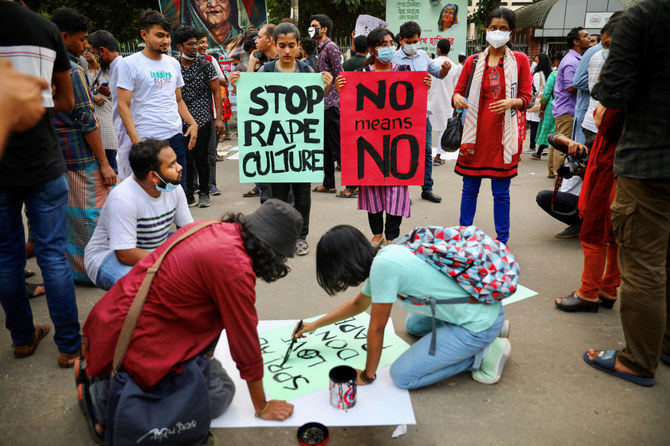
Students and activists prepare placards as they take part in an ongoing protest in Dhaka on October 9, 2020 demanding justice for an alleged gang rape of a woman in Noakhali, Bangladesh. (Reuters)
2 / 3
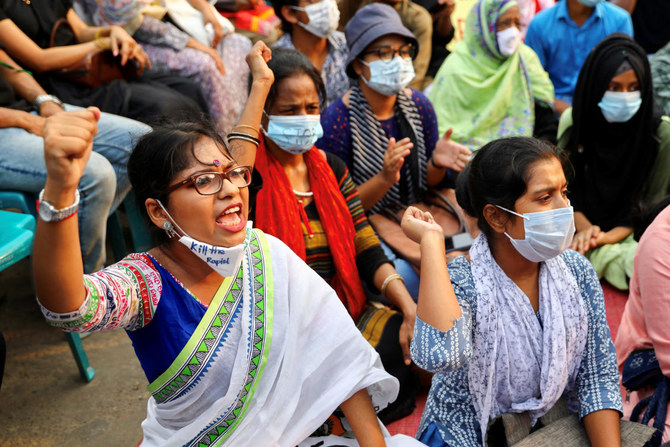
Students and activists prepare placards as they take part in an ongoing protest in Dhaka on October 9, 2020 demanding justice for an alleged gang rape of a woman in Noakhali, Bangladesh. (Reuters)
3 / 3
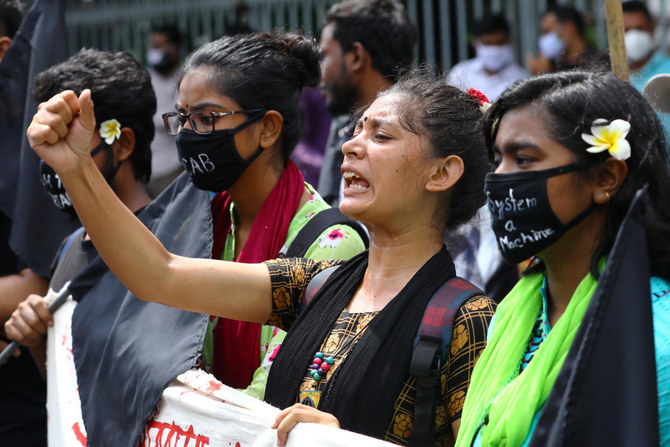
Students and activists prepare placards as they take part in an ongoing protest in Dhaka on October 6, 2020 demanding justice for an alleged gang rape of a woman in Noakhali, Bangladesh. (Reuters)
Short Url
Updated 09 October 2020
Follow

Bangladesh PM urged to take action on rape cases

  • 975 women were raped between January and September this year, with 208 of those subjected to gang rape
  • Forty-five women were killed after being assaulted, while 12 were reported to have killed themselves

DHAKA: There were protests in Bangladesh on Wednesday against recent incidents of rape and sexual violence, with some demonstrators demanding that the prime minister introduce the death penalty for convicted rapists.

According to data from the human rights group Ain O Salish Kendro, 975 women were raped between January and September this year, with 208 of those subjected to gang rape. Forty-five women were killed after being assaulted, while 12 were reported to have killed themselves.

“It's happening due to the existing system of lawlessness in society,” Asmani Asha, a spokesperson for the civil society group Bangladesh Against Rape (BAR), told Arab News. “The whole system in the country needs an overhaul to ensure a safe environment for women.” 

The protests followed two gang-rapes in the country’s Noakhali and Sylhet districts.

In the first case, which took place on Sept. 2, the victim was attacked at her home. The perpetrators filmed the assault and shared it on social media. There have been six arrests in Noakhali so far.

On Sept. 25, a woman who was with her husband at a college campus in Sylhet city was abducted and gang raped in a dormitory. Police have arrested six people, who are reported to be student leaders in the ruling Awami League (AL) party headed by Prime Minister Sheikh Hasina.

“The ruling party’s activists were found accused in connection with rape incidents, and many cases didn't come under the purview of legal systems. Our prime minister is a woman too. So we expect a bold initiative from her to protect the women of the country," Asha added, demanding the death sentence for the perpetrators. “Our protests will continue until the demands are met."

There is no provision for the death penalty for sex-related crimes in Bangladesh, and individuals are sentenced to life imprisonment if convicted. 

The government has pledged to bring all perpetrators to justice “irrespective of their political and social affiliations.” 

Officials on Wednesday expressed their solidarity with the victims.

“I am very saddened over the recent rape and violence incidents in the country … I express my solidarity with the protesters and personally believe that the culprits should be awarded capital punishment," Fazilatun Nessa Indira, minister for women and children affairs, told Arab News. She urged Bangladeshis to “boycott” the rapists.

“A pervert mindset instigates people in such heinous misdeeds. Our law enforcement agencies are working relentlessly to prevent the miscreants. Our parents should be more caring to teach children about morality and they should be more vigilant about their children's movement and activities.”

AL general secretary and government minister Obaidul Quader urged people to be patient and to inform authorities about any incidents of violence against women.

“I will tell everyone to be patient, no need to protest,” he told a party meeting on Tuesday. “The government is not releasing anyone involved. That is why the government is bringing the perpetrators to justice to solve the problem.”

But rights groups are pushing for the Women and Children Repression Act to be revised and for authorities to make necessary amendments so that perpetrators cannot exploit loopholes to evade justice. 

“We need to see the whole situation from a holistic approach,” rights activist Khushi Kabir told Arab News. “The authorities in charge should keep in mind that their duty is to serve the state, not any political party.”

She said that the government alone could not stop violence against women, and that authorities should call for social unity to make people aware of crimes against women.  

Sheikh Hafizur Rahman Karzon, a law professor at Dhaka University, said there needed to be a change in the existing trial process for rape cases.

“In some cases, the laws are not women-friendly,” he added. “The victims have to face another round of embarrassment during the trials.”

Loopholes in the legal process meant that 3 percent of rape cases tried in court resulted in convictions. 

“If we don't change the procedures, we can't ensure justice for the victims.”


After accepting US deportees, South Sudan wanted sanctions relief for top official, documents show

Updated 1 sec ago
Follow

After accepting US deportees, South Sudan wanted sanctions relief for top official, documents show

JUBA: After agreeing to accept deportees from the United States last year, South Sudan sent a list of requests to Washington that included American support for the prosecution of an opposition leader and sanctions relief for a senior official accused of diverting over a billion dollars in public funds.
The requests, contained in a pair of diplomatic communications made public by the State Department this month, offer a glimpse into the kind of benefits that some governments may have sought as they negotiated with the US over the matter of receiving deportees.
In the documents, the US expresses “appreciation” to South Sudan for accepting the deportees and details the names, nationalities and crimes for which each individual was convicted.
In July, South Sudan became the first African country to receive third-country deportees from the US Rwanda, Eswatini, Ghana and Equatorial Guinea have since received deportees.
The eight deportees to South Sudan included nationals of Mexico, Cuba, Vietnam, Laos, Myanmar and South Sudan itself.
Contentious deportations
They arrived in the South Sudanese capital of Juba after spending weeks on a US military base in Djibouti, where they were held after a US court temporarily blocked their deportation. Six of the eight men remain at a residential facility in Juba under the supervision of security personnel.
South Sudanese national Dian Peter Domach was later freed, according to the Ministry of Foreign Affairs, while Jesus Munoz-Gutierrez, a Mexican, was repatriated in September.
South Sudanese officials have not publicly said what long-term plan is in place for those still in custody. The third-country deportations were highly contentious, criticized by rights groups and others who expressed concern South Sudan would become a dumping ground.
Details of the deal between the US and South Sudan remain murky. It is still unclear what, if anything, South Sudan may have actually received or been promised. The documents only offer a glimpse into what the South Sudanese government hoped to get in return.
In other cases, Human Rights Watch said it saw documents showing the US agreed to pay Rwanda’s government around $7.5 million to take up to 250 deportees. The US will give Eswatini $5.1 million to take up to 160 deportees, according to the group.
For South Sudan, in one communication dated May 12 and marked confidential, South Sudan’s Ministry of Foreign Affairs raised eight “matters of concern which the Government of South Sudan believes merit consideration.” These ranged from the easing of visa restrictions for South Sudanese nationals to the construction of a rehabilitation center and “support in addressing the problem of armed civilians.”
Request to lift sanctions
But an eye-catching ask was for the lifting of US sanctions against former Vice President Benjamin Bol Mel as well as Washington’s support for the prosecution of opposition leader Riek Machar, the now-suspended first vice president of South Sudan who faces treason, murder and other criminal charges in a controversial case.
The allegations against Machar stem from a violent incident in March, when an armed militia with historical ties to him attacked a garrison of government troops. Machar’s supporters and some activists describe the charges as politically motivated.
Bol Mel is accused of diverting more than a billion dollars earmarked for infrastructure projects into companies he owns or controls, according to a UN report. He wielded vast influence in the government and was touted by some as Kiir’s likely successor in the presidency until he was dismissed and placed under house arrest in November.
Bol Mel was also viewed as a key figure behind the prosecution of Machar, one of the historical leaders of South Sudan’s ultimately successful quest for independence from Sudan in 2011.
Machar was Kiir’s deputy when they fell out in 2013, provoking the start of civil war as government troops loyal to Kiir fought forces loyal to Machar.
A 2018 peace agreement brought Machar back into government as the most senior of five vice presidents. His prosecution has been widely criticized as a violation of that agreement, and has coincided with a spike in violence that the UN says killed more than 1,800 people between January and September 2025.
The UN has also warned that a resurgence of fighting has brought the country “back to the edge of a relapse into civil war.” Machar is under house arrest in Juba while his criminal trial proceeds slowly.
In its communications with the US, South Sudan also asked for sanctions to be lifted over South Sudanese oil companies “to encourage direct foreign investments,” and for the US to consider investing in other sectors including fossil fuels, minerals and agriculture.
When asked if the US government had provided or promised South Sudan anything in return for accepting the deportees, a State Department official said, “In keeping with standard diplomatic practice, we do not disclose the details of private discussions.”
A spokesman for South Sudan’s Ministry of Foreign Affairs, Thomas Kenneth Elisapana, declined to comment.
US aid cuts
Despite accepting the US request to admit deportees, relations between the two governments have been strained in recent months.
In December, the US threatened to reduce aid contributions to the country, accusing the government of imposing fees on aid groups and obstructing their operations.
The US has historically been one of the largest donors to South Sudan, providing roughly $9.5 billion in aid since 2011. Over the years, South Sudan’s government has struggled to deliver many of the basic services of a state, and years of conflict have left the country heavily reliant on foreign aid.