

Study: Europe oil majors fall short of UN climate goals

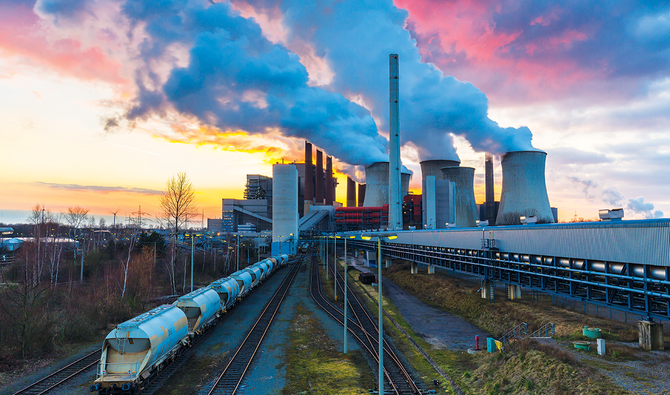
None of Europe’s major oil companies are on course to meet the Paris Agreement’s goals on limiting global warming, according to the TPI study. (Shutterstock)
Short Url
Updated 08 October 2020
Follow

Study: Europe oil majors fall short of UN climate goals

  • BP and Royal Dutch Shell named among 59 firms not meeting conditions set in Paris Agreement

LONDON: Europe’s top oil companies are not yet aligned with UN-backed targets to combat climate change despite their plans to slash carbon emissions and pivot to renewable energy, a report from major investors has found.

The study by the Transition Pathway Initiative (TPI), which unites investors with $22 trillion in holdings, comes as shares of European energy companies including BP and Royal Dutch Shell have struggled amid concerns over their ability to successfully shift away from oil and gas.

TPI’s analysis of 59 major oil, gas and coal companies said that seven European firms — Glencore, Anglo American, Shell, Repsol, Total, Eni and Equinor — have set out plans to align with long-term pledges made by some governments to cut greenhouse gas emissions.

But those targets equate to global temperatures rising by 3.2 degrees and are “widely regarded as insufficient to avert dangerous climate change,” the report said.

No company would meet the UN-backed Paris Agreement’s goal of limiting global warming to “well below” 2 degrees Celsius above pre-industrial levels by cutting emissions to net zero.

Several of the firms said in statements that they disagreed with the way TPI calculates the alignment, based on fuels’ carbon intensity.

“We’re very happy that some oil and gas companies are seeing these fundamental changes and trying to respond,” said Bill Hartnett, stewardship director of ESG Investment at Aberdeen Standard Investments, a TPI member.

“Some (companies) might have made bigger statements so far than the others and the important thing is the direction of travel. But none of them are making net zero yet.”

BP, whose CEO Bernard Looney plans to grow the company’s renewables business twenty-fold by the end of the decade, is the least aligned among the European companies, not even meeting the government pledges level, according to the report.

BP said in response that it disagreed with TPI’s focus on carbon intensity, which it said was not “a reliable measure.”

Fossil fuels are the main cause of greenhouse gas emissions.

Investors such as Aberdeen are regularly talking to companies about their Paris Agreement alignment on issues including emissions from fuels sold, known as Scope 3 emissions, and their memberships in energy associations around the world, Hartnett said.

“Engagement is ongoing and there is pretty good momentum on getting toward Paris alignment.”

A Shell spokeswoman said the company continues “to engage with TPI over their methodology” to show it is how it is aligned with “society’s move toward” the Paris goals.

Anglo American said in a statement: “achieving these targets is not all within our control, so we are working with governments, industry peers and civil society.”

Repsol said: “We will continue to engage with TPI to demonstrate our progress in this respect.”

Eni said: “We consider the best way for companies to align with such goals is to set absolute emissions targets.”

Total, which aims to be carbon neutral in Europe by 2050, said in a statement that the rhythm of the transition will depend on energy demand and policies put in place.


Over 150 Chinese investors seek Saudi partnerships in petrochemicals, plastics, and printing

Updated 6 sec ago
Follow

Over 150 Chinese investors seek Saudi partnerships in petrochemicals, plastics, and printing

RIYADH: More than 150 Chinese investors in the petrochemicals, plastics, and printing sectors are seeking strategic partnership opportunities with their Saudi counterparts, aiming to localize specialized industries and boost investment flows.

Over three days, Dammam is hosting a new edition of the Gulf 4P International Exhibition for Plastics, Printing, Packaging, and Petrochemicals at the Dhahran International Exhibitions Center. The exhibition continues its position as one of the largest specialized industrial and commercial platforms in the region, according to Al-Eqtisadiah. 

Following the exhibition’s inauguration, Hamad Homoud Al-Hammad, chairman of the National Contracting Committee at the Federation of Saudi Chambers, stated: “Through strategic support, the availability of raw materials, and the existence of infrastructure, Saudi Arabia has managed to become the largest plastic industry in the Middle East, supported by a consumer base both domestically and externally.”

Al-Hammad explained that estimates indicate that demand for plastic products is set to grow by more than $3 billion in the coming years, opening wide horizons for promising investment opportunities. 

He pointed out that the exhibition represents an opportunity for suppliers, investors, and manufacturers to gather to enhance partnership opportunities and exchange knowledge and technology, thanks to the broad participation from international and local companies. 

The exhibition also contributes to cementing Saudi Arabia’s position as a globally attractive destination for advanced industries, especially in the plastics, printing, and petrochemicals sectors.

Significant growth in sector-related markets

For his part, ‏Mshari Al-Kuwaiflie, Regional Director of MIE Events, the exhibition organizer, told Al-Eqtisadiah that the Chinese companies and factories participating in the exhibition are opening wide horizons for Saudi investors to build commercial and investment partnerships. 

They will be able to learn about the latest technologies in packaging, printing, plastic manufacturing, and petrochemicals, especially since the market in the Kingdom is witnessing accelerated growth in these sectors.

He clarified that the value of the packaging market in Saudi Arabia exceeded $2 billion in 2021, with expectations to reach $2.6 billion by 2027.

According to estimates from exhibition participants, the plastic packaging market is estimated at about $8.59 billion in 2025, poised to rise to more than $10 billion by 2030. The value of the printing market in 2023 reached about $1.435 billion, with expectations to exceed $1.871 billion by 2030.

‏Al-Kuwaiflie said: “The numbers demonstrate that there are promising and available investment opportunities that can form a solid foundation for launching commercial and investment partnerships between the participating Chinese companies and factories and Saudi companies, especially in sectors related to transformative industries amid a broad industrial transformation witnessed by Saudi Arabia, which is the largest in the Gulf in the printing, packaging, and plastics sectors.”

An international platform for manufacturers and suppliers

The exhibition, which witnessed participation from factories from Turkiye, India, and other countries, offers extensive displays of the latest industrial innovations and technologies in petrochemicals, plastics, and packaging, in addition to industrial equipment, construction and building sectors, and conditioning systems.

The exhibition’s program also includes business sessions and direct meetings between companies, buyers, and decision-makers, along with a dedicated B2B platform for coordinating meetings between investors and exhibitors.

This is with the participation of trade delegations from Saudi Arabia, the Gulf, Asia, and Europe, aiming to build new international partnerships that contribute to enhancing a diversified economy based on knowledge and modern technologies, in line with the objectives of Saudi Vision 2030.