

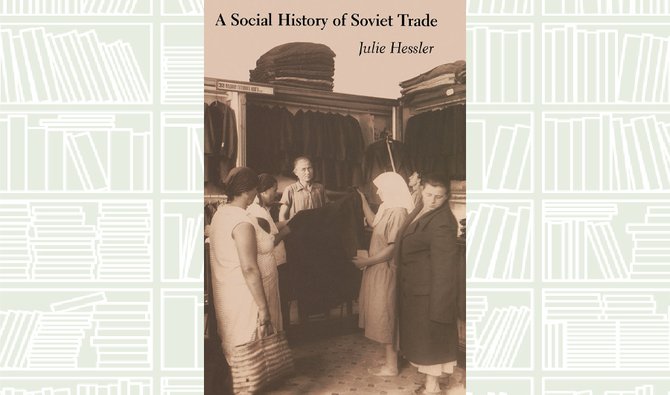
What We Are Reading Today: A Social History of Soviet Trade by Julie Hessler

Short Url
Updated 07 October 2020
Follow

What We Are Reading Today: A Social History of Soviet Trade by Julie Hessler

In this sweeping study, Julie Hessler traces the invention and evolution of socialist trade, the progressive constriction of private trade, and the development of consumer habits from the 1917 revolution to Stalin’s death in 1953. The book places trade and consumption in the context of debilitating economic crises. Although Soviet leaders, and above all, Stalin, identified socialism with the modernization of retailing and the elimination of most private transactions, these goals conflicted with the economic dynamics that produced shortages and with the government’s bureaucratic, repressive, and socially discriminatory political culture.

A Social History of Soviet Trade explores the relationship of trade — official and unofficial — to the cyclical pattern of crisis and normalization that resulted from these tensions. It also provides a singularly detailed look at private shops during the years of the New Economic Policy, and at the remnants of private trade, mostly concentrated at the outdoor bazaars, in subsequent years.

Drawing on newly opened archives in Moscow and several provinces, this richly documented work offers a new perspective on the social, economic, and political history of the formative decades of the USSR.


Book Review: ‘The Alchemist’ by Paulo Coelho

Updated 21 January 2026
Follow

Book Review: ‘The Alchemist’ by Paulo Coelho

I first picked up “The Alchemist” at a time when I felt restless; not unhappy but unsettled, with the quiet sense that I was meant for something more than routine and familiarity.

From the very first pages, Paulo Coelho’s novel felt less like a story I was reading and more like one that spoke to me gently.

The book follows Santiago, a young shepherd who dares to leave behind what is comfortable in search of a dream he cannot ignore. His journey across unfamiliar lands mirrors the internal journey many of us experience but rarely act on.

I found myself reflecting on my own hesitations, the dreams I had postponed, and the fears I had allowed to guide my decisions. 

What struck me most about “The Alchemist” was its simplicity. Coelho’s writing is clear and almost meditative, yet the ideas carry emotional weight.

The concept of a “personal legend” stayed with me long after I finished the book. It made me question whether I was truly listening to my own desires or simply following the path that felt safest. 

There were moments while reading when certain lines felt uncomfortably accurate, as if the book was holding up a mirror. It reminded me how easy it is to convince ourselves that timing is wrong, that circumstances are not ideal, or that dreams can wait. Coelho challenges that thinking, suggesting that the real risk lies in never trying at all. 

While some may find the book idealistic, I found comfort in its optimism. “The Alchemist” does not promise success without struggle, but it reframes setbacks as part of the journey rather than signs of failure. That perspective felt reassuring and grounding. 

By the time I reached the final pages, I did not feel like I had found all the answers, but I did feel more aware. “The Alchemist” encouraged me to trust my instincts, accept uncertainty and believe that ambition does not need justification.

For anyone who senses there is more waiting beyond fear and familiarity, this book has the power to gently shift how you see your own path.