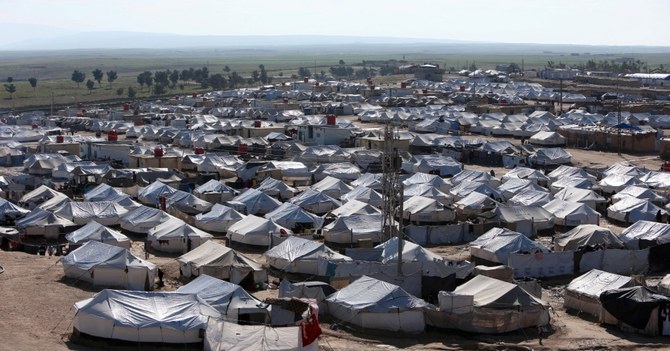

ANKARA: The Kurdish-led Syrian Democratic Council administration of Raqqa announced on Monday its decision to release all Syrians from the northeastern Al-Hol detention camp, where thousands of Daesh families, including wives and children of Daesh fighters, are being kept.
The move is likely to further undermine the regional security, with rising fears that a significant number of Daesh-affiliated detainees may infiltrate the borders of neighboring countries.
The looming specter of Daesh has emerged in Turkey recently, and the country began the week with a massive anti-terror operation in capital Ankara.
Twenty-four Iraqi nationals and one Finnish suspect were arrested over supposed links to Daesh members in conflict zones.
Since August, dozens of Daesh suspects have been arrested in different cities across Turkey, showing that the group is still active in the country, with reported plans to attack on tourists, politicians and prominent figures.
Dareen Khalifa, a senior analyst at the International Crisis Group, said that a blanket amnesty for all Syrian residents of Al-Hol could be detrimental to the security of the area.
“Their release will require the kind of support the Syrian Democratic Forces (SDF) simply cannot and should not bear on its own. The SDF’s capacity to detain or manage the reintegration of thousands of detainees is waning,” she told Arab News.
“Both the ideologues and the victims require currently unavailable social or mental health support, and labour market integration,” Khalifa added.
Two weeks ago, Turkish police detained 16 foreign nationals in Ankara and five others in the southern province of Adana, some of them Iraqi nationals, under another counter-terrorism operation against Daesh.
These operations followed others during previous weeks in several other cities.
According to the testimony of those arrested in Adana, they were planning to kidnap prosecutors, judges and tourist groups to trade in return for Daesh captives in Iraq and Syria.
Turkey also captured the group’s “Turkish emir,” Mahmut Ozden, in August before he could carry out attacks on Hagia Sophia, in Istanbul, and prominent figures in Turkey, including politicians and civil society activists. Daesh’s head in Turkey’s southeastern Diyarbakir province was also caught in early September.
Turkey foiled 152 Daesh terror attacks in 2020, according to Interior Ministry data.
Mehmet Emin Cengiz, a research assistant at Al-Sharq Strategic Research, said Al-Hol served as a radicalization school for many families of Daesh members, where women in particular play a role in indoctrinating other inmates.
These fanatical women, known as “Daesh enforcers,” have killed and wounded others in the camp by throwing rocks or setting their tents on fire for turning their backs on Daesh. The climate of fear is believed to have resulted in psychological trauma among the many children of Daesh members being kept there.
“Around 70,000 people are believed to live in this camp. The administration of the Syrian Democratic Council might have taken this decision to broker a deal with the Arab tribes in the region because the tribes were asking for the release of some captives, and such a move could earn the support of the tribes for the Syrian Kurds in the region,” Cengiz told Arab News.
He also noted that Daesh had been trying to re-establish itself in Syria and Iraq ever since the loss of its territorial gains.
Vyacheslav Gladkikh, a Russian major general, was killed, reportedly by Daesh, in late August in a roadside bomb in the Syrian city of Deir Ez-Zor.
“It is also likely that they (Daesh) are planning to act within Turkey’s territories to show that they are still alive and robust,” he said.
Research published in July by Kings College London’s Defence Studies Department cautioned that Daesh fighters, once freed, were regrouping in other parts of the world, posing a major security risk.