

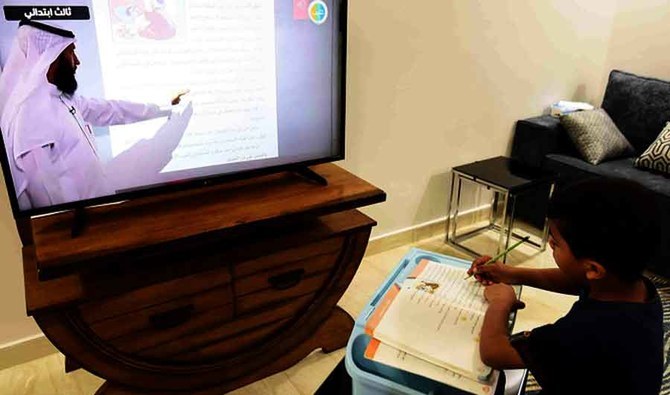

JEDDAH: Parents of school-age children in the Kingdom are anxiously waiting for the news about the reopening of schools as many of them are concerned about the upcoming flu season and the ongoing coronavirus disease (COVID-19) pandemic.
Saudi Minister of Education Dr. Hamad bin Mohammed Al-Sheikh said his ministry evaluated the remote educational process after 5 weeks of its implementation since the beginning of the school year and submitted the results to the higher authorities and the Health Ministry to decide whether to return to traditional schooling or continue with distance learning.
The school year in the Kingdom began on Aug. 30. Due to the pandemic, classes are being held online to ensure social distancing and curb the spread of the virus.
The wait is keeping parents on their toes as many have already adjusted to home schooling their children and are now afraid of what to expect next especially given the rise in cases after the resumption of schools in the UK, US and other countries.
According to Al-Sheikh, distance learning has now become a strategic option for the future, requiring continuous development.
Some parents believe that classroom learning is more effective, but they are reluctant to send their children back to schools for fear they might contract COVID-19.
“I am hesitant to have them go back to school. In the classroom, they focus better and absorb more information. At the same time, I’m scared because children’s immune systems are weak and still developing, so they contract viruses quickly. I would prefer it if they continue this semester electronically,” said Dina Al-Nahari, mother of two daughters aged 8 and 5.
Online learning carries some disadvantages, such as technical glitches, audiovisual problems or internet connectivity issues.
“It is a good platform, but there were a few shortcomings in certain classes. Some teachers rely on videos to give examples and when students have a question, sometimes the teacher cannot hear them,” Al-Nahari told Arab News.
“My daughters relied on me more to explain certain chapters. I would come home from work at 2:30 p.m. and immediately log onto the platform. The girls would mute their microphones to ask me what was being displayed, and I would explain it to them.”
Dr. Rafat Mosalli, an associate professor of pediatrics at Umm Al-Qura University, said there has not been any evidence that primary schools are the main source of COVID-19 infections in children.
He advised parents to tackle the issue calmly.
“School closures have had a negative impact on children’s health — their educational, physical, psychosocial and mental development — as well as on family wellness and the overall economy,” he told Arab News.
“As we enter the second semester (of online learning), children are psychologically accustomed to the house now,” said Mosalli.
“Children fear the image they have created in their minds about the virus, which they see as a monster. They are consumed by the idea that they might be harmed greatly by the virus. It is a global psychological problem.
“Whether a child can go back to school depends on their health condition, the current transmission rate of COVID-19 within our community, and the protective measures that schools, the health sector and the community have put in place to reduce the risk of transmission — all of which are very satisfactory,” he said.
“Children who are suffering from certain conditions such as asthma, obesity, cancer or premature babies with weak immune systems are at higher risk of developing severe diseases than children without other health conditions,” Mosalli said.
He said children under the age of 14 represent less than 8 percent of the reported cases worldwide, with fewer deaths.
“The symptoms are usually mild. We still need further international and national studies to better understand transmission of the virus in this age group,” Mosalli said.
While current evidence suggests the risk of complication and death in children is lower overall than for adults, special precautions still need be taken to minimize the risk of infection among children.
“The overall benefits of returning to school should also be considered,” Mosalli added.


