In plain sight: Blind Pakistani repairman keeps working against the odds

Zarnosh Khan, a blind repairman, fixes an electric motor in Qasbna Colony, Karachi, Pakistan on Octover 3, 2020. (AN photo)
Short Url
Updated 05 October 2020
Follow

In plain sight: Blind Pakistani repairman keeps working against the odds

  • Zarnosh, now in his thirties, experienced vision loss since birth but around ten years ago he lost his sight completely
  • Now he has to depend on friends and family to help him move around, but that hasn’t stopped him from carrying on with his work as a plumber and electrician 

KARACHI: Muhammad Zarnosh picks up his toolbox and reaches for his young son's hand, ready to leave home for the plumbing and electronic repairs shop where he works in an impoverished neighborhood in the Pakistani port city of Karachi. 
Zarnosh, now in his thirties, experienced gradual vision loss since birth but around ten years ago he lost his sight completely. Since then, he has had to depend on friends and family to help him move around, but that hasn’t stopped him from carrying on with his work as a repairman. 
Zarnosh learnt plumbing and electric repairs from his father as a teenager. When he became blind, he strived to continue his job even though it put him at risk
“It’s better to do work and labor to earn a livelihood for my children than to beg," he told Arab News in an interview in Karachi’s Qasba Colony area. “I am disabled but I am toiling for bread and butter. I have seen people who have no hands or legs but still do hard work. I believe that hard work is the right thing."
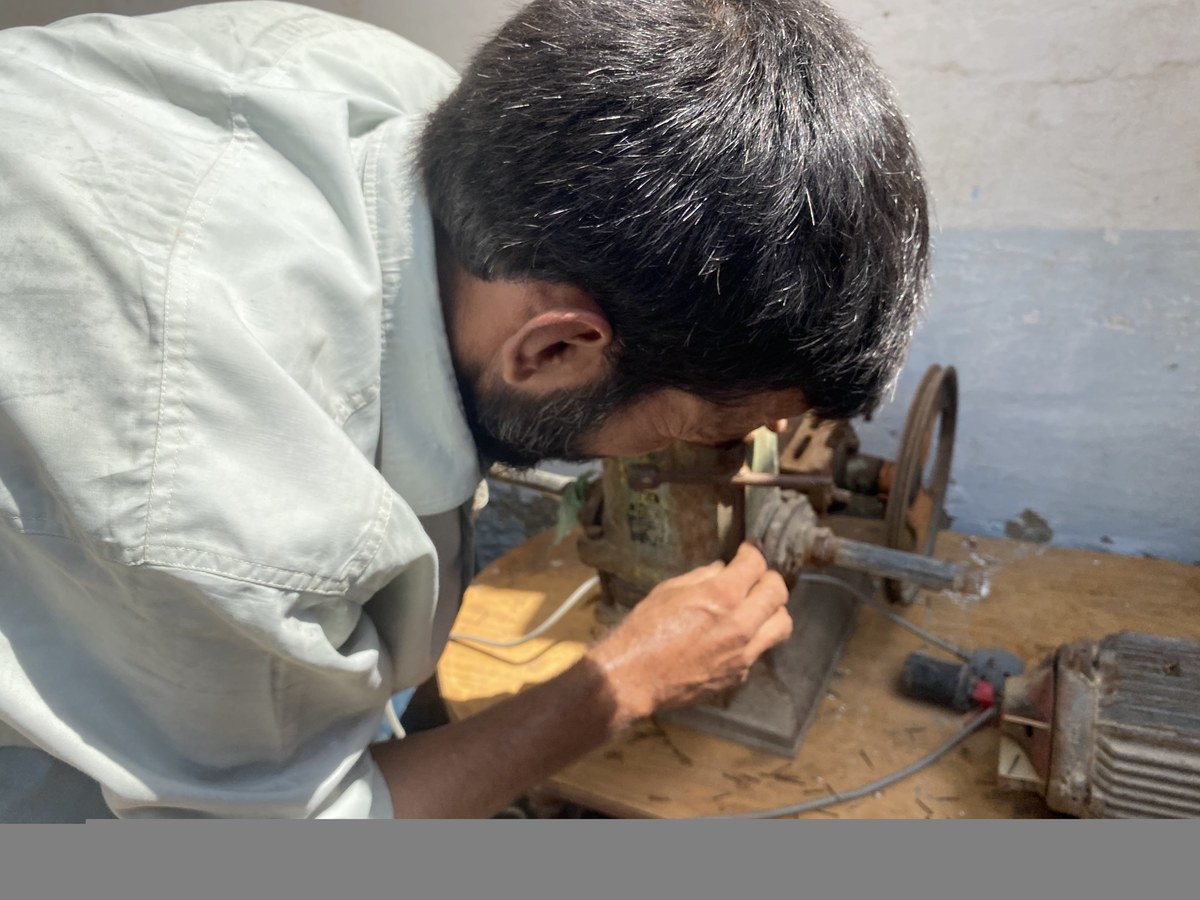


Blind repairman Zarnosh Khan fixes a water motor in Qasbna Colony, Karachi, Pakistan on October 3, 2020. (AN photo)

According to Human Rights Watch, estimates of the number of people living with disabilities in Pakistan wildly vary from 3.3 million to 27 million. Pakistan ratified the Convention on the Rights of Persons with Disabilities in 2011.
Last month, Pakistan passed a new disability law through a joint session of parliament, raising hopes that discrimination, especially in the workplace, against millions of Pakistanis could be curbed. 
While it remains to be seen how far the Pakistani state will implement the new law, Zarnosh said he was confident that despite his disability, he got the job done as well as any able-bodied repairman. Whoever called him for work once, he said, always called again. 
Speaking about the onset of blindness, Zarnosh said he initially had trouble seeing at night but then a decade ago “it also ended.”  
"Now, when I go for work, I have to take someone with me,” he said. Apart from needing someone to accompany him to work, there was also the added risk of accidental electrocution. 
"There are wires, these are burnt, they are mixed up,” Zarnosh said. “I take them out, separate them, some are cold and some hot. So many times, I got electric shocks.
“What can I do? What will I do, if not this? I have to do hard work. I haven’t learnt anything else,” he added. 
But Zarnosh said he never loses hope, despite the setbacks, or considers his ability a “difficulty”. After all, he has a family to provide for. 
“I couldn’t study. I learnt this skill. But I want my children to study, to join any office, join the army or police," he said. "The only difficulty I have is [providing for] the education of my children."  

Pakistan’s president condemns Kabul blast, accuses Taliban of allowing militant ‘safe havens’

Updated 12 sec ago
Follow

Pakistan’s president condemns Kabul blast, accuses Taliban of allowing militant ‘safe havens’

  • President Zardari links attack on Chinese-run restaurant to Kabul’s failure to meet Doha commitments
  • He highlights the ‘failure’ of Afghanistan’s Taliban to establish a ‘broad-based and inclusive government’

KARACHI: President Asif Ali Zardari on Monday condemned a blast that ripped through a Chinese-run restaurant in Kabul, killing at least seven people, while criticizing Afghanistan’s Taliban administration for allowing “safe havens” to militant groups to export extremist violence in the region.

The explosion struck the restaurant in Kabul’s Shahr-e-Naw commercial district, an area considered one of the safest in the Afghan capital, killing one Chinese national and six Afghans and wounding several others, including a child, according to Afghan authorities.

The Afghan affiliate of Daesh militant group claimed responsibility, saying the attack was carried out by a suicide bomber.

“The Taliban regime in Afghanistan has failed to honor the commitments made under the Doha Peace Agreement, particularly the obligation to prevent the use of Afghan soil for the export of terrorism,” Zardari said in a statement circulated by his office.

“Pakistan has repeatedly stressed that no terrorist groups should be allowed safe havens in Afghanistan and that regional peace and security must be upheld,” he continued, adding that “it is not just Pakistan but other neighbors of Afghanistan, including Tajikistan, [that] have recently been affected by the terrorists operating out of Afghan soil.”

Pakistan has frequently accused Afghanistan of sheltering proscribed armed factions such as the Tehreek-e-Taliban Pakistan and the Balochistan Liberation Army, and of facilitating attacks on Pakistani civilians and security forces, allegations the Taliban deny.

The two countries witnessed major border skirmishes in October last year, followed by talks mediated by Qatar and Türkiye.

Pakistan subsequently closed its border and suspended bilateral and transit trade with Afghanistan, a move that led to a 17% drop in “cross-border attacks,” according to the Center for Research and Security Studies.

Late November also saw a series of deadly incidents along the Tajikistan–Afghanistan border, with militants on the Afghan side firing across the frontier into Tajikistan, killing five Chinese workers employed on Chinese–Tajik mining and construction projects.

In December, Tajik border forces clashed with armed individuals who crossed from Afghanistan, killing several assailants but losing a border guard in the fighting.

Zardari paid tribute to Chinese nationals working in Afghanistan “despite rising insecurity” and expressed solidarity with the victims and their families, while reiterating calls for political reform in Kabul.

“The failure to establish a broad based and inclusive government by the Taliban is contrary to the Doha Agreement,” he said in the statement.