

In plain sight: Blind Pakistani repairman keeps working against the odds

Zarnosh Khan, a blind repairman, fixes an electric motor in Qasbna Colony, Karachi, Pakistan on Octover 3, 2020. (AN photo)
Short Url
Updated 05 October 2020
Follow

In plain sight: Blind Pakistani repairman keeps working against the odds

  • Zarnosh, now in his thirties, experienced vision loss since birth but around ten years ago he lost his sight completely
  • Now he has to depend on friends and family to help him move around, but that hasn’t stopped him from carrying on with his work as a plumber and electrician 

KARACHI: Muhammad Zarnosh picks up his toolbox and reaches for his young son's hand, ready to leave home for the plumbing and electronic repairs shop where he works in an impoverished neighborhood in the Pakistani port city of Karachi. 
Zarnosh, now in his thirties, experienced gradual vision loss since birth but around ten years ago he lost his sight completely. Since then, he has had to depend on friends and family to help him move around, but that hasn’t stopped him from carrying on with his work as a repairman. 
Zarnosh learnt plumbing and electric repairs from his father as a teenager. When he became blind, he strived to continue his job even though it put him at risk
“It’s better to do work and labor to earn a livelihood for my children than to beg," he told Arab News in an interview in Karachi’s Qasba Colony area. “I am disabled but I am toiling for bread and butter. I have seen people who have no hands or legs but still do hard work. I believe that hard work is the right thing."
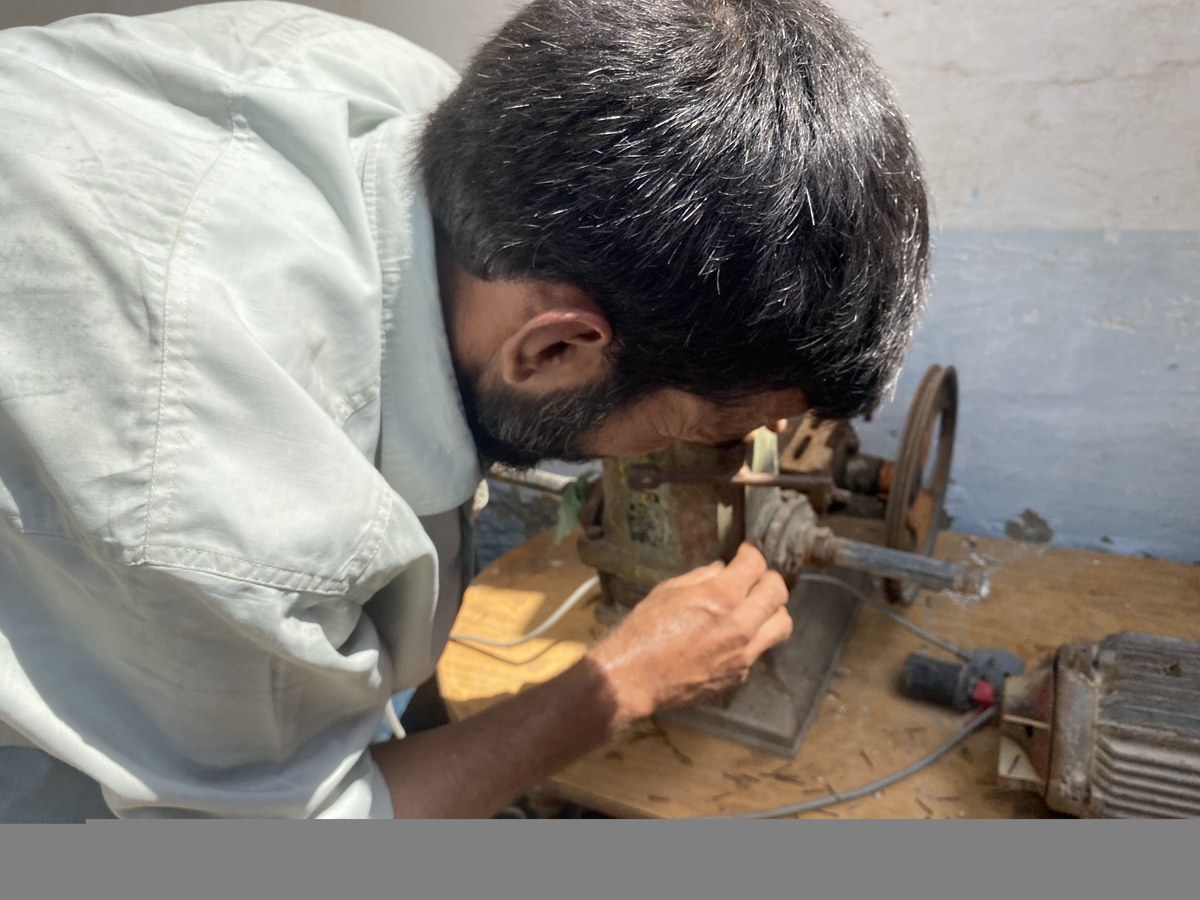


Blind repairman Zarnosh Khan fixes a water motor in Qasbna Colony, Karachi, Pakistan on October 3, 2020. (AN photo)

According to Human Rights Watch, estimates of the number of people living with disabilities in Pakistan wildly vary from 3.3 million to 27 million. Pakistan ratified the Convention on the Rights of Persons with Disabilities in 2011.
Last month, Pakistan passed a new disability law through a joint session of parliament, raising hopes that discrimination, especially in the workplace, against millions of Pakistanis could be curbed. 
While it remains to be seen how far the Pakistani state will implement the new law, Zarnosh said he was confident that despite his disability, he got the job done as well as any able-bodied repairman. Whoever called him for work once, he said, always called again. 
Speaking about the onset of blindness, Zarnosh said he initially had trouble seeing at night but then a decade ago “it also ended.”  
"Now, when I go for work, I have to take someone with me,” he said. Apart from needing someone to accompany him to work, there was also the added risk of accidental electrocution. 
"There are wires, these are burnt, they are mixed up,” Zarnosh said. “I take them out, separate them, some are cold and some hot. So many times, I got electric shocks.
“What can I do? What will I do, if not this? I have to do hard work. I haven’t learnt anything else,” he added. 
But Zarnosh said he never loses hope, despite the setbacks, or considers his ability a “difficulty”. After all, he has a family to provide for. 
“I couldn’t study. I learnt this skill. But I want my children to study, to join any office, join the army or police," he said. "The only difficulty I have is [providing for] the education of my children."  


Pakistan’s deputy PM visits Saudi Arabia for OIC meeting on West Bank

Updated 8 sec ago
Follow

Pakistan’s deputy PM visits Saudi Arabia for OIC meeting on West Bank

  • The session will review Israel’s land registration move in occupied territory
  • Dar will present Pakistan’s stance on Israel’s settlements, annexation plan

ISLAMABAD: Pakistan’s Deputy Prime Minister and Foreign Minister Ishaq Dar embarked on a three-day visit to Saudi Arabia on Thursday, where he is scheduled to attend an emergency meeting of the Organization of Islamic Cooperation (OIC) in Jeddah to discuss Israel’s recent measures in the occupied West Bank.

Israel decided this month to approve land registration procedures in parts of the West Bank for the first time since 1967, drawing sharp criticism from Muslim nations along with several European countries, which described it as a move to ease the path for settlement expansion and annexation.

These countries urged Israel in a joint statement to reverse its decision and end settler violence against Palestinian residents in the West Bank.

“Deputy Prime Minister/Foreign Minister Senator Mohammad Ishaq Dar @MIshaqDar60 has departed Islamabad for Saudi Arabia to attend the Open-Ended Extraordinary Ministerial Session of the Organization of Islamic Cooperation (#OIC) Executive Committee in Jeddah (26–28 February 2026),” the foreign office said in a social media post on X.

“He will hold sideline meetings with counterparts from OIC Member States,” it continued. “During the visit, he will also undertake brief visits to the Holy Cities.”

https://x.com/ForeignOfficePk/status/2026920463377830237?s=20

More than 500,000 Israelis live in settlements and outposts in the West Bank, excluding Israeli-annexed East Jerusalem, alongside nearly three million Palestinians.

Settlements are considered illegal under international law, a position Israel disputes.

Addressing a weekly media briefing during the day, Foreign Office Spokesperson Tahir Andrabi said the OIC conference would review Israel’s attempt to impose its sovereignty over the occupied West Bank.

“In the ministerial session of this OIC event, the Deputy Prime Minister and Foreign Minister will share Pakistan’s perspective on this latest illegal measure by Israel to convert areas of the occupied West Bank into the so-called state land,” he added.