STEPANAKERT, Azerbaijan: Armenian and Azerbaijani forces exchanged rocket fire as fighting intensified over Nagorno-Karabakh on Sunday, with the breakaway region’s capital and Azerbaijan’s second-largest city bombarded.
Yerevan said Nagorno-Karabakh’s main city Stepanakert, which has been under artillery fire since Friday, was hit again on Sunday and AFP journalists said there were regular explosions and smoke rising in parts of the city.
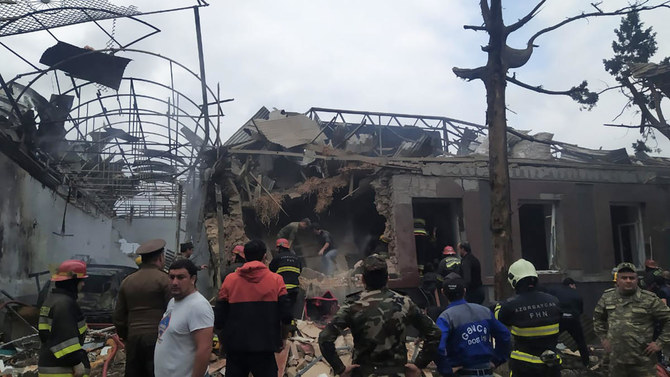
Azerbaijan’s defense ministry said Ganja, a city of more than 330,000 in western Azerbaijan, was also “under fire” while separatist forces claimed to have destroyed an air base there.
The two sides accused each other of targeting civilian areas, as the conflict appeared to be widening a week after heavy fighting broke out in the decades-old dispute over Karabakh.
Armenia and Azerbaijan have resisted international calls for a cease-fire and clashes have intensified in recent days, with both sides claiming victories on the front and saying they are inflicting heavy losses.
Sirens were sounding and explosions were heard at regular intervals in Stepanakert, where residents were taking shelter including several families in the basement of a church.
Armenia’s foreign ministry said Stepanakert and the town of Martakert were under rocket attack and accused Azerbaijani forces of “the deliberate targeting of the civilian population.”
It said the air force was also involved. Drones could be heard flying over Stepanakert.
Azerbaijan said Ganja was under fire, including from areas outside of Karabakh.
“Armenian forces struck Ganja with rockets from Armenian territory,” said Hikmet Hajjiyev, an adviser to Azerbaijani President Ilham Aliyev.
He said Armenian forces had also used heavy artillery and rockets against the towns of Terter and Goradiz in Azerbaijan.
Karabakh’s separatist forces said they had targeted and destroyed an air base in Ganja, while the region’s leader, Arayik Harutyunyan, warned that it would now consider “military facilities in Azerbaijan’s big cities” as legitimate targets.
“I call on the residents of these cities to immediately leave,” Harutyunyan said in a post on Facebook.
Azerbaijan claims to have made gains in Karabakh in recent days, with its defense ministry saying that 14 settlements have been taken as well as a strategically important plateau.
In an address to the country on Saturday, Prime Minister Nikol Pashinyan said Armenians were facing a “decisive moment” and called for the nation to come together.
Armenia on Saturday announced the deaths of 51 more separatist fighters, taking the number of reported fatalities on both sides above 240, including more than 30 civilians.
Russia, the United States and France — whose leaders co-chair a mediation group that has failed to bring about a political resolution to the conflict — have called for an immediate halt to the fighting.
Armenia has said it is “ready to engage” with mediators but Azerbaijan — which considers Karabakh under Armenian occupation — has said Armenian forces must fully withdraw before a cease-fire can be brokered.
Karabakh’s declaration of independence from Azerbaijan during the collapse of the Soviet Union sparked a war in the early 1990s that claimed 30,000 lives.
Talks to resolve the conflict have made little progress since a 1994 cease-fire agreement.
The breakaway province is not acknowledged as independent by any country — including Armenia — and Karabakh said Saturday that international recognition was “the only way toward peace and security in the region.”
Yerevan has accused Turkey of dispatching mercenaries from Syria and Libya to the fighting — an allegation confirmed and denounced by Russia and France.


![]()

Cities under fire as Armenia-Azerbaijan fighting intensifies
Short Url
https://arab.news/nawaf
Cities under fire as Armenia-Azerbaijan fighting intensifies
- Yerevan said Nagorno-Karabakh’s main city Stepanakert was hit again on Sunday
- Azerbaijan’s defense ministry said Ganja, in western Azerbaijan, was also 'under fire'


Latest updates





© 2026 SAUDI RESEARCH & PUBLISHING COMPANY, All Rights Reserved And subject to Terms of Use Agreement.