

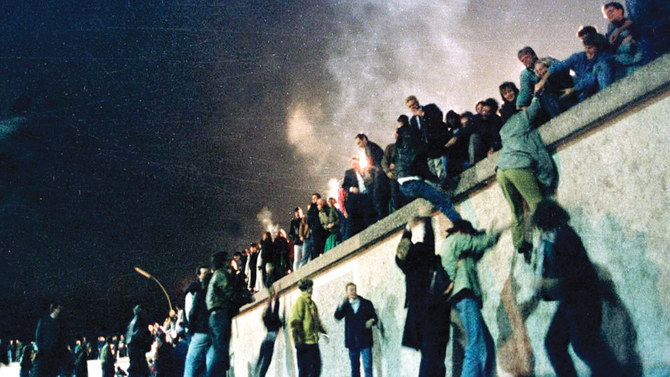

 Jubilant masses at the Brandenburg Gate. People in one another’s arms, simultaneously laughing and crying with joy. We associate emotional images such as these with the fall of the Berlin Wall in November 1989, which was followed by the reunification of Germany 30 years ago today.
The whole world watched incredulously, amazed by the power unleashed by people’s courage, and by how a longing for justice and freedom could peacefully overcome a dictatorship.
As surprising as the events of autumn 1989 were to everyone, the fall of the Berlin Wall did not come from nothing. The ground was prepared by a policy of reconciliation and rapprochement, and by decades of civil society dialogue — between individuals — that formed a bridge across that wall. Courageous people then brought about its collapse.
The unification of the two German states followed a year later, on Oct. 3, 1990. It was the result of intensive and dedicated political negotiations with the Allies and neighboring countries. It is also down to them that our country today is firmly anchored within the international community and in a united, peaceful Europe.
As we celebrate 30 years of German unity, it offers an occasion not only for many people in Germany to look back, but also for many others throughout the world. The message at the time it happened was that major successes cannot be achieved single-handedly but only in close cooperation with neighbors and partners.
Close cooperation based on trust is a guiding principle of German foreign policy. Even though efforts to find joint solutions do not always produce results as quickly as everyone would like, uncompromising, go-it-alone efforts and a retreat into national egoism are wrong turns that do not lead to anything good.
We all sense that the major issues concerning humanity can only be resolved by joining forces, or not at all — as, most recently, the coronavirus disease (COVID-19) pandemic has shown us. These solutions must be based on efforts to foster greater exchanges and a deeper understanding of one another. That is a task not only for policymakers but also for civil society, education and culture.
Art and culture in particular can build valuable bridges of dialogue. They can help us to understand the dreams and traumas of our societies and to seek common perspectives.
Germany, which has now been united for 30 years, advocates a policy of peace and focuses on cooperative solutions — in the EU, in the UN, and also in the Alliance for Multilateralism, which Germany launched in April 2019 with its partners.
The fall of the Berlin Wall and German reunification showed us that many things are possible that for a long time seemed impossible. Achieving them requires courage, determination and the instinctive ability to make the right decisions at the right time. We still need all these qualities today when, as an international community, we are facing particularly great challenges.
But we have no reason to resign ourselves to our fate. Let us cast our minds back to the founding of the UN 75 years ago, after the horrors of the Second World War. At that time, people had every reason to distrust one another. They had every reason to be afraid of what the future might hold. And yet we said that we were founding this UN organization because we believed that together we can be more effective in our work to promote peace and freedom.
We should remind ourselves of this more often. We have reason to be hopeful. When should the people of Germany be more aware of that, if not today?
• Heiko Maas is Germany's federal minister for foreign affairs.


