LONDON: The British Muslim billionaire Issa brothers and private equity group TDR Capital have agreed to buy the British supermarket chain Asda from Walmart for an enterprise value of $8.8 billion and plan to roll out more smaller stores.
The deal will enable Mohsin and Zuber Issa, who founded petrol station operator EG Group nearly two decades ago, to take Asda back under British ownership for the first time since 1999, when Walmart paid 6.7 billion pounds for the business.
The new owners want to drive growth at Britain’s third-biggest supermarket chain by expanding its presence into smaller neighborhood shops to add to its large supermarket format, bringing it more in line with competitors Tesco and Sainsbury’s which offer both.
Walmart will retain an unspecified equity investment in the business, an ongoing commercial relationship and a seat on the board, while British retail veteran Roger Burnley will remain in charge at Asda.
“After a successful period as part of Walmart we are looking forward to helping Asda build a differentiated business that will continue to serve customers brilliantly in communities across the UK,” the brothers said.
The new owners will invest more than 1 billion pounds in the next three years in Asda to keep prices low and to protect its supply chains.
British finance minister Rishi Sunak welcomed the deal for Asda which will retain its headquarters in the northern English city of Leeds.
Britain’s highly competitive supermarket sector has been upended this year by the COVID-19 crisis which sparked a jump in sales — and costs — as shoppers stocked up on goods during lengthy lockdowns.
While Asda’s sales increased, the chain still lagged market leader Tesco, Sainsbury’s, and smaller rival Morrisons.
All of the so-called big-four supermarket chains have also faced fierce competition from German discounters Aldi and Lidl in recent years.
In response, Walmart previously sought to sell Asda to Sainsbury’s for 7.3 billion pounds but the deal was thwarted by Britain’s competition regulator last year.
The lower price announced on Friday reflects the integration benefits that a merged Asda-Sainsbury’s would have produced. ($1 = 0.7744 pounds)

Walmart sells Asda to billionaire British Muslim brothers and TDR for $8.8 bln

https://arab.news/wedd8
Walmart sells Asda to billionaire British Muslim brothers and TDR for $8.8 bln
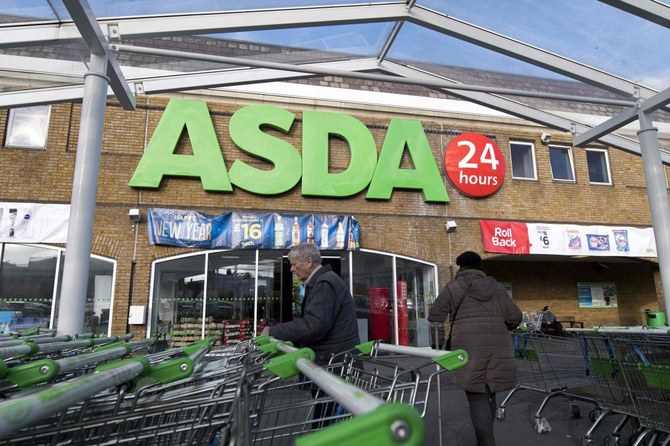
- The new owners want to drive growth at the supermarket chain by expanding its presence into smaller neighborhood shops to add to its large supermarket format
- The new owners will invest more than 1 billion pounds in the next three years in Asda to keep prices low
Jordan’s industry fuels 39% of Q2 GDP growth
JEDDAH: Jordan’s industrial sector emerged as a major contributor to economic performance in 2025, accounting for 39 percent of gross domestic product growth in the second quarter and 92 percent of national exports.
Manufactured exports increased 8.9 percent year on year during the first nine months of 2025, reaching 6.4 billion Jordanian dinars ($9 billion), driven by stronger external demand. The expansion aligns with the country’s Economic Modernization Vision, which aims to position the country as a regional hub for high-value industrial exports, the Jordan News Agency, known as Petra, quoted the Jordan Chamber of Industry President Fathi Jaghbir as saying.
Export growth was broad-based, with eight of 10 industrial subsectors posting gains. Food manufacturing, construction materials, packaging, and engineering industries led performance, supported by expanded market access across Europe, Arab countries, and Africa.
In 2025, Jordanian industrial products reached more than 144 export destinations, including emerging Asian and African markets such as Ethiopia, Djibouti, Thailand, the Philippines, and Pakistan. Arab countries accounted for 42 percent of industrial exports, with Saudi Arabia remaining the largest market at 955 million dinars.
Exports to Syria rose sharply to nearly 174 million dinars, while shipments to Iraq and Lebanon totaled approximately 745 million dinars. Demand from advanced markets also strengthened, with exports to India reaching 859 million dinars and Italy about 141 million dinars.
Industrial output also showed steady improvement. The industrial production index rose 1.47 percent during the first nine months of 2025, led by construction industries at 2.7 percent, packaging at 2.3 percent, and food and livestock-related industries at 1.7 percent.
Employment gains accompanied the sector’s expansion, with more than 6,000 net new manufacturing jobs created during the period, lifting total industrial employment to approximately 270,000 workers. Nearly half of the new jobs were generated in food manufacturing, reflecting export-driven growth.
Jaghbir said industrial exports remain among the economy’s highest value-added activities, noting that every dinar invested generates an estimated 2.17 dinars through employment, logistics, finance, and supply-chain linkages. The sector also plays a critical role in narrowing the trade deficit and supporting macroeconomic stability.
Investment activity accelerated across several subsectors in 2025, including food processing, chemicals, pharmaceuticals, mining, textiles, and leather, as manufacturers expanded capacity and upgraded production lines to meet rising demand.
Jaghbir attributed part of the sector’s momentum to government measures aimed at strengthening competitiveness and improving the business environment. Key steps included freezing reductions in customs duties for selected industries, maintaining exemptions for production inputs, reinstating tariffs on goods with local alternatives, and imposing a 16 percent customs duty on postal parcels to support domestic producers.
Additional incentives in industrial cities and broader structural reforms were also cited as improving the investment climate, reducing operational burdens, and balancing consumer needs with protection of local industries.


