

US says ‘can’t tolerate’ attacks by Iranian-backed militias in Iraq

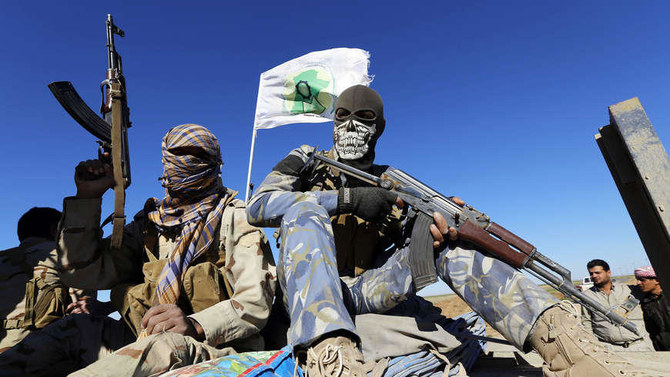
Masked Shiite fighters hold their weapons in Al Hadidiya, south of Tikrit, Iraq. (Reuters/File Photo)
Short Url
Updated 01 October 2020
Follow

US says ‘can’t tolerate’ attacks by Iranian-backed militias in Iraq

  • Iraq has long been caught in a tug-of-war between its allies Iran and the US
  • Iraq said Monday it was “not happy” with the reported American pullout threat

WASHINGTON: The US administration warned Thursday that it would not tolerate attacks on American interests in Iraq by Iran-backed militias, as Baghdad worries about a possible US withdrawal.

“We can’t tolerate the threats to our people, our men and women serving abroad,” David Schenker, assistant secretary of state, for near Eastern affairs, told reporters.

Schenker did not confirm or deny a reported US threat to withdraw its troop and close its embassy in Baghdad unless the attacks against them stop.

“We are working, and we look forward to continuing to work with our Iraqi partners to keep our personnel and our facility safe,” he said.

Also on Thursday, the US envoy on Iran Elliott Abrams said Tehran was the “main engine of violence” in the Middle East and remained one of the main sponsors of global terrorism.

Several political and diplomatic sources have told AFP that US Secretary of State Mike Pompeo issued an ultimatum last week that all US personnel would leave Iraq unless the government puts a stop to a rash of attacks against them.

On Monday a wayward rocket targeting American troops killed seven civilians near Baghdad — one of around 40 attacks targeting US interests since early August.

Iraq said Monday it was “not happy” with the reported pullout threat.

A US withdrawal could lead to further pullouts by members of the US-led coalition fighting holdout extremists, which would be “dangerous, because the Daesh group threatens not only Iraq but the whole region,” Iraqi Foreign Minister Fuad Hussein said.

Iraq has long been caught in a tug-of-war between its allies Iran and the US, rendered rockier by Washington’s “maximum pressure” policy against Tehran since 2018.

On Wednesday evening several rockets fell in Iraq’s autonomous Kurdish region in the environs of a base used by the Democratic Party of Iranian Kurdistan, a commander for that group said.

Kurdish Iraqi authorities pinned the blame on the Hashed Al-Shaabi, an Iraqi state-sponsored paramilitary network dominated by pro-Iran forces.

“The single biggest problem in Iraq is the Iranian-backed militias that are undermining stability there, and attacking the United States,” Schenker said.

“The arms are not under the control of the central government. Groups continue to launch rockets at our embassy, attack Americans,” he said.


Hamas says technocratic committee key to consolidating Gaza truce

Updated 2 sec ago
Follow

Hamas says technocratic committee key to consolidating Gaza truce

  • A senior Hamas official on Thursday welcomed the formation of a technocratic committee to govern post-war Gaza, saying it would help consolidate the ceasefire and prevent a return to fighting
GAZA: A senior Hamas official on Thursday welcomed the formation of a technocratic committee to govern post-war Gaza, saying it would help consolidate the ceasefire and prevent a return to fighting.
Egypt, a mediator in indirect ceasefire talks between Israel and Hamas, announced the formation of a 15-member Palestinian technocratic committee that would operate under the overall supervision of a so-called “Board of Peace,” to be chaired by US President Donald Trump.
“The formation of the committee is a step in the right direction,” said Bassem Naim, a senior leader in the Palestinian Islamist movement.
“This is crucial for consolidating the ceasefire, preventing a return to war, addressing the catastrophic humanitarian crisis and preparing for comprehensive reconstruction,” he said.
Hamas has exercised total control over public life in Gaza since 2007.
It has repeatedly said it does not seek a role in any future governing authority in Gaza and would limit its involvement to monitoring governance.
Naim said Hamas was ready to hand over administration of the Gaza Strip to the national transitional committee and to facilitate its work.
“The ball is now in the court of the mediators, the American guarantor and the international community to empower the committee,” he said.
He urged them to counter what he described as Israeli Prime Minister Benjamin Netanyahu’s attempts to “stall or obstruct” the next stages of the ceasefire.
Since the ceasefire took effect on October 10, Gaza has been split by a so-called “Yellow Line,” marking the boundary between territory controlled by Hamas and areas under Israeli military authority.
Washington’s top envoy, Steve Witkoff, said on Wednesday the ceasefire had moved into its second stage.
Key elements of the second stage include the gradual withdrawal of Israeli forces from Gaza, the demilitarization of the territory including the disarmament of Hamas, and steps to address the humanitarian crisis through accelerated aid deliveries and reconstruction.
The US-proposed Board of Peace is expected to be led on the ground by Bulgarian diplomat and politician Nickolay Mladenov, who has recently held talks with Israeli and Palestinian officials.
Mladenov previously served as the United Nations envoy for the Middle East peace process from early 2015 until the end of 2020.
Media reports say Trump is expected to announce the members of the Board of Peace in the coming days, with the body set to include around 15 world leaders.