

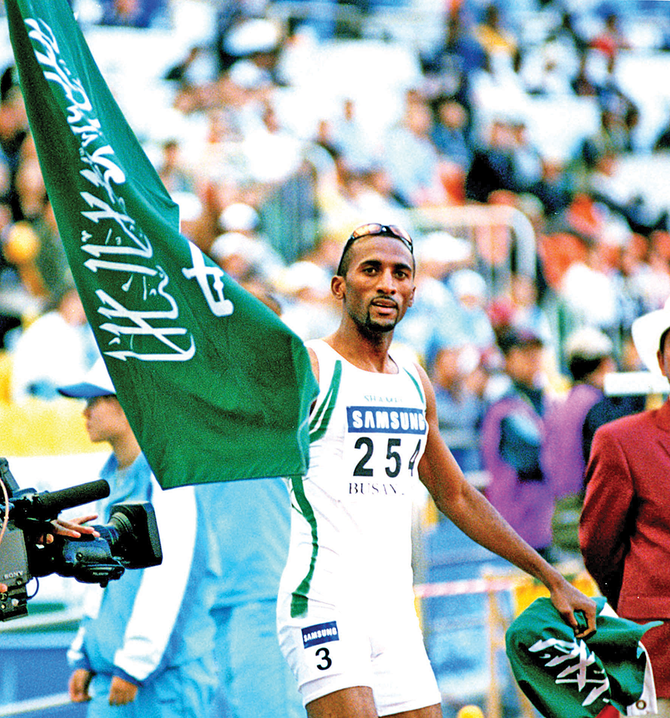
Saudi Arabia celebrates 20th year of first Olympic medal win

Hadi Souan has Saudi national pride soaring high after winning the 400m hurdles silver medal at the Sydney Olympics. (Supplied)
Short Url
Updated 28 September 2020
Follow

Saudi Arabia celebrates 20th year of first Olympic medal win

  • Hadi Souan scooped silver in Sydney at 29; athlete says success was for whole nation

JEDDAH: Saudi Arabia’s first Olympic medal win 20 years ago inspired a generation of athletes and was a catalyst for the development of sport, according to the president of the Kingdom’s Olympic committee.

Hadi Souan won silver in the 400m hurdles at the Sydney Games in 2000.

The accomplishment was one of many in a long and successful journey for the athlete, who became a board member of the Saudi Arabian Athletics Federation (SAAF), the Saudi Arabian Olympic Committee (SAOC) Assembly, a member of the Olympic Council of Asia Athlete Commission, sports and events manager at Qiddiya Investment Company, a member of the Saudi Sports Arbitration Center, and a member of the SAOC’s International Relations Committee.

“Today we celebrate Souan’s achievement, which inspired a generation of Saudi athletes and was a catalyst for the development of sport in the Kingdom,” said the SAOC’s president, Prince Abdul Aziz bin Turki Al-Faisal. “It gives me great pleasure to see sport thriving in Saudi Arabia. We are committed to ensuring that this trend continues and that the Kingdom’s next generation enjoys the benefits of participating in sport, both in Saudi Arabia and at major global sporting events.”

Souan started out as a footballer but took up athletics in PE class, winning second place in a school championship. He qualified to compete at the Kingdom level and went on to become a national team member in less than a year.

He started with the high jump, then decathlon and finally found himself taking on the 400m hurdles.

He trained under Egyptian coach Mohammed Thu Alfaqqar from 1991, under the Americans until 1994, and under 1968 Olympic gold medalist Lee Evans. But the best place Souan remembers training at was UCLA.

“It is a sport and artistic society indeed,” he said. “We spoke, ate, slept, and even relaxed for sport. These little things and the different sleeping habits here and there made me suffer a bit when I came back from the States, but we got used to it and I knew it made a difference in my lifestyle and mentality-wise.”

Souan also trained the European way in Paris under a Russian coach and France’s Amadou Dia Ba. “Hence I started to learn the difference between European and American schools,” he added. The US schools concentrated on endurance, while the French focused on speed.

He was grateful for the exposure to different cultures while training abroad with elite athletes, especially at a time when there was limited social awareness about the importance of sport.

“When I started training with US 400m hurdler Kevin Young, who clocked an Olympic record of 46.78 seconds at the 1992 Barcelona Games and which remains unbeaten until now, I felt that I could do what he is doing. I only need to be determined, disciplined, and committed and everything from there started to become imaginable. I started to see myself winning and when the time came and toward the end of the race I knew I was getting there but I wasn’t first. First place went to American Angelo Taylor who won in 47.50 seconds, while I did 47.53.”

He remembers the winning moment and never expected how the country would react to his achievement. It was overwhelming. 

He modestly said it was not his success alone, that it was a success for the whole nation and all of his team headed by the former SAAF president Prince Nawaf bin Mohammed, agent Emanuel Hudson, and coach John Smith. They all worked hard to create the right environment for him to deliver the medals.

“We were welcomed by the late King Fahd of Saudi Arabia, by the former president of General Presidency of Youth Welfare Prince Sultan bin Fahd, and everyone was happy and proud of what we did. I knew then that what I was fortunate to do was not simple at all and, luckily, was appreciated. I believe everyone started to look up for Saudis in athletics and watch out for similar future talents.”

The beauty of sport, he added, was its spirit and the values that were learned and developed through years of training, competing, winning and losing. 

“Although Taylor won first place we all, as a sports community, remain friends and also competed afterwards in several matches where he again took first place and I came second again. He came from a distance running race which allowed him to master his skills at the end of the 400m hurdles events, his approach was and still is just amazing.”

Souan won the silver medal aged 29 at his second Olympic appearance, in what he felt was perfect timing as he might not have been as successful at subsequent Games.

“Usually when you get to taste that level of achievement on a global scale you want more, but I knew that it was time to give back now and help my teammate and younger generations taste it at an early age.”

That’s how I got involved in the athletics federation and the Sports Ministry afterwards.”

He said that it did not matter how someone was built, as long as they had the willpower to work on their body and skills in order to become the best they could be in the sport that they liked. He added that parents had greater awareness, as did athletes, and wished that more Saudis could do what he could not.

Although Souan retired as an athlete at the age of 34, after competing in the 2006 Asian Games in Qatar, he was and still is a role model who keeps giving back to his country. Because of his passion for sports he was a physical education teacher and then supervisor at the Ministry of Education. 

“I always felt responsible to keep my record clean because I’ve seen how parents and students used to look up to me so, as an Olympian, I wanted to give a good example.”

In addition to the Olympic silver medal he won, with an Asian record of 47.53 seconds, Souan counts the 2001 Goodwill Games hurdles silver from Brisbane as his most prized possession. 

All told Souan has won 40 gold medals including one from the 2002 Asian Games in Busan, South Korea.


A new UAE-based player arrives on cricket’s media field

Updated 8 sec ago
Follow

A new UAE-based player arrives on cricket’s media field

  • ‘Mr Cricket UAE,’ Anis Sajan, has launched a Dubai based cricket-focused digital media house under the aegis of the Mr. Cricket UAE Media Group.

A former Australian international cricketer, Michael Hussey, who retired in 2013, was known as “Mr Cricket.” It has always appeared to me to be a strange nickname. Even with my passion for the game and its quirks, it has been difficult to fathom its origins, to the point of deciding to delve no deeper. I was jolted out of this inertia by an introduction to “Mr. Cricket UAE,” Anis Sajan. As detailed in Arab News on Dec. 18, he has launched a Dubai-based cricket-focused digital media house, under the aegis of the Mr. Cricket UAE Media Group.
Sajan is a rags-to-riches person, from the chawls of Mumbai to the heights of the Danube Group, of which he is vice-chairman. He told me of his early days playing gully cricket in Mumbai, of how he developed into roles as a radio commentator on cricket prior to moving to Dubai in the early 1990s. He admits to no great proficiency in cricket but has managed to establish close relationships with leading players in the game.
This was very evident on Dec. 17 at the launch of the Mr. Cricket UAE platform in Dubai. His invited guests included three of England’s 2019 World Cup-winning team, Eoin Morgan, Moeen Ali and Adil Rashid. The last two are playing in the current DP World ILT20. There was even a videoed message from Michael Hussey, who was rather dismissive of his own Mr. Cricket nickname. Apparently, Hussey is on record as saying that he is not very fond of it. Quite when it was bestowed on him and by whom is unclear, but his enthusiasm for cricket was well known on the circuit. He was always the first to practice and the last to leave, hitting balls in every spare minute, giving himself every chance of doing well. Hence the nickname should be regarded as a mark of respect for his dedication and commitment.
The launch of the Mr. Cricket UAE platform represents an entry into a new market for the Danube Group, which is established in real estate, retail, building materials and hospitality. The company was started in 1993 as a small trading firm in Dubai by Anis’ elder brother Rizwan. Since then, Danube has expanded rapidly in the region and in 2018 was ranked amongst the top real-estate companies in Middle East by Forbes. The group has its headquarters in Dubai and operates in 10 countries, including the UK, where it opened an office in 2025.
When Anis moved to Dubai from India, he carried with him his passion for cricket. After the Danube team had great success in local indoor cricket leagues, Sajan told me that in 2012 he started and funded two Danube outdoor corporate cricket teams — the Lions and the Tigers — which played against themselves and other corporate teams on regular basis. The teams were launched by none other than the great Indian batter, Sunil Gavaskar. At the time, Gavaskar said: “The objective is to connect every cricket connoisseur and professional directly or indirectly with the game. The idea is to discover and nurture the young talents and also instill the right spirit to help the young players lead a healthy lifestyle.”
Thirty players were recruited to the teams through a professional selection system. They were employed solely to play cricket and were good enough to compete with visiting touring teams. In November 2015, for example, the national teams of Nepal and Papua and New Guinea were hosted for 50-over matches. In February 2016, Ireland played a 20-over match, followed in March by Derbyshire’s county cricket team, who won a 50-over match by 69 runs. In August 2017, the Sajan brothers and one other businessman joined forces to purchase a team to compete in the inaugural Ten Cricket League, played in Sharjah.
After this time, Anis stepped back from direct involvement in cricket to focus on work and family, but his passion for it was never lost. This was apparent when talking with members of his staff, who say that they have been pushing him for some time to be involved again. Over the years of writing this column, it has become apparent to me that the growth of cricket in the Gulf region would benefit from dedicated coverage. There are excellent media outlets which provide coverage of cricket around the world, including tournaments and major matches in the Gulf, but their emphasis is on the big events, teams and players.
ESPNcricinfo is 80 percent owned by ABC, Inc, an indirect subsidiary of The Walt Disney Company, and 20 percent by Hearst. It is rated the world’s leading multi-platform sports entertainment brand. Cricbuzz, owned since 2014 by Times Internet in India, is an omnipresent cricket media platform which provides real-time scores, news and in-depth analysis of cricket matches worldwide. Cricket World is an independent British site which has an impressive global coverage, given its limited resources compared with Cricinfo and Cricbuzz. Two long-established magazines, Wisden and The Cricketer, now have digital imprints. The latter is more than 100 years old and has undergone a series of fluctuating fortunes. It is a now looking to lever its brand heritage and loyal readership into the digital age, for which it will probably need investment. Associate nations cricket is represented by the Emerging Cricket website, whilst there are literally hundreds of blogs which address the many different aspects of the game. Cricket is a sport which indulges itself in statistics.
In response to this, there are a number of excellent databases. Cricket Archive claims to be the world’s leading authority on compiling cricket data. Its statisticians have created a source of fully searchable first-class, List A and T20 cricket records from around the world. Another source of statistics is HowSTAT, which began in Adelaide in the early 1990s when a group of friends with a passion for cricket needed a resource to help settle some of their arguments. Then, there is The Association of Cricket Statisticians and Historians, which was founded in 1973. It is an international body represented in more than 20 countries and its membership includes most of the world’s leading cricket statisticians. All of these sites cover both men’s and women’s cricket, but there is a site dedicated to women’s cricket — Female Cricket.    
Not unexpectedly, Anis Sajan is well aware of these platforms. In fact, he told me that he is in awe of several of them. However, he is also cognizant that cricket in the Gulf is a growth sector, for both men and women. At the heart of this lies the UAE, which has built a reputation for hosting international tournaments in world-class facilities and is fast strengthening its development structures for local talent. This is now to be supplemented by a UAE-based digital media house which will initially focus on cricket with specific reference to the region. The digital sports media industry is growing rapidly and the Danube Group is entering that market at a pivotal stage, leveraging its position in physical industries.
The new platform plans to embrace in-depth narratives, matchday coverage, viral short-form videos and community-first stories. It will be fascinating to watch how its mission “to become the world’s most relatable, trusted and culturally connected cricket media brand” will play out. In particular, it will be interesting to see how it fits alongside the established platforms and how it will establish a point of difference from them. Although Michael Hussey did not encourage the use of his Mr. Cricket nickname, the sobriquet is going live on the global stage through Anis Sajan and the Danube Group.