

Saudi Olympic committee holds monthly conference to mark Olympic Day

1 / 4
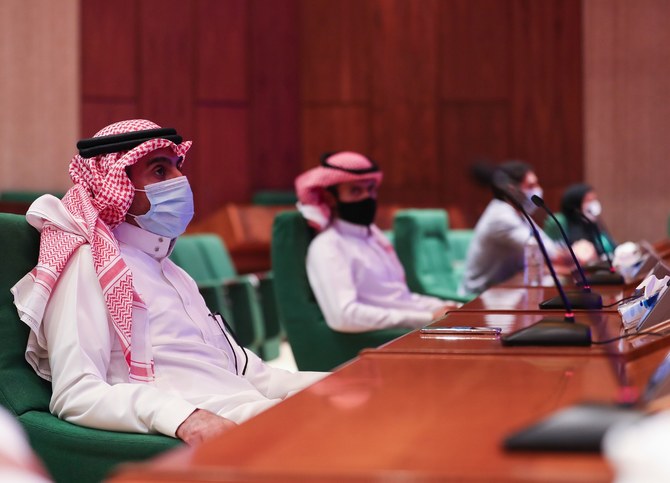
The conference, hosted online ran under the patronage of Prince Abdulaziz Alfaisal, president of SAOC, attracted the attendance of SAOC and Saudi national sports federation members, and sports specialist in the kingdom. (Supplied)
2 / 4
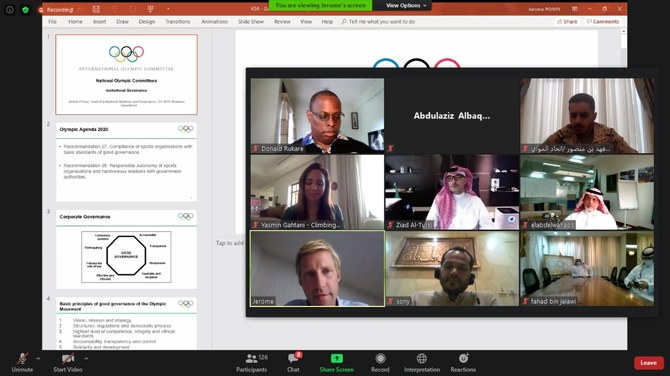
The conference, hosted online ran under the patronage of Prince Abdulaziz Alfaisal, president of SAOC, attracted the attendance of SAOC and Saudi national sports federation members, and sports specialist in the kingdom. (Supplied)
3 / 4
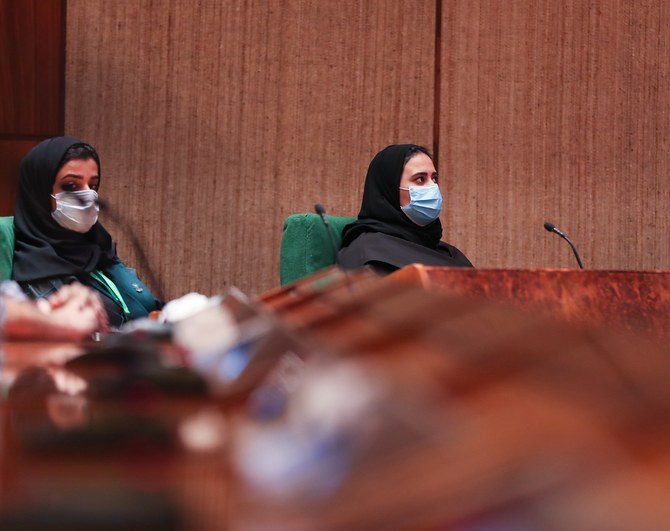
The conference, hosted online ran under the patronage of Prince Abdulaziz Alfaisal, president of SAOC, attracted the attendance of SAOC and Saudi national sports federation members, and sports specialist in the kingdom. (Supplied)
4 / 4
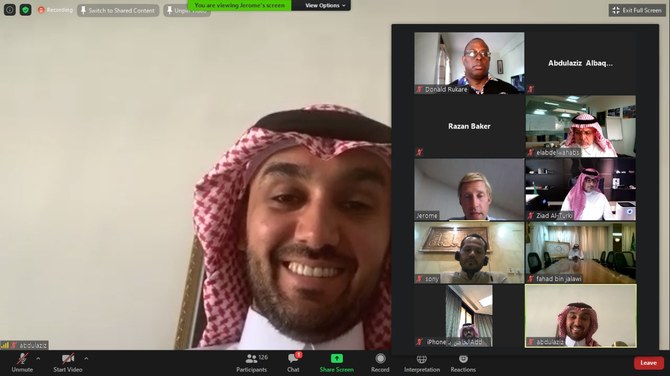
The conference, hosted online ran under the patronage of Prince Abdulaziz Alfaisal, president of SAOC, attracted the attendance of SAOC and Saudi national sports federation members, and sports specialist in the kingdom. (Supplied)
Short Url
Updated 24 June 2020
Follow

Saudi Olympic committee holds monthly conference to mark Olympic Day

RIYADH: The Saudi Arabian Olympic Committee (SAOC) held its initial monthly conference to mark the Olympic Day on Tuesday to discuss sports governance.

The Head of Institutional Relations and Governance International Olympic Committee, Jerome Poivey, and Advocate at the High Court of Uganda and Secretary General of Uganda Olympic Committee, Donald Rukare, were also present for the discussion.

The conference, hosted online ran under the patronage of Prince Abdulaziz Alfaisal, president of SAOC, attracted the attendance of SAOC and Saudi national sports federation members, and sports specialist in the kingdom.

Rukare started the first session on the principles of governance and highlighted that transparency, accountability, and equality and equity, fairness, and being inclusive are the most crucial principles to follow.

Poivey meanwhile discussed the role of the national Olympic committees and new IOC agenda 2020 and its recommendations which included for an example.

Several Olympic issues were also discussed, such as the coronavirus pandemic, women sports and the interrelation between all various sport institutions.

When asked about the unprecedented conditions for athletes due to the pandemic, Rukare said: “We need national Olympic committees to go back and review their policies because most of it was framed during the time we thought things would be done in physical presence only, but now we need to go back to the guidelines and re configure and amend it to be suitable for nowadays things like taking decisions online.”

“For example, can we do campaigns online without breaching the law, then we need to put that process and build capacity. We need to offer access, quality, and building capacity once again because for example maybe not everyone has internet,” he continued.

When asked about governance and what module would be useful to use for a sport federation in Saudi, Poivey said: “We tend to ask the NOCs to follow the IOC charter and see if the values are reflected then they can approve it if it doesn’t contradict by the law.”

“There must be some flexibility so we need to make sure the basic principle is there,” he added.

The relationship between NOC and governance in terms of rules, implementation and auditing with reference to the IOC agenda 2020 was also brought to the discussion table, Poivey explained.

“Every NOC should imply with the sports law and Olympic charter. The issue is when sports law is not reflected then we try to negotiate to find solution and usually it works, if not then we suspend the NOC because it doesn’t follow the Olympic movement for example there must be an election process and sport law must be respected,” he said.

About women and sports, Donald explained that all sport institutions need to embed a mechanism to empower more women in sports.

“Each country needs to find what works best for them within their context. the IOC agenda 2020 is very clearly trying to have 50/50 percentage of men and women employed. You need to embed it in the system and deliver programs to target women in leadership and sports acquisition courses. This will attract them and help build capacity and women power through encouraging them and of course then you will have to document it and identify particular women to mentor and help further to grow,” he said.

The second SAOC monthly conference will be held in July with a new topic: Managing National federations.


Sabalenka says ‘Battle of the Sexes’ pays off after ruthless win

Updated 06 January 2026
Follow

Sabalenka says ‘Battle of the Sexes’ pays off after ruthless win

  • Aryna Sabalenka said her much-maligned exhibition match against Nick Kyrgios had paid dividends as she demolished Cristina Bucsa on Tuesday to launch her Australian Open preparations

BRISBANE: Aryna Sabalenka said her much-maligned exhibition match against Nick Kyrgios had paid dividends as she demolished Cristina Bucsa on Tuesday to launch her Australian Open preparations.
The world number one took just 48 minutes to dispose of the Spaniard 6-0, 6-1 in the second round of the season-opening Brisbane International.
The ease of the win against the world number 50 will send a warning to the Belarusian’s rivals ahead of the Australian Open starting January 18.
She raced through the first set in just 22 minutes and took only 26 minutes to claim the second against an opponent who had no answer to the power of the 27-year-old.
Sabalenka said the fact that she played so well in her first match of the season showed that the December 28 exhibition in Dubai against the mercurial but controversial Kyrgios was worthwhile.
“I mean, when you play against a guy, the intensity is completely different,” she said.
“Especially when there is Nick, who is drop-shotting every other shot, so you move a lot, so there was a great fitness for me.
“And today I was, like, whew, let’s move around, you know.
“That exhibition, it was fun. It was a great challenge,” she added.
“I think we brought so many eyes on tennis. It wasn’t about proving something to anyone, it was able to show that tennis can be really huge.”
Sabalenka will now play either Jelena Ostapenko or Sorana Cirstea in the third round and remains on track to meet Madison Keys in the quarter-finals in a rematch of last year’s Australian Open final, won by the American.
Keys reached the Brisbane third round with a 6-4, 6-3 win over fellow American McCartney Kessler.
Like Sabalenka, Keys had a bye into the second round and said she had found it tough to find her rhythm early on.
“I think it’s sometimes a little bit harder when the person you’re playing has already played a match, and then you’re kind of trying to still knock off a bit of the rust,” she said.
“I felt like it took a little bit just to find my rhythm, but I feel like once I did it, I kind of settled in a little bit better.”
There were two major upsets in the men’s draw with second-seeded Spaniard Alejandro Davidovich Fokina and Canada’s fifth seed, Denis Shapovalov both losing.
American Brandon Nakashima downed Davidovich Fokina 7-6 (7/4), 6-4 while Belgian qualifier Raphael Collignon beat Shapovalov 6-4, 6-2.