

DIY a bright spot for consumer spending

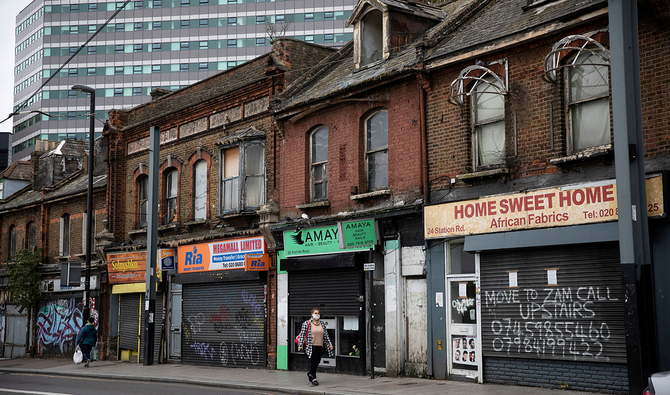
Pedestrians walk past shuttered and bordered up retails stores, amid the spread of the coronavirus disease (COVID-19), in Croydon, south London, Britain, September 27, 2020. (Reuters)
Short Url
Updated 28 September 2020
Follow

DIY a bright spot for consumer spending

  • In UK, sales volumes within household goods stores increased by 9.9 percent when compared with February

PARIS: Many retailers have been caught off-guard by coronavirus restrictions and shifting consumer habits, but DIY stores are enjoying a boom as people spend money on their homes and gardens.

A recent report by consulting group McKinsey found that faced with a prolonged period of financial uncertainty due to the pandemic, consumers “intend to continue shifting their spending largely to essentials ... and cutting back on most discretionary categories.”

Data has shown consumers worldwide are cutting back on clothing and shoes, but spending more to improve their homes.

In Britain, the sector has helped consumer spending overall to rebound to a level higher than before the pandemic hit.

“Spending for home improvements continued to rise in August as sales volumes within household goods stores increased by 9.9 percent when compared with February,” Britain’s Office for National Statistics said this month.

This shouldn’t come as too much of a surprise, as people are spending more time at home, and even when not under lockdown, many people are working from home or have fewer public activities to participate in.

A recent survey carried out in 20 countries by consulting firm Accenture found that over two-thirds of respondents expect most of their social activities will take place at their home or that of a friend.

The unease and concern that many people now feel in public spaces may push a lasting shift toward people spending more time at home, with Accenture even calling it a “decade of the home.”

Certainly many Germans have used coronavirus downtime to “repair, refurbish and decorate their homes,” the country’s BHB trade association for home improvement, building and gardening said in a recent report.

Sales in the sector rose by 15.6 percent year-on-year to nearly €12 billion ($14 billion) over the first half of 2020, boosted by the fact that many DIY stores and garden centers were allowed to stay open during virus lockdowns.


Closing Bell: Saudi equities continue 4-day upward trend 

Updated 14 January 2026
Follow

Closing Bell: Saudi equities continue 4-day upward trend 

RIYADH: Saudi equities closed higher on Wednesday, with the Tadawul All Share Index rising 51.52 points, or 0.47 percent, to finish at 10,945.15. 

Trading activity was robust, with 373.9 million shares exchanged and total turnover reaching SR6.81 billion. 

The MT30 Index also ended the session in positive territory, advancing 11.93 points, or 0.82 percent, to 1,472.82, while the Nomu Parallel Market Index declined 116.82 points, or 0.49 percent, to 23,551.47, reflecting continued volatility in the parallel market.

The main market saw 90 gainers against 171 decliners, indicating selective buying. 

On the upside, Al Kathiri Holding Co. led gainers, closing at SR2.18, up SR0.12, or 5.83 percent. Wafrah for Industry and Development Co. advanced to SR23, gaining SR0.99, or 4.5 percent, while Al Ramz Real Estate Co. rose 4.35 percent to close at SR60.

SABIC Agri-Nutrients Co. added 4.21 percent to SR118.70, and Al Jouf Agricultural Development Co. climbed 4.12 percent to SR45. 

Meanwhile, losses were led by Saudi Industrial Export Co., which fell 9.73 percent to SR2.69. United Cooperative Assurance Co. declined 5.08 percent to SR3.74, while Thimar Development Holding Co. dropped 4.54 percent to SR35.30.  

Abdullah Saad Mohammed Abo Moati for Bookstores Co. retreated 4.15 percent to SR48.50, and Gulf Union Alahlia Cooperative Insurance Co. slipped 3.96 percent to SR10.44. 

On the announcement front, Saudi National Bank announced its intention to issue US dollar-denominated Additional Tier 1 capital notes under its existing international capital programe, with the final size and terms to be determined subject to market conditions and regulatory approvals.  

The planned issuance aims to strengthen Tier 1 capital and support the bank’s broader financial and strategic objectives.  

The stock closed at SR42.70, gaining SR0.70, or 1.67 percent, reflecting positive investor reaction to the capital management move. 

Separately, Almasane Alkobra Mining Co. said its board approved the establishment of a wholly owned simplified joint stock company to provide drilling, exploration and related support services, with a share capital of SR100 million and headquarters in Najran, subject to regulatory approvals.  

The new subsidiary aligns with the company’s strategy to enhance operational efficiency and expand its role in the Kingdom’s mining sector.

Shares of Almasane Alkobra Mining closed at SR98.70, up SR0.30, or 0.3 percent, by the end of the session.