

Turkey’s behavior in region is ‘explosive and dangerous’ to its neighbors, says Cypriot envoy

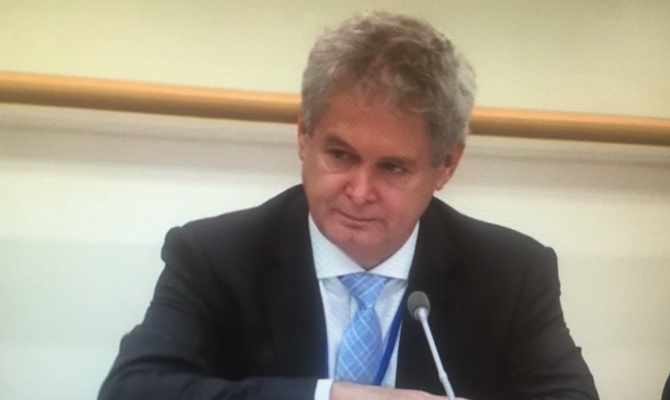
Andreas Mavroyiannis, the permanent representative of Cyprus to the UN, (Photo credit: Cyprus Mission in the UN)
Short Url
Updated 26 September 2020
Follow

Turkey’s behavior in region is ‘explosive and dangerous’ to its neighbors, says Cypriot envoy

  • Cypriot ambassador to UN condemns expansionist policies and urges Ankara to refrain from activities that violate international law

NEW YORK: Turkey is engaged in an “expansionist and imperialistic policy” that is creating “very, very explosive and dangerous” problems for neighboring countries, according to Andreas Mavroyiannis, the permanent representative of Cyprus to the UN.

Turkey and Greece have been fighting over Cyprus for decades. In 1974, the ruling Greek military junta staged a coup in an attempt to incorporate the island into Greece. In response, Turkey invaded and, after gaining control of the north, unilaterally declared the establishment of the Turkish Republic of Northern Cyprus.

Almost 50 years later, tensions between Greece and Turkey continue to run high and recent developments, including a dispute over rights to energy resources in the eastern Mediterranean, have raised concerns that they could escalate into open conflict.


Last year, Ankara signed a maritime accord with the Libyan Government of National Accord and began gas exploration operations in areas of the Mediterranean Greece considers part of its economic zone. More recently, Turkey sent survey vessels close to areas the Cypriot government have licensed to multinational companies to explore for oil and gas.

“Recently, we have this more hegemonic Turkish policy in the area,” said Mavroyiannis in an exclusive interview with Arab News. “(It is an) expansionist and imperialistic policy that creates problems for all neighbors.

“The (Turks) are trying to create a fait accompli and the situation is very, very explosive and dangerous.”

He conceded that his country’s small size and lack of military power means that its options for responding to Ankara’s actions are limited to diplomatic and political channels.
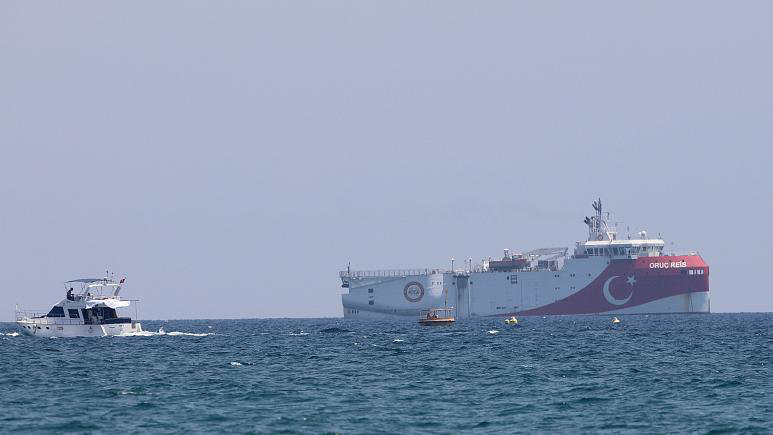


Exploratory drilling by Turkey's research vessel Oruc Reis on waters claimed by Greece has raised tensions in the eastern Mediterranean. (AP file photo)

“But this is (only the situation) for us,” said Mavroyiannis. “I understand and appreciate that for other neighbors — and in particular Greece, which is now the focus of the Turkish expansionist policies — it is very different.

“Greece not only has the means to react (but) it is compelled to use those means if Turkey continues with its current violations of international law and of maritime zones.”

The dispute between Greece and Turkey escalated in August when Ankara sent survey vessels, accompanied by Navy warships, to explore gas reserves in the eastern Mediterranean. During the standoff that followed, Greek and Turkish warships were involved in a minor collision.

Athens subsequently announced significant weapons purchases, along with plans to expand its armed forces.


However, Turkey’s activities in the region have repercussions not only for Cyprus and Greece, said Mavroyiannis. One way or another, all neighboring nations — including Egypt, Israel and Syria — are affected, he added, and Ankara’s policies should be of concern to the entire Arab world.

France sides with Greece and has urged Turkish President Recep Tayyip Erdogan to “refrain from any new unilateral action likely to provoke tensions, and to engage without ambiguity in the construction of an area of peace and cooperation in the Mediterranean.”

While France has adopted an aggressive stance, as evidenced by heated exchanges between Erdogan and his French counterpart, Emmanuel Macron, Germany has struck a more conciliatory tone, proposing incentives for Ankara in return for deescalation.

“Those (two European) schools of thought are two sides of the same coin,” said Mavroyiannis. “On the one hand the stick, and on the other hand the carrot.

“(If) Turkey accepts the approach of Germany and we have deescalation, (then) of course, the relationship will improve. If (the Turks) don’t (it must be made) clear that there are consequences. (Turkey) has to understand that there is no free ride.”


Despite intensive diplomatic efforts, in Cyprus the dispute between Turkish and Greek Cypriots remains as tense as it was four decades ago. The most recent round of talks between the two sides collapsed in 2017.

During his speech to the 75th General Assembly of the UN this week, Cypriot President Nicos Anastasiades, who leads his country’s internationally recognized government, reaffirmed his commitment to resuming reunification talks with Turkish Cypriots, “but not at gunpoint.”

Following a meeting with UN Secretary-General Antonio Guterres in Berlin last November, both sides in Cyprus agreed to wait until after the presidential election in Northern Cyprus that was scheduled for April this year before resuming negotiations. However, the election was delayed until October 11 as a result of the COVID-19 pandemic.

During his opening remarks at the General Assembly, Guterres stressed the importance of confidence-building measures from all parties, and warned against any further “unilateral actions” that might further stoke the fear of war in the eastern Mediterranean.

“To resume actual, substantive negotiations, we need to have the right atmosphere — we cannot negotiate under duress,” Mavroyiannis said.


“The message from the secretary-general is this: there is a need for those who don’t abide by the rules to stop their activities and to allow the negotiations to move forward.

“So, for us, (this is) a clear message to Turkey to stop all those violations of international law (and) of Cyprus’s maritime zones, to create a climate conducive to negotiation.”

Mavroyiannis also expressed regret over what he described as the suffering that has been inflicted on the region by the decision of the US to reduce its presence and withdraw troops. This, he said, has emboldened Erdogan.

“The US is the number one world power,” he said. “Turkey and the US are also partners in NATO. I believe that the US has a lot of leverage and we would like them to exercise it.

“At the end of the day, for us the most important thing is to have our place under the sun, and to continue having seamless cooperation with all our neighbors to promote peace and security and prosperity in the eastern Mediterranean.”


Bangladesh halts controversial relocation of Rohingya refugees to remote island

Updated 29 December 2025
Follow

Bangladesh halts controversial relocation of Rohingya refugees to remote island

  • Administration of ousted PM Sheikh Hasina spent about $350m on the project
  • Rohingya refuse to move to island and 10,000 have fled, top refugee official says

DHAKA: When Bangladesh launched a multi-million-dollar project to relocate Rohingya refugees to a remote island, it promised a better life. Five years on, the controversial plan has stalled, as authorities find it is unsustainable and refugees flee back to overcrowded mainland camps.

The Bhasan Char island emerged naturally from river sediments some 20 years ago. It lies in the Bay of Bengal, over 60 km from Bangladesh’s mainland.

Never inhabited, the 40 sq. km area was developed to accommodate 100,000 Rohingya refugees from the cramped camps of the coastal Cox’s Bazar district.

Relocation to the island started in early December 2020, despite protests from the UN and humanitarian organizations, which warned that it was vulnerable to cyclones and flooding, and that its isolation restricted access to emergency services.

Over 1,600 people were then moved to Bhasan Char by the Bangladesh Navy, followed by another 1,800 the same month. During 25 such transfers, more than 38,000 refugees were resettled on the island by October 2024.

The relocation project was spearheaded by the government of former Prime Minister Sheikh Hasina, who was ousted last year. The new administration has since suspended it indefinitely.

“The Bangladesh government will not conduct any further relocation of the Rohingya to Bhasan Char island. The main reason is that the country’s present government considers the project not viable,” Mizanur Rahman, refugee relief and repatriation commissioner in Cox’s Bazar, told Arab News on Sunday.

The government’s decision was prompted by data from UN agencies, which showed that operations on Bhasan Char involved 30 percent higher costs compared with the mainland camps in Cox’s Bazar, Rahman said.

“On the other hand, the Rohingya are not voluntarily coming forward for relocation to the island. Many of those previously relocated have fled ... Around 29,000 are currently living on the island, while about 10,000 have returned to Cox’s Bazar on their own.”

A mostly Muslim ethnic minority, the Rohingya have lived for centuries in Myanmar’s western Rakhine state but were stripped of their citizenship in the 1980s and have faced systemic persecution ever since.

In 2017 alone, some 750,000 of them crossed to neighboring Bangladesh, fleeing a deadly crackdown by Myanmar’s military. Today, about 1.3 million of them shelter in 33 camps in the coastal Cox’s Bazar district, making it the world’s largest refugee settlement.

Bhasan Char, where the Bangladeshi government spent an estimated $350 million to construct concrete residential buildings, cyclone shelters, roads, freshwater systems, and other infrastructure, offered better living conditions than the squalid camps.

But there was no regular transport service to the island, its inhabitants were not allowed to travel freely, and livelihood opportunities were few and dependent on aid coming from the mainland.

Rahman said: “Considering all aspects, we can say that Rohingya relocation to Bhasan Char is currently halted. Following the fall of Sheikh Hasina’s regime, only one batch of Rohingya was relocated to the island.

“The relocation was conducted with government funding, but the government is no longer allowing any funds for this purpose.”

“The Bangladeshi government has spent around $350 million on it from its own funds ... It seems the project has not turned out to be successful.”