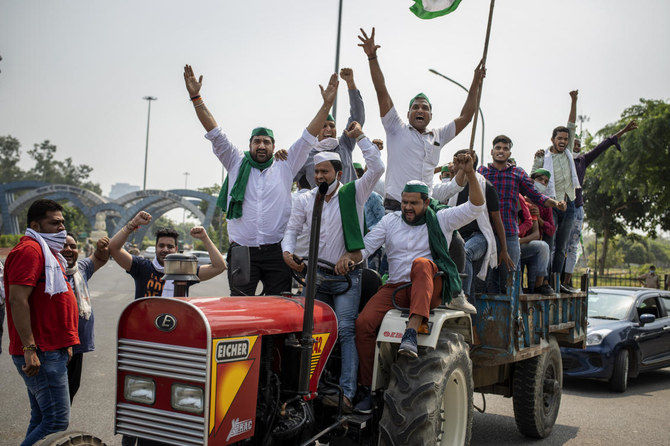
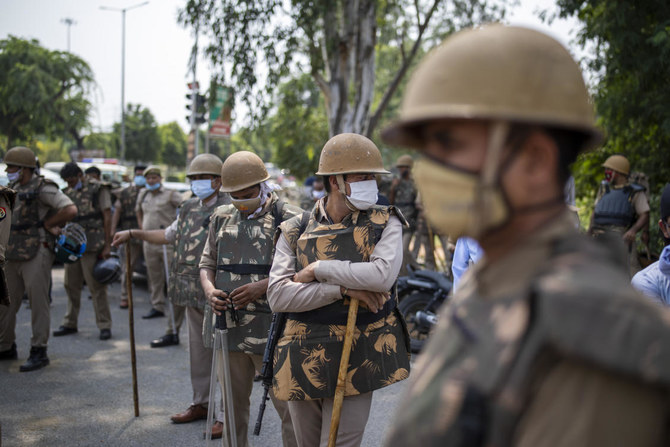
NEW DELHI: Farmers across India have blocked roads and railways in a nationwide shutdown to protest new farm bills, which they say will leave them at the mercy of market forces.
Hundreds of farmer organizations across India supported by opposition parties are protesting new legislation that was passed on Tuesday despite resistance from all opposition parties. The protest is concentrated in the country’s north, the “food bowl of India,” where farm yields are high.
“Farmers, who are already in a precarious situation, face new uncertainty with the bills, which leave us at the whims and fancies of market forces,” Sunil Pradhan of the Indian Farmers Union in the northern Uttar Pradesh state told Arab News.
He is protesting, along hundreds of others, in Noida city.
“How can we trust the words of the government that the market will be good for us? We have seen its past schemes, which sound good on paper but which actually turn out to be hollow,” Pradhan said.
The opposition wanted the new bills to be subject to vote, but the government did not allow it.
“The haste with which the government passed the bills without going in for voting on such crucial matters raises questions about the intent of the government,” Satish Mishra, a political analyst from the Delhi-based Observer Research Foundation, told Arab News.
The new legislation exposes the agriculture sector to market forces. It has a provision to allow farmers to sell their produce directly to private players and allow corporate investment in farms. Until now, produce prices have been fixed by the government under the Minimum Support Price (MSP), which is usually higher than market rates.
Farmers fear that once the free market assumes a bigger role in the agriculture sector, the government would withdraw from the MSP.
The largest protests have been held in the northern Indian states of Punjab and Haryana, with farmers blocking roads and railway tracks.
“If we don’t protest, our survival will be at stake. The government cannot withdraw its hands from the procurement, and we cannot be left at the whims of the market forces,” Balbir Singh Rajewal, the Punjab-based leader of the Indian Farmers Union, told Arab News.
Jagdish Awana, a Haryana-based farmer, raised questions why Prime Minister Narendra Modi did not consult the main stakeholders while introducing the reform.
“Modi has been in power for the last six years. He never discussed these reforms with farmers. Suddenly, during the pandemic, when people are struggling for their livelihood, he brings in such a far-reaching change that will disturb everything that has been built for decades,” Awana said.
In response to the protests, Modi said on Friday that some actors are deliberately confusing the farmers and telling them lies about the bill.
“Some people…these days are engaged in confusing the farmers because of their political selfishness. These people are spreading rumors,” he said in a meeting with the ruling party workers in Delhi.
“In the name of farmers and laborers, governments were formed many times in the country, but what did they get? Just a tangled web of promises and laws, a trap that neither the farmer nor the laborer could understand,” the prime minister said.
According to the opposition Congress party, which supports the protests, the Modi regime is determined to “enslave” the farmers.
“The new agriculture laws will enslave our farmers,” Rahul Gandhi, the Congress party’s former president, said in a Twitter post on Friday.
Punjab-based agriculture expert Devinder Sharma said that farmers fear the new legislation will pave the way for the corporatization of the agriculture sector.
“Farmers fear that the new bill will lead to the corporatization of agriculture. They will be pushed out and deprived of the assured prices that they get for wheat and paddy, the main staple food in the country,” he told Arab News.
“Only 6 percent of farmers get MSP from the government, and the rest of India is dependent on the market. If the markets are really benevolent, then tell me why Indian agriculture is in deep crisis. The government should have expanded the model that benefits 6 percent of farmers to the rest of the country rather than the other way around.”
Protests are also taking place in the southern Indian states of Karnataka, Andhra Pradesh and Tamil Nadu and the eastern Indian states of Bihar, Orissa and Bengal.
“The bill keeps in mind the benefits of the market, not the larger interests of the farmers. Bihar, which removed MSP in 2006, has seen the fate of farmers changed. The situation worsened, and that’s why many people migrate from Bihar to other states to work in the field,” Sharma said.
According to Professor Ronki Ram, a political analyst from Punjab University, the protests may lead to a realignment of political forces in India’s agriculture-dominated states.
“The farmers’ solidarity will have its political impact. This might lead to a new political alternative and a realignment of political forces in north India, where farmers hold sway,” he said.


![]()
![]()
![]()
![]()

Indian farmers block roads, railways in nationwide shutdown to protest reform


Short Url
https://arab.news/vrpxg
Indian farmers block roads, railways in nationwide shutdown to protest reform
- Farmers demonstrate against government’s move to open agriculture to private and corporate sector
- Protest is concentrated in country’s north - the “food bowl of India”


Latest updates


Recommended


© 2026 SAUDI RESEARCH & PUBLISHING COMPANY, All Rights Reserved And subject to Terms of Use Agreement.