Pakistani leader denounces India over Kashmir

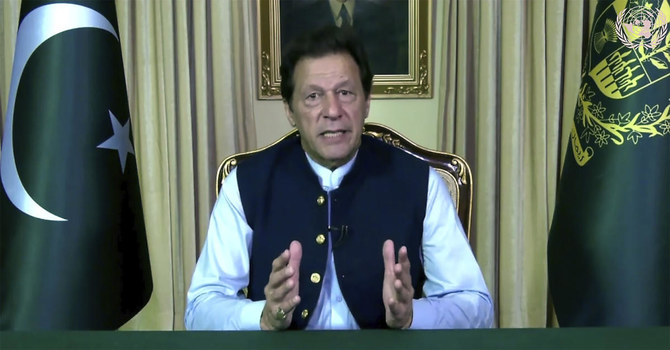
Prime Minister of Pakistan Imran Khan speaks in a pre-recorded message which was played during the 75th session of the United Nations General Assembly, Friday, Sept. 25, 2020. (AP)
Short Url
Updated 25 September 2020
Follow

Pakistani leader denounces India over Kashmir

  • Khan said Friday that Islamophobia prevails in India today and threatens the close to 200 million Muslims who live there
  • “They believe that India is exclusive to Hindus and others are not equal citizens,” Khan said

UNITED NATIONS: Pakistani Prime Minister Imran Khan has assailed India’s Hindu nationalist government and its moves to cement control of Muslim-majority Kashmir, calling India a state sponsor of hatred and prejudice against Islam.
Khan said Friday that Islamophobia prevails in India today and threatens the close to 200 million Muslims who live there.
“They believe that India is exclusive to Hindus and others are not equal citizens,” Khan said in a prerecorded speech to the UN General Assembly, which is being held virtually amid the coronavirus pandemic.
Khan has frequently criticized the decision by the government of Prime Minister Narendra Modi in August 2019 to strip Jammu and Kashmir’s statehood, scrap its separate constitution and remove inherited protections on land and jobs. India’s security clampdown has sparked protests, and UN-appointed independent experts have called on the Indian government to take urgent action.
India accuses Pakistan of arming and training insurgents fighting for Kashmir’s independence from India. Pakistan denies the charge and says it offers only diplomatic and moral support to the rebels.
The Kashmir region is split between India and Pakistan, which have fought two wars over the territory.
Khan, as he did in his speech before the world body last year, also condemned the targeting of Muslims in many countries and provocations and incitement “in the name of free speech.”
Despite Khan’s outcry at the treatment of Muslims worldwide, Pakistan has not criticized China’s assault on its Muslim minority Uighur population. Pakistan’s silence, like that of other influential Muslim nations, is linked to its economic ties to China. Pakistan is heavily indebted to China and the two countries have a long history of cooperation both economically and militarily.


Indonesia reaffirms Yemen’s territorial integrity, backs stability efforts amid tensions

Updated 01 January 2026
Follow

Indonesia reaffirms Yemen’s territorial integrity, backs stability efforts amid tensions

  • Statement comes after Saudi Arabia bombed a UAE weapons shipment at Yemeni port city
  • Jakarta last week said it ‘appreciates’ Riyadh ‘working together’ with Yemen to restore stability

JAKARTA: Indonesia has called for respect for Yemen’s territorial integrity and commended efforts to maintain stability in the region, a day after Saudi Arabia bombed a weapons shipment from the UAE at a Yemeni port city that Riyadh said was intended for separatist forces. 

Saudi Arabia carried out a “limited airstrike” at Yemen’s port city of Al-Mukalla in the southern province of Hadramout on Tuesday, following the arrival of an Emirati shipment that came amid heightened tensions linked to advances by the UAE-backed Southern Transitional Council in the war-torn country. 

In a statement issued late on Wednesday, the Indonesian Ministry of Foreign Affairs said it “appreciates further efforts by concerned parties to maintain stability and security,” particularly in the provinces of Hadramout and Al-Mahara. 

“Indonesia reaffirms the importance of peaceful settlement through an inclusive and comprehensive political dialogue under the coordination of the United Nations and respecting Yemen’s legitimate government and territorial integrity,” Indonesia’s foreign affairs ministry said. 

The latest statement comes after Jakarta said last week that it “appreciates the efforts of the Kingdom of Saudi Arabia, as well as other relevant countries, working together with Yemeni stakeholders to de-escalate tensions and restore stability.” 

Saudi Arabia leads the Coalition to Restore Legitimacy in Yemen, which includes the UAE and was established in 2015 to combat the Houthi rebels, who control most of northern Yemen. 

Riyadh has been calling on the STC, which initially supported Yemen’s internationally recognized government against the Houthi rebels, to withdraw after it launched an offensive against the Saudi-backed government troops last month, seeking an independent state in the south.  

Indonesia has also urged for “all parties to exercise restraint and avoid unilateral action that could impact security conditions,” and has previously said that the rising tensions in Yemen could “further deteriorate the security situation and exacerbate the suffering” of the Yemeni people. 

Indonesia, the world’s biggest Muslim-majority country, maintains close ties with both Saudi Arabia and the UAE, which are its main trade and investment partners in the Middle East.