

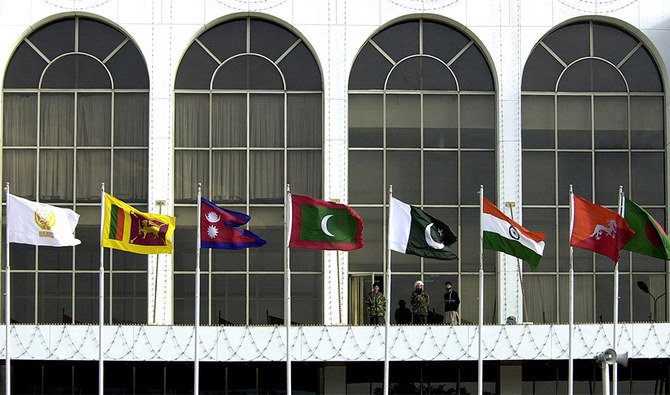

ISLAMABAD: Pakistani foreign minister Shah Mahmood Qureshi has said this week the South Asian nation had restated its willingness to host the next summit of the South Asian Association for Regional Cooperation (SAARC).
A summit of South Asian leaders set for Islamabad in 2016 was called off as several countries, led by India, decided not to attend amid rising tensions between arch-rivals New Delhi and Islamabad over militant attacks.
SAARC member states are Afghanistan, Bangladesh, Bhutan, India, the Maldives, Nepal, Pakistan and Sri Lanka.
“I restated Pakistan’s willingness to host the 19th SAARC Summit and for obstacles created in its way to be removed for SAARC to function as an effective instrument of regional cooperation,” Mahmood said in a Twitter post, providing details of the SAARC Council of Ministers meeting held on the sidelines of UN75, the 75th anniversary of the UN.
In this same spirit, I restated Pakistan’s willingness to host the 19th SAARC Summit and for obstacles created in its way to be removed for SAARC to function as an effective instrument of regional cooperation. https://t.co/vjzuAYHoKC
— Shah Mahmood Qureshi (@SMQureshiPTI) September 24, 2020
“As a founding member of #SAARC, [Pakistan] attaches great importance to the platform & charter which upholds the principle of sovereign equality as basis for meaningful regional cooperation,” the foreign minister added. “We will continue to play a proactive role toward the success of this important organization.”
In 2016, tensions between India and Pakistan rose as Indian Prime Minister Narendra Modi canceled a visit to Islamabad for SAARC after blaming Islamabad for a deadly assault on an army base in the disputed Himalayan region of Kashmir that had heightened fears of a new conflict between the nuclear-armed neighbors.
India said militants sneaked across the de facto border that separates the countries and killed 18 soldiers on September 18, 2016, the biggest loss of life for Indian security forces in the region for 14 years.
Pakistan rejected the accusation and said India should conduct a proper investigation before it apportions blame.
Divided between India and Pakistan since 1947, the flashpoint of Kashmir lies at the heart of the countries’ rivalry.


