

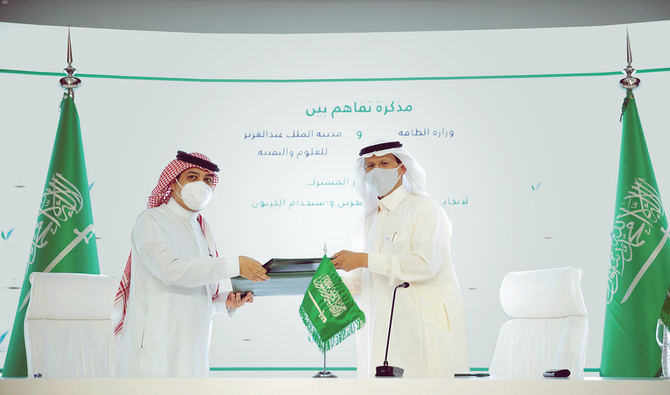

RIYADH: The Ministry of Energy and the King Abdul Aziz City for Science and Technology (KACST) inked on Wednesday a memorandum of understanding (MoU) to establish the Joint Center for Research on Carbon Capture, Storage and Use Technologies, with the aim of providing scientific support for the Kingdom’s carbon emissions commitments.
The MoU was signed by Prince Abdul Aziz bin Salman, minister of energy, and the head of KACST, Dr. Anas bin Fares Al-Faris. It aims to maximize local content in this field, provide a research environment to address carbon emissions and turn them into products of economic value, develop national research and development capabilities in cooperation with advanced global centers through technology transfer and marketing, and promote global leadership in the field of carbon capture, storage and use technologies.
Under the MoU, the two parties will work to develop a general framework to encourage research and development in the field of carbon capture, storage and use research techniques, unite efforts among research entities, cooperate with global centers, and focus on the Kingdom’s priorities, thus contributing to the diversification of its economic resources.
The memorandum includes promoting the exchange of statistical information and data for the implementation of research and joint ventures, and the exchange of scientific and research expertise and technical advice between the parties. It also includes research and development in carbon capture techniques at fixed sources of emissions such as power plants and cement plants, and seeks to reduce carbon dioxide (CO2) and nitrogen oxide emissions using oxygen combustion technology, and the development of carbon dioxide-to-solar photovoltaic conversion systems.
Other objectives of the MoU include the development of CO2 injection techniques with polymeric materials and fly ash in reservoirs, and the development of chemical catalysts for converting captured CO2 into high-performance polycarbonate.


