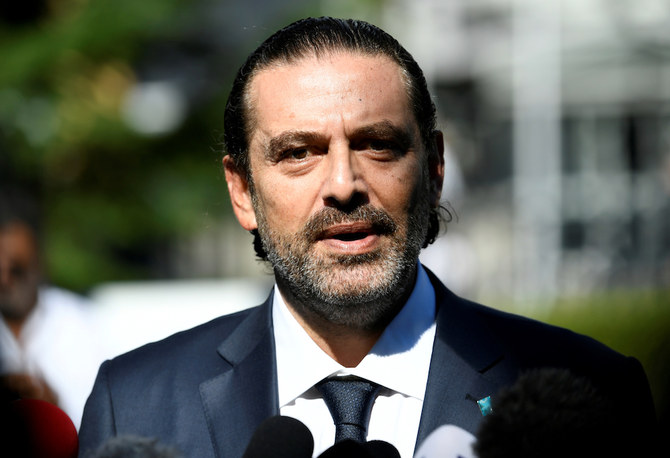

BEIRUT: France has welcomed former Lebanese prime minister Saad Hariri’s attempts to end the deadlock over the formation of a new government as the country confronts an increasingly urgent political and economic crisis.
Hariri said on Tuesday that he will assist Mustapha Adib, the prime minister-designate, in naming a finance minister from the Shiite community, chosen by Adib on the basis of “competence, integrity and lack of party affiliation.”
The former leader’s initiative appeared to be a concession to Amal Movement and Hezbollah demands that the portfolio be given to a Shiite MP nominated by both parties. Previously he had insisted the portfolio should be rotated between the rival political factions.
Hariri described his initiative as “taking poison alone once again,” while the French foreign ministry praised his efforts as “courageous and in the national interest of Lebanon.”
France’s response helped ease the pessimism that followed Lebanon’s failure to meet a deadline for the formation of a new government.
On Sept. 1, French President Emmanuel Macron gave rival Lebanese parties two weeks to form a mini-government of specialized ministers, with portfolios to be rotated between rival factions, saying that the government’s task should be exclusively to implement required reforms.
Paris has made widespread political and economic reform a condition of financial aid in the wake of the devastating Beirut port blast in early August.
The French foreign ministry said that Hariri’s initiative “constitutes an openness, the importance of which must be appreciated by all, in order for the mission government to be formed.”
It added: “This is what the Lebanese and Lebanon’s international partners want in these critical moments.”
The ministry called on “Lebanese political leaders to respect the commitments they made to President Macron, with the sole aim of meeting the urgent needs of Lebanon.” It promised that “France will continue to stand by Lebanon, and will ensure that the terms of international support for Lebanon are respected at every stage.”
On Wednesday, Adib said that he hoped to form a government “in consultation with President Michel Aoun that satisfies all the Lebanese and works to implement the economic, financial and monetary reforms stipulated in the French initiative.”
Hezbollah and the Amal Movement made no immediate response to Hariri’s move.
Deputy Parliament Speaker Elie Ferzli said after meeting the head of the Amal Movement, Speaker of Parliament Nabih Berri, that “there is promising potential to form a government, but we must wait.”
Hariri’s initiative is a “development that must be valued,” Ferzli added.
The Free Patriotic Movement (FPM), which refused to link the finance portfolio to a Shiite figure, said it hoped “Hariri’s initiative will contribute to a solution and that a productive government will be formed to implement reforms.”
Alain Aoun, an MP and FPM member, said: “The Hariri initiative opened a door that may be expanded to reach a new government.”
Sources close to Hariri said that he had retreated from his stance on the finance ministry after a phone call with Macron.
However, the former prime minister warned that the decision to designate a Shiite minister for the finance portfolio “is a one-time event and does not constitute a custom on which to build future governments.”
He described the step as “necessary to prevent the collapse of Lebanon and to save the Lebanese.”
Meanwhile, Lebanese journalist and activist Naufal Daou appeared before the Lebanese judiciary in a lawsuit filed by Health Minister and Hezbollah MP Hamad Hassan over claims that Iranian drugs and medicines had entered Lebanon illegally without undergoing required tests.
Daou said that he opened the Iranian medicine file during the term of former health minister Jamil Jabak, and described his summoning as “an attempt to silence a voice.”
He added: “Everything that comes to us from Iran is outside the law, ranging from medicine to weapons. As a journalist, if I commit a mistake, I must be tried before the publications court, not before the Criminal Investigation Department.”
Daou is a member of the Our Lady of the Mountain, a group that opposes Hezbollah.
Former MP Faris Saeed, who is also a member of the group, told Arab News that summoning Daou to appear before the judiciary “shows the administration has no tolerance and the Lebanese judiciary is working to implement political desires.”
The Media Against Violence Association condemned what it said was an attack on freedom of speech and expression.
“Freedom of expression is a red line in defense of a free and democratic Lebanon,” the association said.