Hopeful Afghan peace talks will yield Islamabad-Kabul agreement against violence — Khalilzad

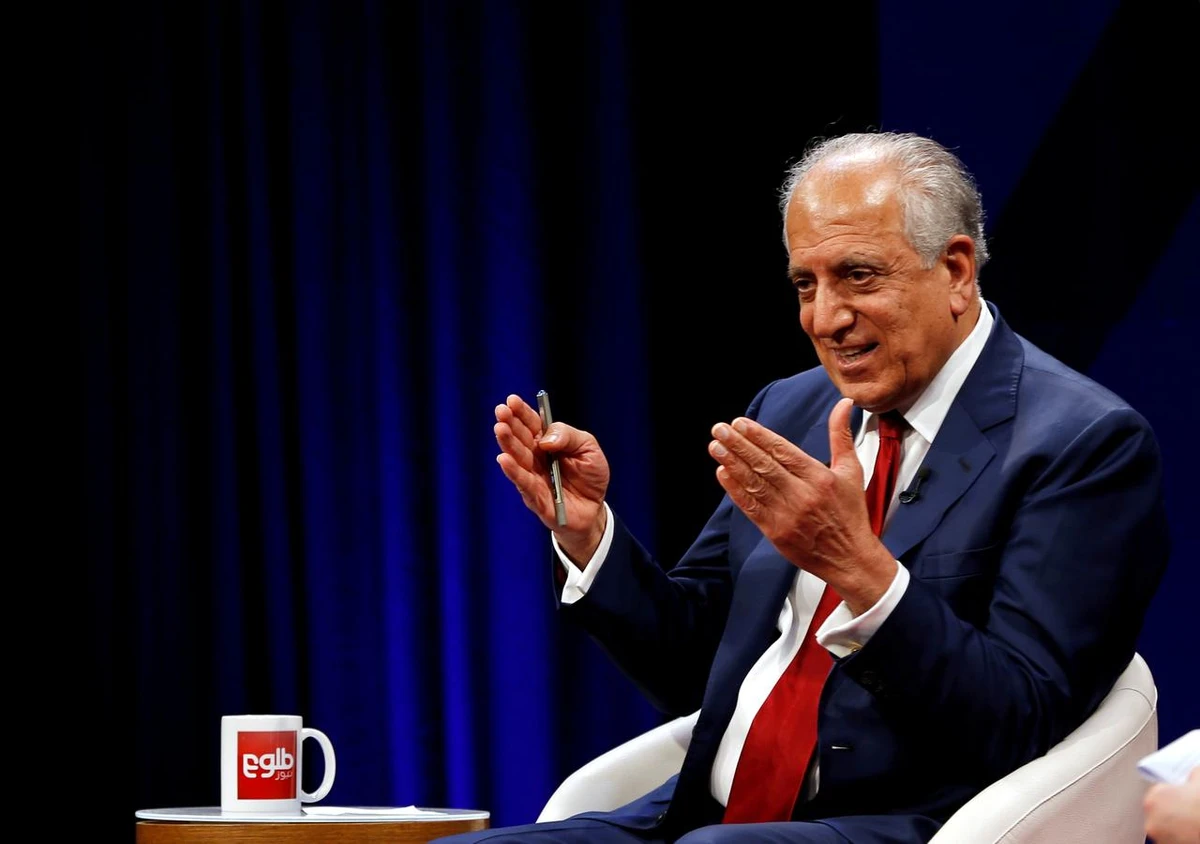
U.S. envoy for peace in Afghanistan Zalmay Khalilzad speaks during a debate at Tolo TV channel in Kabul, Afghanistan April 28, 2019. (Reuters)
Short Url
Updated 23 September 2020
Follow

Hopeful Afghan peace talks will yield Islamabad-Kabul agreement against violence — Khalilzad

  • US special representative on Afghan peace says Washington looking forward to Pak-Afghan agreement that neither side’s territory would be used to attack the other
  • Afghan government and Taliban remain divided on even basic issues 10 days into peace talks meant to end two decades of war

WASHINGTON: Washington and allies were hoping peace talks between the Afghan Taliban and the Kabul government would also yield an agreement between Afghanistan and Pakistan that neither side’s territory would be used to attack the other, the Special Representative for Afghanistan said on Tuesday, as the insurgents and Kabul remained divided on even basic issues 10 days into talks meant to end two decades of war.
Afghanistan has for years accused Pakistan of supporting Taliban militants. Pakistan denies doing so and in turn accuses Afghanistan of supporting militants fighting Islamabad, which Kabul denies. 
“We’re hoping that by the time that these other negotiations are over, we could also achieve success in that regard,” special envoy Zalmay Khalilzad told a House of Representatives hearing, referring to a deal between Kabul and Islamabad.
The level of violence in Afghanistan is unacceptably high and the United States expects further setbacks during talks, Khalilzad said: “By any measure, current levels of violence are too high … We know that reductions are possible.”
Despite difficulties, the talks are the best hope for peace in years and come as a result of a February pact between the Taliban and United States, allowing US forces to withdraw in exchange for Taliban promises on terrorism.
But the militant group has refused to agree to a cease-fire and the war grinds on.
In recent months, the Taliban has pledged to respect women’s rights under sharia but many educated women who have come of age since the Taliban were ousted in 2001 for harboring Al-Qaeda leader Osama bin laden have doubts.
During the hearing, Democrats asked Khalilzad about the possibility that after 20 years of war, billions of dollars and thousands of deaths, the withdrawal of US forces could end education for Afghan girls.
“I want to assure the Afghan women that we will be with them,” Khalilzad said.
Since the spotlight faded from the lavish September 12 opening ceremony for the talks in Qatar, the two sides have only confirmed that they are diametrically opposed on virtually every issue.
“While we have reasons to be hopeful, we are under no illusions about the challenges ahead. ... We expect that there will be setbacks and obstacles,” Khalilzad said.
The United States is expected to reduce troop levels to 4,000 to 5,000 in the coming months and will look at further reductions based on conditions.
David Helvey, who is performing the duties of assistant secretary of defense for Indo-Pacific security affairs, told the subcommittee hearing the Pentagon was carrying out “prudent planning” to withdraw all US troops from Afghanistan by May 2021 if conditions were met.
He added that for now Defense Secretary Mark Esper had not issued any orders to go below 4,000 troops.


Pakistan says on ‘strong path’ toward polio eradication after last vaccination drive of 2025

Updated 5 sec ago
Follow

Pakistan says on ‘strong path’ toward polio eradication after last vaccination drive of 2025

  • Pakistani health volunteers vaccinated over 44.6 million children from Dec. 15-21 campaign
  • Pakistan has reported 30 polio cases this year and has not reported a single one since September

ISLAMABAD: Pakistan’s National Emergency Operations Center (NEOC) said on Tuesday that the nation was on a “strong path” toward polio eradication, after authorities conducted the last nationwide anti-polio vaccination drive of the year a few days earlier. 

Pakistani health authorities conducted the last nationwide anti-polio vaccination of 2025 from Dec. 15-21. The NEOC earlier this week said it had vaccinated a total of 44.6 million children under the age of five during the seven-day campaign across the country. 

Pakistan and neighboring Afghanistan are the only two countries where transmission of the wild poliovirus has never been interrupted, posing a risk to global eradication efforts. The virus, which can cause irreversible paralysis, has no cure and can only be prevented through repeated oral vaccination.

“The NEOC reaffirms that Pakistan is on a strong path toward polio eradication,” the authority said in a statement. 

It noted that health volunteers vaccinated over 22.8 million children in Punjab, over 1 million in Sindh, over 7.1 million in Khyber Pakhtunkhwa (KP), and over 2.5 million children in Balochistan during the campaign. 

In Islamabad, over 450,000 children were vaccinated while in Gilgit-Baltistan, over 274,000 children and in Azad Kashmir over 714,000 were given polio drops. 

The NEOC said Pakistan’s polio cases declined from 74 in 2024 to 30 in 2025, reflecting measurable progress compared to the previous year.

“No polio cases have been reported since September 2025, highlighting the remarkable progress achieved through consistent and comprehensive immunization efforts across the country,” it said. 

Health officials say insecurity remains a major obstacle. Polio workers and their security escorts have repeatedly been targeted in militant attacks, particularly in parts of KP and Balochistan, complicating efforts to reach every child.

A gun attack targeting a polio vaccination team in Pakistan’s northwestern Bajaur district on Dec. 16 left one police constable and a civilian dead.

Natural disasters, including flooding, have also disrupted vaccination campaigns in recent years.

“The NEOC calls upon all stakeholders, including parents, community leaders and health workers, to continue their active support,” the center said.