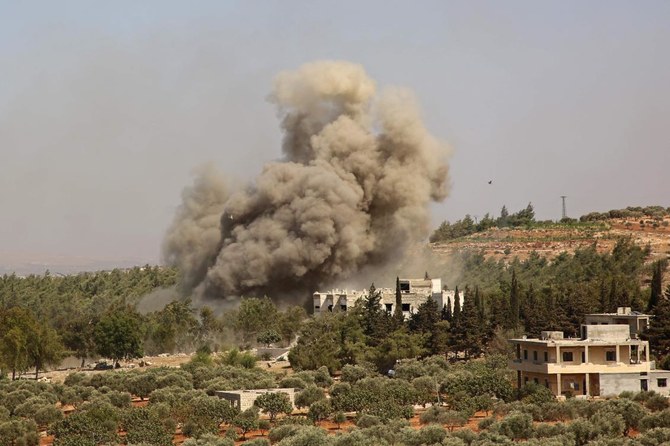
AMMAN: Syrian opposition sources said Russian jets bombed rebel-held northwestern Syria on Sunday in the most extensive strikes since a Turkish-Russian deal halted major fighting with a cease-fire nearly six months ago.
Witnesses said the warplanes struck the western outskirts of Idlib city and that there was heavy artillery shelling in the mountainous Jabal al Zawya region in southern Idlib from nearby Syrian army outposts. There were no immediate reports of casualties.
“These 30 raids are by far the heaviest strikes so far since the cease-fire deal,” said Mohammed Rasheed, a former rebel official and a volunteer plane spotter whose network covers the Russian air base in the western coastal province of Latakia.
Other tracking centers said Russian Sukhoi jets hit the Horsh area and Arab Said town, west of the city of Idlib. Unidentified drones also hit two rebel-held towns in the Sahel Al-Ghab plain, west of Hama province.
There has been no wide-scale aerial bombing since a March agreement ended a Russian-backed bombing campaign that displaced over a million people in the region which borders Turkey after months of fighting.
There was no immediate comment from Moscow or the Syrian army who have long accused militant groups who hold sway in the last opposition redoubt of wrecking the cease-fire deal and attacking army-held areas.
The deal between Turkish President Tayyip Erdogan and Russia’s President Vladimir Putin also defused a military confrontation between them after Ankara poured thousands of troops into Idlib province to hold back Russian-backed forces from new advances.
Western diplomats tracking Syria say Moscow piled pressure on Ankara in the latest round of talks on Wednesday to scale down its extensive military presence in Idlib. Turkey has more than ten thousand troops stationed in dozens of bases there, according to opposition sources in touch with Turkish military.
Witnesses say there has been a spike in sporadic shelling from Syrian army outposts against Turkish bases in the last two weeks. Rebels say the Syrian army and its allied militias were amassing troops on front lines.
Two witnesses said a Turkish military column comprising at least 15 armored vehicles was seen overnight entering Syria through the Kafr Lusin border crossing in the direction of a main base in rural Idlib.


![]()

Russian jets strike Syrian rebel-held bastion in heaviest strikes since cease-fire
Short Url
https://arab.news/8bb78
Russian jets strike Syrian rebel-held bastion in heaviest strikes since cease-fire
- 30 areas struck the western outskirts of Idlib city
- There were no immediate reports of casualties


Latest updates



© 2026 SAUDI RESEARCH & PUBLISHING COMPANY, All Rights Reserved And subject to Terms of Use Agreement.