

US military strengthens deployment in Syria

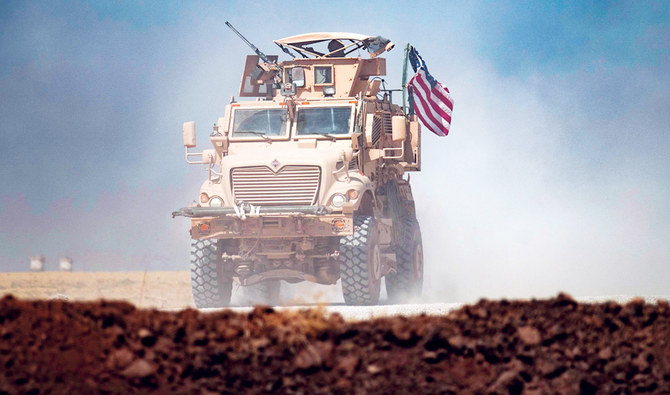
A US military vehicle patrols near the Rumaylan oil fields in Syria’s northeastern Hasakeh province, as Washington stepped up its military deployment in the area. (AFP)
Short Url
Updated 20 September 2020
Follow

US military strengthens deployment in Syria

  • Several incidents in recent weeks have pitted the US military against Russian forces now deployed along the Turkish border under an agreement with Ankara

WASHINGTON: The US Army announced on Friday it was stepping up its military deployment — both troops and equipment — in northeastern Syria despite a push to limit its presence there, a move that follows tensions with Russia in the region.
US Central Command (Centcom) “has deployed Sentinel radar, increased the frequency of US fighter patrols over US forces, and deployed Bradley Fighting Vehicles to augment US forces” in the area, which is controlled by the US and its Kurdish allies, spokesman Captain Bill Urban said in a statement.
The number of armored vehicles sent as reinforcement did not exceed half a dozen, and “less than 100 people” were sent to maneuver them, a US official who spoke on condition of anonymity said.
Without mentioning Russia, Urban said the moves were meant “to help ensure the safety and security of coalition forces,” and that the US “does not seek conflict with any other nation in Syria, but will defend coalition forces if necessary.”
The US official, who spoke on condition of anonymity, said however that the actions “are a clear signal to Russia to adhere to mutual de-confliction processes and for Russia and other parties to avoid unprofessional, unsafe and provocative actions in northeast Syria.”
US Bradley Fighting Vehicles were pulled out of the region last October by President Donald Trump, who tried in early 2019 to recall all US troops from Syria, before agreeing to leave a few hundred to protect oil wells.
Several incidents in recent weeks have pitted the US military against Russian forces now deployed along the Turkish border under an agreement with Ankara.
At the end of August, seven American soldiers were injured in a collision with a Russian vehicle.
Videos posted on Twitter, apparently filmed by witnesses and the Russians themselves, showed Russian armor and helicopters attempting to block American vehicles and then force them out of the area.

HIGHLIGHT

Several incidents in recent weeks have pitted the US military against Russian forces now deployed along the Turkish border under an agreement with Ankara.

The tanks were flown in from a base in Kuwait, anti-militant coalition spokesman Col. Wayne Marotto said in another statement.
US and Russian troops frequently interact in Syria, but confrontations have been rare.
Meanwhile, the Syrian regime criticized the Netherlands on Saturday for launching a new bid through international bodies to hold it responsible for alleged gross human rights violations.
A Foreign Ministry source quoted by state news agency SANA accused the Netherlands of abusing its position as host of a number of the bodies concerned.
“The Dutch government ... is determined to use the International Court of Justice (ICJ) in The Hague to serve the political agendas of its American master,” the ministry source said.
The source accused the Netherlands of doing so “in a flagrant violation of its obligations and commitments as the headquarters state of this international organization.”
On Friday, the Dutch government announced that it was pursuing all legal avenues to ensure that the Syrian regime was held to account for its human rights record.
An attempt to refer top Syrian government officials to the International Criminal Court (ICC) in The Hague for prosecution was blocked by Chinese and Russian vetoes in May 2014.
But the Dutch government said that, if arbitration failed, it would pursue action through an international court, the most likely being the ICJ, also in The Hague.
Unlike the ICC, which deals with cases against individuals, the ICJ deals with disputes between UN member states and breaches of UN treaties, and is the world body’s top judicial organ.
Syria signed the UN Convention against Torture in 2004 and the Dutch government said its legal action would focus on alleged breaches of that treaty.
The US and the EU have targeted numerous figures linked to the Damascus regime with economic sanctions since the civil war erupted in 2011.
But concerted international action has been blocked by deep divisions over the conflict.
The war has killed more than 380,000 people and driven millions from their homes since it started with the brutal repression of anti-government protests.


Israeli minister calls West Bank measures ‘de facto sovereignty,’ says no future Palestinian state

Updated 4 sec ago
Follow

Israeli minister calls West Bank measures ‘de facto sovereignty,’ says no future Palestinian state

  • Eli Cohen’s comments on Tuesday suggest these steps prevent the establishment of a Palestinian state
  • alestinians, Arab countries, and human rights groups view the actions as annexation
RAMALLAH: A top Israeli official said Tuesday that measures adopted by the government that deepen Israeli control in the occupied West Bank amounted to implementing “de facto sovereignty,” using language that mirrors critics’ warnings about the intent behind the moves.
The steps “actually establish a fact on the ground that there will not be a Palestinian state,” Energy Minister Eli Cohen told Israel’s Army Radio.
Palestinians, Arab countries and human rights groups have called the moves announced Sunday an annexation of the territory, home to roughly 3.4 million Palestinians who seek it for a future state.
Cohen’s comments followed similar remarks by other members of Prime Minister Benjamin Netanyahu’s government, including Finance Minister Bezalel Smotrich and Defense Minister Israel Katz.
The moves — and Israeli officials’ own descriptions of them — put the country at odds with both regional allies and previous statements from US President Donald Trump. Netanyahu has traveled to Washington to meet with him later this week.
Last year, Trump said he won’t allow Israel to annex the West Bank. The US-brokered ceasefire between Israel and Hamas that aimed to stop the war in Gaza also acknowledged Palestinian aspirations for statehood.
Widespread condemnation
The measures further erode the Palestinian Authority’s limited powers, and it’s unclear the extent to which it can oppose them. Still, Hussein Al Sheikh, the Palestinian Authority’s deputy president, said on Tuesday “the Palestinian leadership called on all civil and security institutions in the State of Palestine” to reject them
In a post on X on Tuesday, he said the Israeli steps “contradict international law and the agreements signed with the Palestine Liberation Organization.”
A group of eight Arab and Muslim-majority countries expressed their “absolute rejection” of the measures, calling them in a joint statement Monday illegal and warning they would “fuel violence and conflict in the region.”
Israel’s pledge not to annex the West Bank is embedded in its diplomatic agreements with some of those countries and renewed warnings that it was a “red line” for the Emirates led Israel to shelve some high-level discussions on the matter last year.
United Nations Secretary General Antonio Guterres said he was “gravely concerned” by the measures.
“They are driving us further and further away from a two-State solution and from the ability of the Palestinian authority and the Palestinian people to control their own destiny,” his spokesperson, Stephane Dujarric, said on Monday.
What the measures mean
The measures, approved by Netanyahu’s Security Cabinet on Sunday, expand Israel’s enforcement authority over land use and planning in areas run by the Palestinian Authority, making it easier for Jewish settlers to force Palestinians to give up land.
Smotrich and Katz on Sunday said they would lift long-standing restrictions on land sales to Israeli Jews in the West Bank, shift some control over sensitive holy sites — including Hebron’s Ibrahimi Mosque, also known as the Tomb of the Patriarchs — and declassify land registry records to ease property acquisitions.
They also revive a government committee empowered to make what officials described as “proactive” land purchases in the territory, a step intended to reserve land for future settlement expansion.
Taken together, the moves add an official stamp to Israel’s accelerating expansion and would override parts of decades-old agreements that split the West Bank between areas under Israeli control and areas where the Palestinian Authority exercises limited autonomy.
Israel has increasingly legalized settler outposts built on land Palestinians say documents show they have long owned, evicted Palestinian communities from areas declared “military zones” and villages near archaeological sites it has reclassified as “national parks.”
More than 700,000 Israelis live in the occupied West Bank and east Jerusalem, territories captured by Israel in 1967 and sought by the Palestinians for an independent state along with the Gaza Strip.
Palestinians are not permitted to sell land privately to Israelis. Settlers can buy homes on land controlled by Israel’s government.
The international community overwhelmingly considers Israeli settlement construction to be illegal and an obstacle to peace.
“These decisions constitute a direct violation of the international agreements to which Israel is committed and are steps toward the annexation of Areas A and B,” anti-settlement watchdog group Peace Now said on Sunday, referring to parts of the West Bank where the Palestinian Authority exercised some autonomy.