
KARACHI: Pakistan’s Agha Steel Industries Limited (ASI) plans to set up a Rs7 billion ($42 million) modern steel manufacturing plant at Port Qasim to meet the growing market demand as the country witnesses a flurry of construction activity under the China-Pakistan Economic Corridor (CPEC) and the prime minister’s flagship Naya Pakistan Housing Program.
“To finance the expansion project, we plan to raise Rs3.6 billion through initial public offering at the Pakistan Stock Exchange early next month,” Hussain Agha, chief executive of the company, told Arab New in an exclusive interview on Friday.
The company is importing Rs2.7 billion worth of plant and machinery.
#WATCH: #Steel consumption in #Pakistan will increase manifolds as #CPEC and local projects fuel demand, says Hussain Agha, Chief Executive of @AghaSteelIndus || #Pakistan #China #ImranKhan #Economy
-
Read special by @Khurshid72: https://t.co/3tGdGl7CYd pic.twitter.com/kqQvKU241j— Arab News Pakistan (@arabnewspk) September 19, 2020
Agha Steel plans to offer 120 million shares at a floor price of Rs30. According to its management, 75 percent of them — or about 90 million shares — will be offered through book building process while the remaining 25 percent will be issued to general public through retail offer at strike price determined by the book building process.
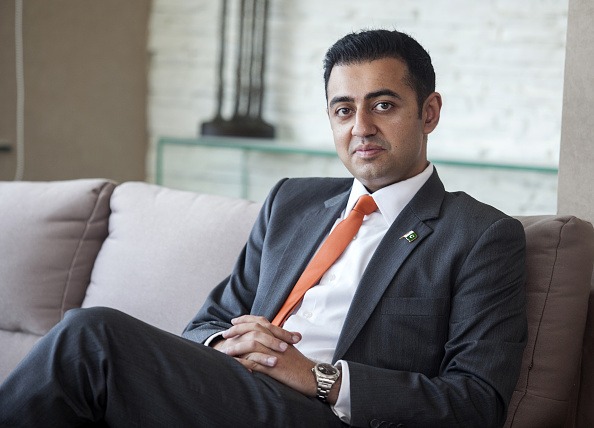
In this undated photo, Hussain Agha of the Agha Steel Industries Limited can be seen at his office in Karachi. The company plans to expand its existing production facility and hope to turn Pakistan into the region's steel making hub. (Picture courtesy of Hussain Agha)
“Potentially the amount may go beyond Rs5 billion,” he noted, as Pakistan’s stock market remains in a bullish mood and is said to be Asia’s best performing market at the moment.
The successful execution of project by March 2021 will allow the company to increase its melting capacity from 450,000 metric tons to 650,000 metric tons.
Agha Steel has also acquired the land right next to its current facility to install a new Micro Mill Danieli Rolling Mill, a super compact unit when compared to traditional mini mills, that occupies about 49 percent less space and gives about 23 hours of uninterrupted production.
“This technology guarantees 99 percent recovery,” Agha informed while explaining that the average yield from billet in Pakistan was 90 to 92 percent while the international standard was 97 percent.
“After the expansion, we will have one of the largest steel manufacturing facilities in Pakistan,” he said, adding that his company would produce all kinds of steel products required in the country, including those used in the construction of dams.
Pakistan’s steel sector is a major beneficiary of the ongoing construction of dams financed by China under the $60 billion mega CPEC program and the ruling Pakistan Tehreek-e-Insaf party’s low cost housing project.
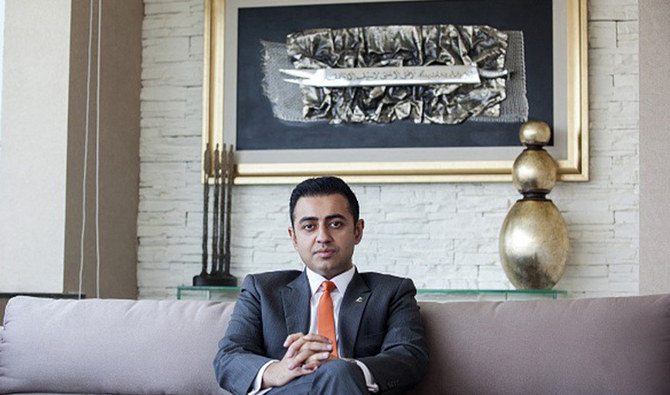
In this undated photo, Hussain Agha of the Agha Steel Industries Limited can be seen at his office in Karachi. The company plans to expand its existing production facility and hope to turn Pakistan into the region's steel making hub. (Picture courtesy of Hussain Agha)
“We have made bids for five dam projects,” the ASI chief said, adding: “We expect that steel will be in a huge demand as the country constructs dams, mainline ML-1 train track and gets into coal and wind projects. Construction activity in Pakistan is booming.”
Pakistan’s steelmakers estimated that 2.17 million tons of steel would be required in 24 months for confirmed dam and Naya Pakistan housing projects. The major demand of about 1.5 million tons is estimated to come from seven hydropower plants, including Dasu and Diamer-Bhasha dams whose combined steel requirement is expected to be 900,000 metric tons.
Pakistan’s dam projects are being constructed and financed by China.
Agha said he could see a surge in demand after Prime Minister Imran Khan announced incentives for the construction sector.
“Last year, our sale to real estate developers was 12 percent,” he said. “Today, we are looking at more than 35 percent … which implies about 200 percent growth in this segment. The government’s policies are translating into ground realities, and the central bank is supporting the growth momentum.”
“If the government built 100,000 housing units, we believe it would generate a demand of about one million tons of steel only for these homes,” he added.
The company expects its revenue to increase to Rs26.18 billion this fiscal year (FY21) from Rs15.7 billion in the outgoing fiscal year (FY20). It forecasts its revenue to be Rs58.4 billion in FY24.
Agha Steel is also eyeing export of its steel products after satisfying the domestic demand which, at present, stands at about 5 million tons per annum.
“Exporting steel from Pakistan was a longtime dream,” Agha said, adding that his company could potentially become an exporter by 2023.
“Pakistan will become the epicenter of steel making in the region,” he told Arab News with conviction.