

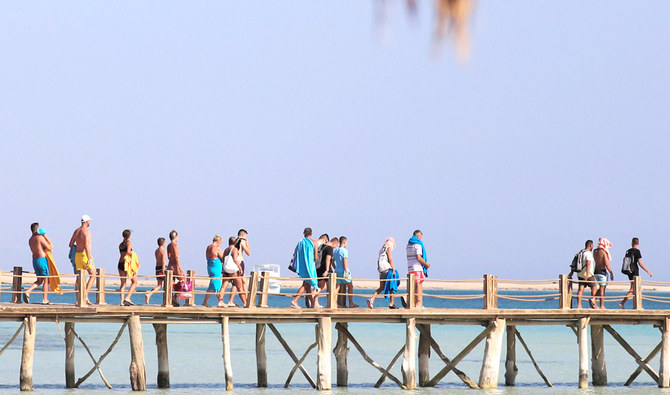
Egypt’s resorts face tough winter as visitor numbers plummet

Tourism accounts for about 15 percent of Egypt’s national output, and the sector is losing about $1 billion a month. The pandemic has taken a heavy toll on the country, which requested $8 billion in new loans from the IMF this year alone. (Reuters)
Short Url
Updated 19 September 2020
Follow

Egypt’s resorts face tough winter as visitor numbers plummet

  • Some regions have seen a 90 percent reduction in tourism, leaving the sector pleading for state assistance

CAIRO: At the Pyramids of Giza, just a handful of tourists walks among the ancient wonders. Only 12 people showed up to admire Luxor’s towering colonnades the day it reopened this month. At Egypt’s Red Sea resorts, visitor numbers are well below previous years.

Even as international flights and tourist spots open up and Egypt’s coronavirus cases remain in check, officials, hotel owners and tour guides concede that the key winter season starting in October is going to be tough.
That could be bad news for the economy. Tourism accounts for up to 15 percent of Egypt’s national output, and officials said it was losing about $1 billion each month after the sector all but shut down from March as the coronavirus pandemic struck.
Egyptian officials say they are making every effort to reassure tourists about their safety and encourage them to visit in the hope that the sector revives gradually.
Egypt is not alone in seeing tourism slump, but it takes a heavy toll on a country that has tapped the International Monetary Fund for $8 billion in new loans this year.
“We used to see about 50 buses here. Now there are none,” said Samir, a souvenir trader who has been working at the pyramids south of Cairo for more than 30 years and has been selling his possessions to pay his son’s school fees.
“We only had one bus, a week ago, full of Russians. They took some photos and left.”
A showpiece museum next to the pyramids is due to open next year, increasing the need for a rapid recovery in 2021.
Westerners typically flock to Egypt’s historic sites and golden sands between October and May to avoid the cold at home and the excessive heat of Egypt’s summer.

FASTFACT

Tourism accounts for about 15 percent of Egyptian GDP.

As the sector gears up, hotel resorts are operating at below half capacity and major sites remain virtually empty, tourist workers and official said.
Some 220,000 tourists have visited the Red Sea province and South Sinai — home to the Sharm El-Sheikh resort — since July 1, less than 10 percent of last year’s levels, said Ghada Shalaby, a deputy minister at the Tourism and Antiquities Ministry.
Shalaby said visitors were gradually returning to the coastal resorts, but people’s safety took priority over boosting tourism numbers.
Hotels currently have capacity capped at 50 percent in line with health regulations.
Occupancy at Sharm el-Sheikh is 30 to 35 percent and in Egypt’s Red Sea Governorate and the resort of Hurghada it is 35 to 45 percent, a Tourism Ministry official said.
As sites in Luxor, across the River Nile from the Valley of the Kings, reopened on Sept. 1, a single group of 12 tourists showed up on a visit from Hurghada, said Tharwat Agamy, head of the regional branch of the Egyptian Travel Agents Association. A few more have visited the city daily since then.
Nile cruises are due to restart in October, but there is little expectation that bookings will pick up without a return of charter flights.
“We hope that next year tourism will be working,” said Agamy.
The state has moved to protect the sector with emergency funding, and more than 9,000 registered tour guides will receive 500 Egyptian pounds ($32) monthly until the end of the year. Tourism firms are pleading for exemptions on some fees to be extended.
Mohamed Othman, who owns a Nile cruise boat and a hotel and markets cultural tourism in southern Egypt, said he was hopeful for some bookings in November, and reopening sent an important signal, even if “an influx won’t happen overnight.”
Officially recorded coronavirus cases have fallen to under 200 daily from highs of about 1,500 daily in mid-June. Officials say tourist sites and hotels are subject to strict controls. Those entering the country are required to take PCR tests. But the EU has not added Egypt to its safe travel list.
“We are sparing no effort to ensure that all measures are in place for the return of tourism to the maximum possible capacity and to spread reassurance to the tourists,” said Shalaby.
At Cairo’s Khan Al-Khalili market, a popular tourist shopping spot, many stores are shuttered.
“There is no one,” said Sayed Abel Khaleq, a silver shop owner.



War threatens food supplies in Asia as fertilizer prices soar 

Updated 10 sec ago
Follow

War threatens food supplies in Asia as fertilizer prices soar 

RIYADH: How could a missile strike on a Qatari gas facility drive up the price of rice in Bangladesh? The answer lies in an unappealing commodity, yet one that forms a significant part of the world’s food supply: fertilizer. 

Qatar burns natural gas to produce ammonia, which is then converted into urea. Urea is added to the soil, where grain is grown. 

According to the South China Morning Post, disrupting the first step, as Iran did when it struck QatarEnergy’s liquefied natural gas processing facility on March 1, will have cascading effects along the food production chain. 

The price of urea in Southeast Asia has jumped by more than 40 percent since the Qatari LNG plant went offline. 

By March 9, prices for April and May shipments had surpassed $700 per tonne, their highest level since the third quarter of 2022, when the Russia-Ukraine War disrupted global supplies. 

The Gulf region currently accounts for about 45 percent of global urea exports. 

But the Iranian attacks have made passage through the Strait of Hormuz extremely risky. As a result, shipments representing about one-third of the world’s fertilizer trade have been halted, with Asia being among the most vulnerable regions. 

3 to 4 million tonnes of fertilizer will not reach markets monthly 

According to estimates by analytics firm Signal Ocean, between 3 and 4 million tonnes of fertilizer per month will not reach markets as long as the Strait of Hormuz remains closed. 

The impact will be particularly severe on South Asia. Pakistan imports most of its LNG from Qatar and the UAE, while Qatar supplies India with more than 40 percent of its LNG imports and about two-thirds of Bangladesh’s. 

All 32 ammonia plants in India — one of the world’s largest producers of nitrogen fertilizers — run on gas. According to Indian media reports, one plant has shut down due to shortages, while three others have reduced production. 

CRU Group vice president of market intelligence and pricing Chris Lawson believes the three South Asian countries will have to “pay a very high price” for fertilizers if they can obtain them on the open market. If they cannot, it will ultimately affect their upcoming harvests.  

Timing is crucial, as farmers in northern India and Pakistan typically fertilize their summer monsoon crops, such as rice, sugarcane, corn, and cotton, between April and July. 

CRU Group estimates that if the disruption to Gulf supplies continues until early April, South Asian buyers could need up to 1.5 million tonnes of additional supply per month. 

The impact of the delay in August 

What makes managing this impending crisis even more difficult is that its effects are not immediate. Fertilizers not purchased in March do not necessarily mean empty shelves in April, but rather a decline in crops in August, by which time the season will be over and nothing can be done about it. 

In an analysis distributed to clients earlier this month, CRU Group warned that if the Gulf crisis continues beyond March 20, “the main risk will shift to wider supply disruptions” due to restricted export routes and limited storage capacity. 

Even if tensions subside, restarting idle production capacity will take an additional two weeks, resulting in a “significant reduction” in Middle East supplies until at least late March. 

Disruptions of this magnitude have triggered a chain reaction in the past, according to Signal Ocean. Farmers use less fertilizer, marginal land requiring more inputs is left uncultivated, and producers switch to crops with lower nitrogen requirements. 

For example, soybeans may replace corn, leading to a surplus in one market and a shortage in another. If enough producers abandon corn cultivation, animal feed will become scarce and prices will rise, followed by higher prices for farmed meat and fish. 

India, China most vulnerable to disruptions 

According to Signal Ocean, India and China are the most vulnerable to supply disruptions, as each relies on the Gulf for approximately 20 percent of its fertilizer imports. 

The company explained that the likely outcome would be lower global crop yields, higher feed and food prices, and increased volatility in agricultural commodity markets. 

Alternative exporters, most notably the US and Brazil, may attempt to compensate for some of the shortfall, but the company indicated that the timing and scale of this response will be crucial in determining the severity of the impact. 

Impossible Choices 

For individual farmers at the periphery of supply chains, the effects could be devastating, according to Alexandra Brand, vice president of sustainability and corporate affairs at Syngenta Group. 

She explained that these farmers already operate on very thin profit margins and may be forced to make difficult choices in the coming months if fertilizer costs rise sharply and supplies dwindle. 

Brand explained that small farmers, family farms, and large commercial farms will all feel the pressure, as each will have to choose between paying prices they cannot afford, cultivating less land, or forgoing fertilizer altogether and accepting a smaller harvest. 

She said that the continued disruption of fertilizer supplies threatens “agricultural productivity and food security for millions of people.” 

Currently, fields are still being planted but most of the fertilizer that was supposed to reach Asian farms is either stuck in the Gulf or has not been produced at all. 

This year’s harvest will reveal this reality. By the time the effects become apparent, it may be too late to act.