

Deal with Israel will help UAE move away from oil: Minister

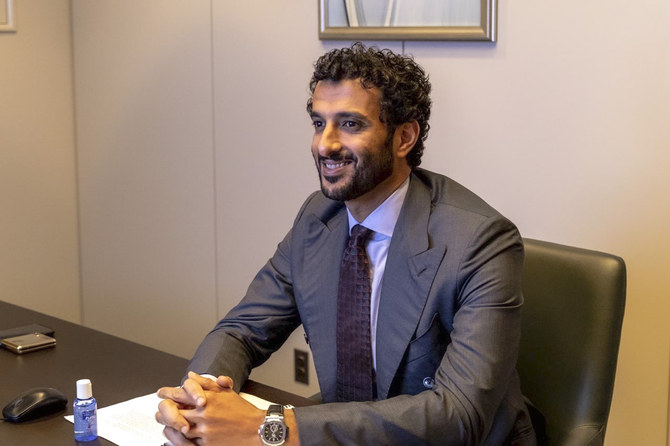
Emirati Economy Minister Abdulla bin Touq Al-Mari said both nations, the UAE and Israel, will learn from each other. (WAM)
Short Url
Updated 17 September 2020
Follow

Deal with Israel will help UAE move away from oil: Minister

  • Abdulla bin Touq Al-Mari said the UAE-Israel accord could generate between $300 million and $550 million in new business deals for his country
  • Al-Mari predicted that the UAE and Israel will partner in developing solar power for the region, that there will be a focus on reducing trade tariffs

CHICAGO: The accord between Israel and the UAE will help the latter shift its reliance on oil production and exportation to other industries in the near future, Emirati Economy Minister Abdulla bin Touq Al-Mari told a gathering hosted by the Atlantic Council and attended by Arab News.

The UAE and Bahrain each signed peace deals with Israel, dubbed the Abraham Accords, at the White House on Tuesday.

Al-Mari said the UAE-Israel accord could generate between $300 million and $550 million in new business deals for his country.

The UAE is the eighth-largest oil-producing country in the world, and seventh in terms of oil exports, which the country estimates accounts for a quarter of its gross domestic product.

“Both nations (the UAE and Israel) will learn from each other … In the UAE we’re very strong in trade. We’re very strong in terms of logistics, in airlines, construction,” Al-Mari said, adding that water and agricultural development are important too.

“There’s a lot of learning in future technology here … The current economic mix for the region can’t depend on oil,” he said.

“We need to redesign the future of the economy, the future of the economic mix. What mix of the economy do we need 10 years down the line? That’s what’s important, and that’s what the conversation is going to be about.”

Al-Mari predicted that the UAE and Israel will partner in developing solar power for the region, that there will be a focus on reducing trade tariffs, and that the accord will progress better than those struck by Israel with Egypt and Jordan.

“We’re very, very excited. I think both nations (the UAE and Israel) come in with an attitude of excitement and curiosity … How can we change for the better?” he said.

“I think it’s important to look at our strengths … We have so many similarities on things that we do. We have a lot of similarities in our economics … and I think it’s just a matter of putting our heart into it, our mind to it and moving forward faster with it,” he added.

“This signing was historic. It was a day that fills the future with optimism, hope and confidence.”

Al-Mari said he received his first phone call from an Israeli official the morning before the discussion, from the minister of economy and trade.

“We had a great conversation … We said, ‘Let’s move fast, let’s move for the nation, let’s move for the people, let’s move for the Palestinian people’.”

Al-Mari emphasized several times that the interests of the Palestinians will continue to be a priority for the UAE.

“We have confirmation from both parties (the US and Israel) that this agreement will bring benefits to the Palestinians,” he said.

Al-Mari added that the UAE-Israel deal will not be one-sided, and that the two countries will “complement” rather than “compete.”


As US weighs its options with Tehran, the region awaits with anticipation

Updated 6 sec ago
Follow

As US weighs its options with Tehran, the region awaits with anticipation

  • Saudi sources deny any attempts to influence position in Washington, DC

RIYADH: The US is continuing to weigh its options toward Iran as the aircraft carrier USS Abraham Lincoln heads toward the Middle East, amid heightened tensions and widespread protests across the Islamic Republic.

The deployment, reported since late Friday, comes as Washington reiterates that all options remain on the table in its approach to Tehran, which it considers a major regional foe, with Iran’s handling of the protests as a key factor in their ongoing deliberations.

Saudi officials have rejected claims that Riyadh is attempting to influence decision-making in Washington.

A senior Saudi official at the Kingdom’s embassy in the US said that reports suggesting Saudi Arabia had advised the US against striking Iran “are not true.”

Earlier this week, Saudi Minister of State for Foreign Affairs Adel Al-Jubeir was asked about the unrest in Iran and the prospect of a US response during a major business conference in Riyadh.

While stopping short of offering a direct view on potential military action, Al-Jubeir said that “everybody is watching the situation very closely,” expressing hope that tensions could be resolved in a way that would “minimize any kind of damage.”

Saudi commentator Ali Shihabi also denied that Riyadh was lobbying either for or against a strike on Iran. Writing on X, he said: “Saudi Arabia did not get involved in this discussion one way or the other.”

In a separate commentary published in the Saudi daily Asharq Al-Awsat, columnist Abdulrahman Al-Rashed hinted that Iran itself now holds the key to avoiding further escalation.

“Ending the nuclear program and stopping external activity could spare Iran foreign intervention that enables internal change by exploiting widespread domestic unrest,” he argued.

Al-Rashed described the current moment as unprecedented for the Islamic Republic.

“The Iranian regime is facing an existential crisis for the first time since the founder of the Islamic Republic returned to Tehran,” he said.

“There is only one actor capable of preventing its descent, and possibly its collapse, and it is neither Washington, nor Israel, nor the Gulf states. The only party capable of saving the Iranian regime from its fate is the regime itself.”

“This time, the threats against it have converged, and together they are capable of bringing it down. Danger surrounds it both internally and externally,” he concluded.