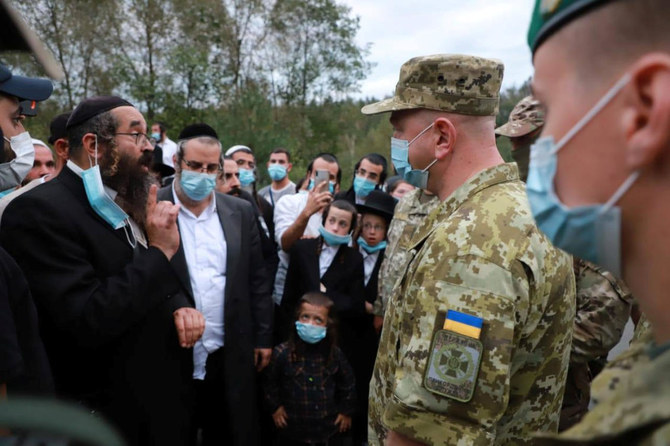
KIEV: The Ukrainian presidency on Wednesday accused Belarus of aggravating tensions along their shared border after Kiev barred entry to some 2,000 Hasidic Jewish pilgrims over coronavirus travel restrictions.
Kiev stopped the pilgrims, who were trying to reach the central Ukrainian city of Uman, in line with its ban on foreign visitors as it battles a sharp increase in new infections.
“We call on the Belarusian authorities to stop creating additional tension on the border,” the Ukraine statement said, accusing Minsk of giving the pilgrims false hope that they would be allowed to enter.
Tens of thousands of Hasidic Jews travel to Uman every Jewish New Year — which falls on September 18-20 this year — to visit the tomb of Rabbi Nahman, the founder of the Breslov Hasidic movement.
The presidency said roughly 2,000 pilgrims, mostly from Israel, had congregated on the border between Belarus and Ukraine “believing rumors that the Ukrainian border with Belarus was open,” the presidency said.
The statement urged Minsk not to spread “false encouraging statements that may give pilgrims the impression that the Ukrainian border may still be open to foreigners.”
A Ukraine border guard spokesman told AFP the pilgrims were attempting to enter the country from different crossings.
Ukraine has closed its borders to foreigners until September as part of reimposed restrictions to slow the spread of the virus.
Belarusian leader Alexander Lukashenko on Wednesday told his officials to negotiate a travel corridor with Kiev for the pilgrims to reach holy sites and offered to coordinate transport.

Belarus inflaming Jewish pilgrim standoff, says Ukraine
https://arab.news/59q4r
Belarus inflaming Jewish pilgrim standoff, says Ukraine
- Kiev says 2,000 pilgrims, mostly from Israel, have congregated on the border between Belarus and Ukraine “believing rumors that the Ukrainian border with Belarus was open”
- Kiev urged Minsk not to spread “false encouraging statements that may give pilgrims the impression that the Ukrainian border may still be open to foreigners”
Philippines struggles to evacuate nationals from Middle East as attacks escalate across region
- Over 1,400 Philippine nationals in Middle East have requested for repatriation
- Filipinos are told to shelter in place, follow host government’s advice on situation
MANILA: The Philippines is in talks to evacuate its nationals from across the Middle East, President Ferdinand Marcos Jr. said on Tuesday, as an increasing number of Filipinos are seeking to leave amid growing destruction from US-Israeli strikes on Iran and Tehran’s counterstrikes against US bases in Gulf countries.
More than 2.4 million Filipinos live and work in the Middle East, where tensions have been high since Saturday, after coordinated US-Israel strikes killed Iran’s Supreme Leader Ali Khamenei and senior Iranian officials.
Tehran responded by targeting US military bases in Gulf countries, and violence has been widening across the region.
Evacuating Philippine nationals across the region is not yet possible, Marcos said, as countries closed their airspace, leading to airport shutdowns and the cancellation of thousands of flights throughout the Middle East.
“For now, we are depending on the advice that will be given to us by the local authorities in the place where our nationals — where our people — are,” Marcos told reporters in Manila on Tuesday.
The Philippine government has received requests for repatriation from more than 1,400 Filipino nationals in various Middle Eastern countries, including 872 from the UAE and almost 300 from Israel. Similar requests have also been made by Filipinos in Iran, Bahrain and Jordan.
“Right now, the most dangerous area for our people right now would be Israel as attacks there are continuous,” Marcos said.
“The problem now is that no planes are flying and airports are being hit. That’s why the situation is very fluid, our assessment is that it may be too dangerous to mount flights.
“Even if we could charter an aircraft, we cannot do anything because number one, the airports are closed. They are all no-fly zones.”
As the Philippine government prepares for multiple scenarios, officials have secured buses and other vehicles for possible evacuation by land.
Filipinos in “danger areas” have been moved to a safer place, Marcos said, citing the targeting of Saudi Arabia’s Ras Tanura oil refinery by Iranian drones on Monday morning.
“But essentially our advice to them is shelter in place and follow the host government’s advice … For now it’s extremely difficult to enter or exit the region because the only aircraft flying are fighter jets and drones, and missiles.
“That’s why it is not a place that you would want to put in a civilian aircraft to take out our nationals,” he said.
“But again, as I said, the situation is changing by the minute, by the hour. We just have to be in very good and close contact with the local authorities.”


