Clashes and low turnout at new French ‘yellow vest’ protests

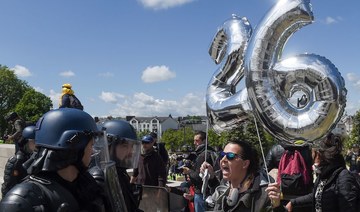
A French CRS riot police officer gestures as a car burns behind him during a demonstration of the yellow vests movement in Paris, France September 12, 2020. REUTERS/Gonzalo Fuentes
Short Url
Updated 12 September 2020
Follow

Clashes and low turnout at new French ‘yellow vest’ protests

  • At least one car and several rubbish bins were set on fire and street furniture was toppled by demonstrators near Place Wagram in northwest Paris
  • Elsewhere in the city center, hundreds of police were deployed at the Champs-Elysees avenue where authorities banned demonstrations

PARIS: Around 1,000 people gathered in two “yellow vest” protests in the French capital Paris Saturday in lower-than-hoped-for numbers for the movement’s hoped-for September comeback, later clashing with police who fired tear gas.
An AFP journalist saw at least one car and rubbish bins set on fire and street furniture toppled by demonstrators near Place Wagram in northwest Paris, while police lobbed tear gas grenades after the march left its planned route.
Tens of thousands rallied in 2018-19 under the yellow vests’ banner against President Emmanuel Macron’s perceived prioritization of business and the rich over struggling ordinary families.
The demonstrations sometimes descended into scenes of violence and looting that drew harsh police responses, which were in turn criticized in France and beyond.
With its weak turnout Saturday, “the movement is dead, I’ll say that clearly, but we’re here because we have nothing to lose. This is a kind of last stand,” said Michael, a 43-year old protester in the crowd at Place de Wagram before the march got started.
Stephane, a 48-year-old who had traveled from the Paris suburbs to join the rally, disagreed.
The yellow vests movement “has been struggling for a few months but it will never die,” he said. “As more people are laid off from their jobs, they’ll increasingly wake up.”
A second march starting from central Place de la Bourse saw protesters brandish signs with modest demands like “being able to fill your fridge properly.”
“Today is kind of a test for what comes next, but the movement isn’t running out of steam,” said pensioners Pascale and Patrick, veterans of the movement’s demonstrations at traffic roundabouts in provincial towns.
They had traveled from Crolles in southeast France because “we don’t want this world for our children and grandchildren, where we’re subjugated by this oligarchy. We’re anti-capitalist, anti-system, former hippies and yellow vests.”
Elsewhere in the city center, hundreds of police were deployed at the Champs-Elysees avenue where authorities banned demonstrations.
Officers checked the identity cards of passers-by and searched their bags, while many storefronts were boarded up in anticipation of looting which occurred repeatedly during last year’s violence.
“We can’t have destruction and chaos on the Champs-Elysees,” Paris police chief Didier Lallement said Saturday morning. “There’s a need for calm on this avenue which is a showcase for our country. So I banned the demonstrations.”
Ahead of Saturday’s protests, police had said they expected up to 5,000 people to attend, with 1,000 of them potentially violent.
Some 193 people had been arrested by around 2:15 p.m. (1215 GMT) especially for carrying objects like screwdrivers, ice axes and knives that “have no place at a demonstration,” the police posted on Twitter.
Interior Minister Gerald Darmanin had announced Friday slightly tougher rules on how police use controversial rubber bullets and other crowd-control weapons ahead of the expected marches.
Officers must now ask supervisors for permission to fire the projectiles, which have been responsible for injuries including destroying the eyes of some protesters like leading light Jerome Rodrigues.
“Yellow vest” marches had been announced for other major cities in France including Marseille, Toulouse, Lyon and Lille.
Authorities in past protest hotspot Toulouse banned the planned demonstration there, citing coronavirus restrictions.


Progress for Ukraine talks in Paris uncertain with US focus shifting to Venezuela

Updated 5 sec ago
Follow

Progress for Ukraine talks in Paris uncertain with US focus shifting to Venezuela

  • Ukraine’s allies are meeting in Paris to discuss security guarantees after a potential ceasefire with Russia. The Trump administration’s focus on Venezuela could complicate progress
  • France and the UK lead efforts to strengthen post-ceasefire defenses for Ukraine, possibly with European forces

PARIS: Ukraine’s allies are meeting Tuesday in Paris for key talks that could help determine the country’s security after a potential ceasefire with Russia. But prospects for progress are uncertain with the Trump administration’s focus shifting to Venezuela.
Before the US capture of Venezuelan leader Nicolás Maduro, French President Emmanuel Macron had expressed optimism about the latest gathering of so-called “coalition of the willing” nations. For months, they have been exploring how to deter any future Russian aggression should it agree to stop fighting Ukraine.
In a Dec. 31 address, Macron said that allies would “make concrete commitments” at the summit “to protect Ukraine and ensure a just and lasting peace.”
Macron’s office said Tuesday’s meeting will gather an unprecedented number of officials attending in person, with 35 participants including 27 heads of state and government. The US will be represented by President Donald Trump’s envoys, Steve Witkoff and Jared Kushner.
Macron’s office said the US delegation was initially set to be led by Secretary of State Marco Rubio, who changed his plans for reasons related to the military intervention in Venezuela.
Participants seek concrete outcomes on five key priorities once fighting ends: ways to monitor a ceasefire; support for Ukraine’s armed forces; deployment of a multinational force on land, at sea and in the air; commitments in case there’s another Russian aggression; and long-term defense cooperation with Ukraine.
But whether that’s still achievable Tuesday isn’t so clear now, as Trump deals with the aftermath of his decision to effect leadership change in Venezuela.
Ukraine seeks firm guarantees from Washington of military and other support seen as crucial to securing similar commitments from other allies. Kyiv has been wary of any ceasefire that it fears could provide time for Russia to regroup and attack again.
Recent progress in talks
Before the US military operation targeting Maduro, Witkoff had indicated progress in talks about protecting and reassuring Ukraine.
In a Dec. 31 post, Witkoff tweeted that “productive” discussions with him, Rubio, and Kushner on the US side and, on the other, national security advisers of Britain, France, Germany and Ukraine had focused on “strengthening security guarantees and developing effective deconfliction mechanisms to help end the war and ensure it does not restart.”
France, which with the United Kingdom has coordinated the monthslong, multination effort to shore up a ceasefire, has only given broad-brush details about the plan’s scope. It says Ukraine’s first line of defense against a Russian resumption of war would be the Ukrainian military and that the coalition intends to strengthen it with training, weaponry and other support.
Macron has also spoken of European forces potentially being deployed away from Ukraine’s front lines to help deter future Russian aggression.
Important details unfinalized
Ukraine’s President Volodymyr Zelensky said during the weekend that potential European troop deployments still face hurdles, important details remain unfinalized, and “not everyone is ready” to commit forces.
He noted that many countries would need approval from parliament even if leaders agreed to military support for Ukraine. But he recognized that support could come in forms other than troops, such as “through weapons, technologies and intelligence.”
Zelensky said that post-ceasefire deployments in Ukraine by Britain and France, Western Europe’s only nuclear-armed nations, would be “essential” because some other coalition members ”cannot provide military assistance in the form of troops, but they do provide support through sanctions, financial assistance, humanitarian aid and so on.”
“Speaking frankly as president, even the very existence of the coalition depends on whether certain countries are ready to step up their presence,” Zelensky said. “If they are not ready at all, then it is not really a ‘coalition of the willing.’”