

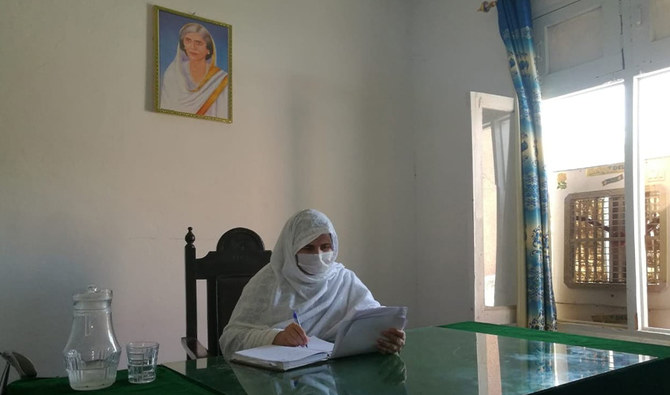

PESHAWAR: In a first, a woman has been appointed to head the education department and bring girls back to school in South Waziristan, a district in Pakistan’s northwestern Khyber Pakhtunkhwa province, long wracked by militancy and where the female literacy rate is one of the lowest in the country.
Noor Khadija, who comes from a family of educators and has been associated with the education department for ten years, was appointed South Waziristan’s deputy district education officer on August 31. She holds a master’s degree in education.
“It was my long-standing desire to serve my community, specifically girls, to remove obstacles in the way of their education,” Khadija told Arab News in a phone interview.
In Khadija’s office, a portrait of Fatima Jinnah, the younger sister of Pakistan’s founding father Muhammad Ali Jinnah, hangs on the wall behind the officer’s desk.
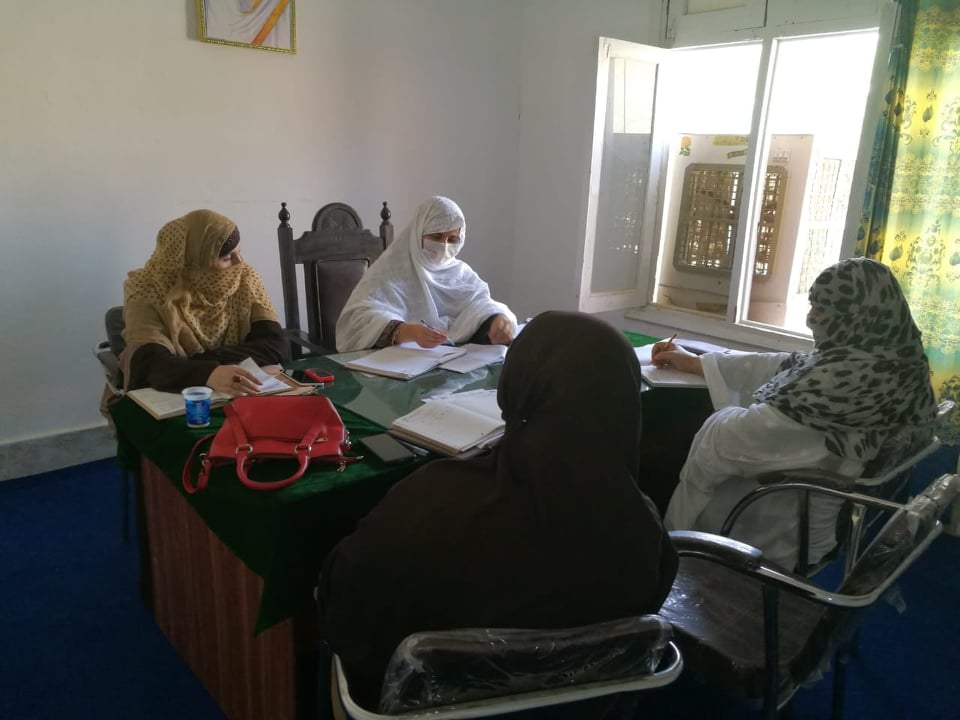
Noor Khadija, the first female deputy district education officer of South Waziristan tribal district Pakistan's Khyber Pakhtunkhwa province, presides over a meeting at her office in Tank on September 8, 2020. (AN photo)
“As a woman, Fatima Jinnah proved that women could make a difference and play a decisive role to lead the society for positive change,” Khadija said. “I will strive to provide girls schools with all missing facilities, to empower girls through education, which is of paramount importance for a vibrant society.”
Pakistan’s semi-autonomous tribal regions used to comprise seven big districts, of which South Waziristan is one, and six towns known collectively as the Federally Administered Tribal Areas (FATA). It was governed for over 150 years by colonial era tribal laws which, coupled with the lack of economic development, led to a pervading sense of neglect and disenfranchisement among the tribal population.
Over the years, the tribal regions remained lawless, providing a haven for militants, gun runners and drug smugglers.
In 2009, the region was overrun with militancy as war raged in neighboring Afghanistan, pushing the Pakistan army to launch armed operations against militant safe havens. Millions of people were forced to flee their homes and thousands of students had to quit school. Educational facilities were destroyed or taken over by militants and the literacy rate plunged to 10.5 percent for girls and 36.66 percent for boys.
In 2018, FATA was merged with Khyber Pakhtunkhwa and the education sector fell under provincial control. But reform has been slow.
According to 2017-2018 data collected by Khyber Pakhtunkhwa’s elementary and secondary education department, 58 percent of children aged between four and 14 years remain out of school in tribal districts.
And though militants have largely fled the region to neighboring Afghanistan and attacks have drastically reduced, there is years of damage to the region’s education infrastructure to undone, Khadija said.
“Posting Khadija on the key position will improve girls’ education in South Waziristan district,” said Muhammad Shoaib Khan, a former deputy director in the erstwhile Federally Administered Tribal Areas (FATA) education directorate. “It will be a considerable relief for female teachers, now they will be able to share their problems with her.”
Khadija, too, is hopeful about the future.
“Educational institutions in tribal areas in general and my home district in particular, face daunting challenges and dearth of basic facilities such as boundary walls and drinking water,” she said. “But I will leave no stone unturned to bring things back on track.”


