

Decision to resume international flights to be based on virus spread: Saudi minister

Saudi Arabia extended visa and residency permit validity for residents outside the country who cannot return due to the border closure. (File/AFP)
Short Url
Updated 10 September 2020
Follow

Decision to resume international flights to be based on virus spread: Saudi minister

  • Saudi Arabia suspended international flights in March

RIYADH: The decision to resume international flights to Saudi Arabia is going to be based on the spread of the virus, the Saudi health minister said.
“We care about the safety of all and thus we are taking all the necessary precautionary measures,” Tawfiq Al-Rabiah told Al-Ekhbariya.
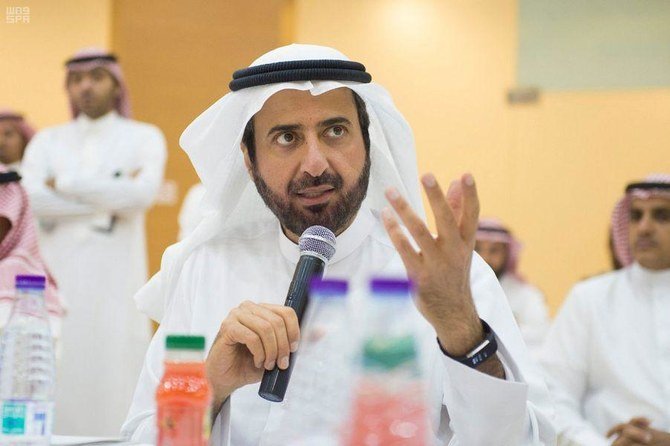


Tawfiq Al-Rabiah. (SPA/File)


“As long as we still have cases, we will always be evaluating the situation so that we would be taking the right decision. Our decision is based on the spread of the virus and the overall situation, under the directives of King Salman,” he said.

Saudi Arabia suspended international flights on March, 15. to reduce the spread of the coronavirus in the Kingdom.
On Monday, the Kingdom extended visa and residency permit validity for residents outside the country who cannot return due to the closure.


Manhood Rules: new program teaches Saudi etiquette to younger generation

Updated 5 sec ago
Follow

Manhood Rules: new program teaches Saudi etiquette to younger generation

JEDDAH: Saudi private tutoring platform AlGooru has launched a unique educational initiative in Jeddah designed to instill traditional values and social skills in children.

The program, titled Manhood Rules, focuses on teaching young participants the fundamentals of Saudi etiquette, hospitality and social conduct in a practical, hands-on format.

The initiative is in response to a gap observed in modern life skills among today’s youth, according to the people behind the program.  

Khalid Abou Kassem, co-founder of AlGooru, explained: “We noticed that principles and discipline hold great significance within Saudi culture, but there is no real platform that addresses the gaps in social and life skills among children.

“This program fills that void in a way that is both practical and culturally rooted.”

Muhanad Al-Jaser, co-founder, added: “Saudi etiquette used to be taught naturally by parents and through our majlis for generations.

“Today, many parents are occupied with providing for their families and often miss out on teaching these important rituals. We introduced the program to support them in filling this gap, not to replace their role.”

The program is structured as a four-hour in-person workshop, designed for groups of 30 children divided by age.

Over the course of the session, participants explore five main topics: greetings and farewells, gathering etiquette, dining etiquette, the art of polite responses and Saudi hospitality and coffee etiquette.

The sessions are practical, featuring role-playing, simulations and interactive exercises rather than traditional lectures.

Abdulmajid Mohammed Al-Ghanim, a Saudi hospitality expert and certified trainer, supervises the curriculum.

“My role consists of supervising the training content and delivering the program in person, while ensuring that the presentation aligns with Saudi cultural values and is age-appropriate.

“The focus is on applied learning, turning values into daily practices that children can experience and carry forward.”

A typical session begins with welcoming the children and preparing them for the experience.

They participate in activities, learning how to greet and bid farewell to guests, respect elders in gatherings, serve and enjoy Saudi coffee and practice proper dining etiquette.

Role-playing real-life situations and participating in group exercises allows them to apply these principles in a safe environment. The session concludes with an open discussion to reinforce the lessons learned.

Al-Ghanim observes that children respond very positively to the program, particularly because of its hands-on approach.

“Some children are shy or hesitant at first,” he said, “but the program addresses this through gradual encouragement, building confidence and helping them engage fully in activities.”

Parents seeking to instill confidence, awareness of right and wrong, and social skills in their children find the program particularly valuable.

It allows children to interact with peers in a structured yet enjoyable environment while learning to connect etiquette and hospitality with their personal identity.

Children also benefit from a museum exploration segment, which introduces them to Saudi history and heritage through rare artifacts, historic schoolbooks and cultural exhibits, strengthening their connection to the traditions of their families and ancestors.

Kassem emphasized the program’s distinctiveness: “This is the first program of its kind in Saudi Arabia. What sets it apart is its practical delivery, measurable outcomes, and focus on real-life application.”

Looking ahead, AlGooru plans to expand the program across the Kingdom.

Al-Jaser said: “We aim to broaden the curriculum to include a wider range of regional customs and traditions, expand the age groups to youth and adults, and introduce specialized tracks tailored to specific audiences.

“Once firmly established locally, we may explore offering the program in other regions in a culturally sensitive way.”